Print Story
X




In his new exhibition, Tariq Gill transforms years of inner exile into a deeply personal visual language
| L |
ike all of us, two personalities are packed into the body of Tariq Gill. One component of this combination is an individual who studied fine art at the National College of Arts, Lahore, from 1983 to 1988. The other layer consists of a man who supported himself by toiling in a chemicals factory for 27 years - from 1977 to 2004 - performing a variety of tasks, starting as a junior plant operator and retiring as operations supervisor. It seems that Gill has uniquely blended these two sides of his personality, drawn from two very different worlds.
This mixture is explored and extended in his art: abundant, yet not produced for spectators. The fact that Gill has created around 20 million drawings, mostly on a tiny scale and unseen by others, is evidence enough. Often, he folds a piece of paper, for instance, the white side of the silver wrapping from a cigarette packet, or any other sheet he finds in his surroundings: plain, smudged, creased, dusty or bearing a few marks. To him, none of it matters because every piece of paper is a field for his aesthetics to play upon.
At his recent solo exhibition, Ecosystems of Fantasies (May 6-12, Muse Art Gallery, Lahore), one encountered a wide range of works: a group of drawings on canvas arranged in identical grid-like units, alongside two large sheets filled with tiny drawings spread across the gallery floor. The images on these thin papers were divided by square folds. The exhibition also included several large and medium-sized paintings, as well as a few small terracotta and plaster sculptures.
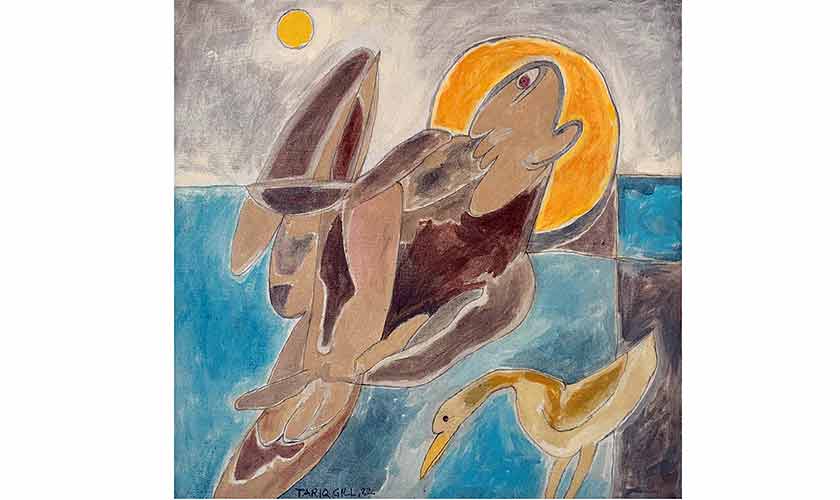
What takes place in each object on display, executed in diverse materials, is distinct. Yet, all participate in a single idiom associated with Tariq Gill. Contorted, stylised and simplified, the characters, places and other elements in his work can easily be described as childlike, caricaturesque or naïve scribblings. The shape of this vocabulary began to emerge in the early 1990s. It was mainly inspired by Afshar Malik, who joined the NCA around Gill’s formative years. Malik also contributed cartoons and illustrations to some newspapers and weekly publications.
Even before being exposed to Malik’s practice, Gill may have been aware of Paul Klee and the work of Indian painters and sculptors like KG Subramanyan and Somnath Hore, whose influence was particularly visible during Tariq Gill’s visit to India in 1986.
Regardless of his pictorial roots, which cannot be confined to a single source, the artist’s special relationship with his acquired imagery is important. Gill, essentially shy, introverted and elusive, comfortably resides in a private world that reflects and reproduces the qualities of its maker. Hence, for anyone who has known Tariq Gill for a long time - in my case, since 1983 - it is not surprising to find oneself engaged in an uncanny conversation with him. Regardless of the subject - books, art, artists or anything under the sky - the pattern of exchange remains peculiar. You ask something, Gill replies, but a satisfactory response is usually stitched together with multiple diversions, emerging from his particular perception and personality.
In much the same way, he constructs an intimate cocoon that is often revealed in his art. Unaffected by what occurs outside, he is like TS Eliot, who, while delivering his presidential address to the Virgil Society in London during World War II, as allied forces battled across mainland Europe and German rockets fell on London, referred to these events obliquely as “accidents of the present time.” It is not that Gill completely ignores socio-political circumstances, but to him they are merely hiccups, by no means compost for his creative growth. This perhaps offers a clue to the consistency of his approach, imagery and execution.
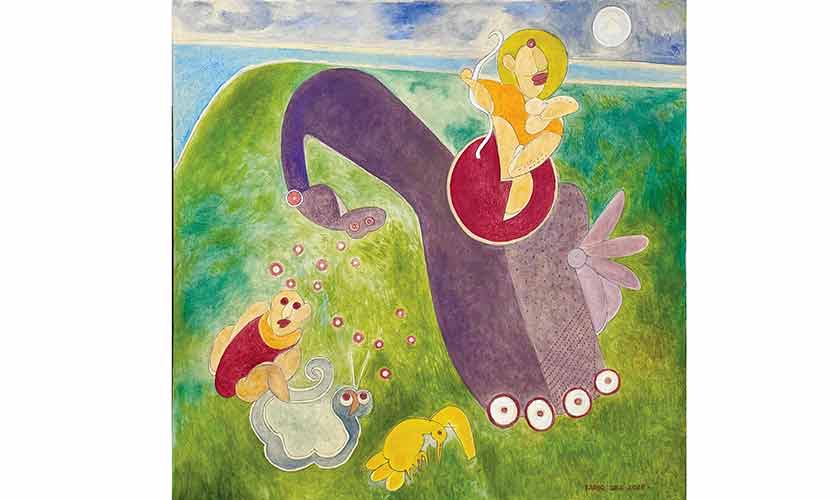
Even though the recent solo show featured a considerable number of paintings suggesting subdued and varied hues, an examination of the architecture of the acrylic and mixed-media work on canvas reveals drawing as its dominant constituent. Colours in different shades are generally used to fill areas between lines. Thus, while one notices the hues, their muted intensity and controlled application render them subservient to imagery conceived through line.
One reason for Gill’s inclination towards line lies in his training as a sculptor. In the history of art, from classical Greek and Roman statues to the Italian Renaissance and later European periods, as taught in our art schools, the ideal figurative sculpture is often understood as blank: marble, plaster cast, terracotta, gold, bronze or steel. (In contrast, Greek sculptures were originally painted in various pigments.) It was only in the 20th Century that sculptors revived the long-forgotten use of colour in their abstract creations. Thus, colourlessness comes naturally to Tariq Gill.
This is evident in the set of 36 drawings, each measuring 12 x 12 inches, rendered in pen and ink on canvas. In their structure and sensitivity, these drawings are not dissimilar to his miniature pen or pencil sketches on paper, since each is composed of one or more creatures existing within a void-like space. If the empty backdrop encourages viewers to focus on the features, actions and conditions of the characters, it also emphasises a sense of loneliness in the lives of those occupying these canvases and sheets of paper.
No matter how disoriented they appear, the humans, animals, birds and hybrids somehow resemble one another, owing to their origin in a fantastical territory fabricated by the artist, a substitute realm beyond our tangible world. Echoing the art of Marc Chagall, Gill’s surfaces present unusual creatures hovering above bearded men (A Carefree Sage), a male figure with petals sprouting from his head and encircled by strange fauna (Life is Going Smooth), and a bewildered face beneath archaic species (Recalling the Time of the Beast).
Although the unexpected twists of line, the unconventional combination of recognisable and abstracted forms and the addition of flowing marks suggest spontaneity in these visuals, what ultimately binds them together is Tariq Gill’s unfathomable experience of working night shifts at the factory. Being alone, despite the presence of other workers, he, as a creative individual, retreated into a solitary and secret world, personal and sacred to him. It is only through his art that he shares its contours and depth. One must not forget that Gill began exhibiting his work publicly only in 2004, 16 years after graduating from the NCA.
Tariq Gill’s style appears natural, but an artist’s language is formulated consciously and intelligently; hence, the variations in pictorial vocabularies, visual concerns and strategic choices. Gill’s work can be compared to children’s drawings, caricatures, naïve art and the imagery of Paul Klee. Diversity is apparent among them, yet one also discovers a unifying relationship: the avoidance of reality as perceived and presented by the mainstream.
Some arrive at this position deliberately, others by nature; a few through intention, and many because of circumstance end up as outsiders. Children draw from imagination, which is not detached from reality, but distant from it. Cartoons, whether political or intended for children, modify reality for a range of purposes: evading state censorship, avoiding accusations of offence or escaping attacks from extremists. So-called naïve artists view their surroundings through unconventional lenses, as seen in figures such as Henri Rousseau and Jean Dubuffet.
Paul Klee’s preference for child-like imagery, on the other hand, was perhaps linked to the political climate of his time. The Swiss-born German artist witnessed both World Wars - an experience that compelled many creative individuals to abandon ideals of scientific progress, social development and Western civilisation.
It can be assumed that this avoidance of external reality seeped into both the personality and artistic production of Tariq Gill during the long, quiet hours of darkness, when one finds no companions other than illusions, hallucinations and nightmares.
The writer is a visual artist, an art critic, a curator and a professor at the School of Visual Arts and Design, Beaconhouse National University, Lahore. He can be contacted at [email protected].