Print Story
X




The May 2025 victory and the ongoing mediation in US-Iran crisis have raised Islamabad’s profile in West Asia
| P |
akistan is clearly trying to carve out a middle-power role for itself—strategically positioned, militarily capable and diplomatically agile. Geography alone provides rare leverage. Gwadar Port, a deep-sea harbour on the Arabian Sea, sits at the crossroads of South Asia, Central Asia and the Middle East. For China, it is the crown jewel of the China-Pakistan Economic Corridor. For the rest of the region, it is a potential linchpin for trade and connectivity—one that could one day rival the Gulf ports.
Talking to The News on Sunday, Pakistan’s former ambassador to China and the European Union Naghmana Hashmi says Islamabad is walking a careful line between Washington, Beijing, Riyadh and Tehran. It has to avoid over-commitment to any one axis. “Recent mediation in West Asian crises shows that it is developing a knack for small-group negotiations that cut through a power gridlock.”
“The May 2025 conflict with India cemented its credentials. By effectively challenging the perception of Indian military superiority, Pakistan demonstrated credible kinetic capability.” Citing a report by the Henry Stimson Centre, she says, the strategic takeaway for outside observers was clear: Pakistan’s air defences and counter-strike capabilities were credible.
Crucially, Islamabad did not press its military advantage. “A ceasefire negotiated on May 10 allowed Pakistan to de-escalate from a position of strength rather than weakness,” she says. “The twin outcome of proven capability and strategic restraint enabled Pakistan to project itself as a regional stabiliser rather than just another nuclear-armed state. This restored a measure of international confidence in the country’s strategic relevance.”
That credibility soon translated into tangible partnerships. The Pak-Saudi Strategic Mutual Defence Agreement followed Israeli strikes on Qatar, as Gulf states realised that American guarantees and advanced air defences could prove useless against Israel. Against this backdrop, Gulf capitals wanted a partner that could deliver under pressure. “Pakistan, fresh from the May crisis, fit the brief,” says Hashmi.
As Georgetown’s F Gregory Gause has noted, the Saudi-Pakistani security relationship is decades old; what changed in 2025 was its formalisation into a binding mutual-defence framework. Other Gulf states are reportedly exploring similar arrangements. The pact’s core clause—that “any aggression against either country shall be considered an aggression against both”—is the closest thing the Gulf has to an Article 5-style commitment. And it is underwritten by the only Muslim-majority state commanding a nuclear arsenal.
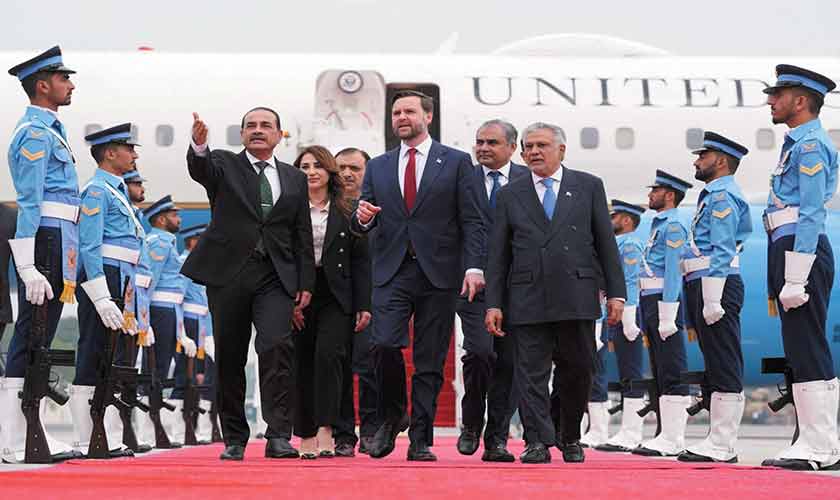
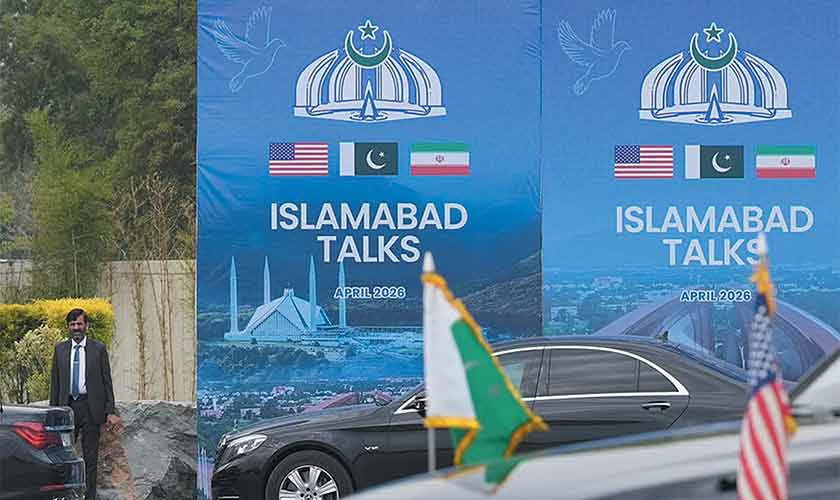
Perhaps, the clearest sign of the shift came when Washington and Tehran agreed on Islamabad as the venue for their dialogue - a move away from traditional Middle East hubs like Doha and Ankara. On March 25, Pakistani officials delivered a fifteen-point US proposal to Tehran; on April 11-12, the Islamabad Talks convened with senior US and Iranian delegates. That was not all. “More remarkable was the security choreography behind the scenes,” says Hashmi.
“In effect, within roughly six months, Pakistan had signed a binding defence pact with Riyadh, hosted Washington and Tehran around the same table and provided physical cover for Iranian military assets. Few states could pull off such a balancing act; fewer still would attempt it.”
However, the national economy remains a persistent constraint. Hashmi says that for now, Islamabad has punched well above its weight. “The diplomatic capital it has accumulated—geographic, military and reputational—is real. However, middle-power status is sustained by balance sheets, not just battlefields. Unless Pakistan’s economic fundamentals catch up with its strategic ambition, the next decade risks being a story of geopolitical reach without the institutional and fiscal depth to consolidate it.”
Diplomatic credibility alone is not enough. To sustain its rise, Pakistan must convert its strategic position into economic heft—starting with its mineral wealth and connectivity infrastructure. Pakistan’s emergence as a major power depends on developing its natural resources, particularly battery minerals and building infrastructure to unlock economic potential and create prosperity. The United States and Canada have shown interest in investing in Pakistan’s rare earth sector. However, these investments remain marginal.
Pakistan’s emergence as a major power depends on developing its natural resources, particularly battery minerals, and building infrastructure to unlock its economic potential and materialise prosperity. The United States and Canada have shown interest in investing in Pakistan’s rare earth sector. However, these investments remain marginal.
Climate change is one of the biggest threats globally. Pakistan’s battery and energy zones can supply critical minerals to position the country as a potential node in the renewable energy supply chain. As Shahryar Khan Niazi argues in The Game Plan: Pakistan Economic Gateway, the minerals beneath Balochistan and Gilgit-Baltistan could help the world break away from fossil fuels—offering a tangible contribution to the low-carbon transition while charting a course for Pakistan’s prosperity. Niazi, a recipient of the UK Foreign and Commonwealth Office’s Secretary of State Award and chair of a coastal development commission, frames Pakistan’s location as its greatest strategic asset.
Niazi describes the Pakistan Economic Gateway as a network of overland, hybrid and maritime corridors that can connect Asia and facilitate global trade by integrating Eurasian and Indian Ocean dynamics. He argues that the PEG’s western corridors, forming the Asian Battery Corridor, will create new supply chains for key battery minerals across Pakistan and Afghanistan. Within Pakistan, Chagai, Gilgit-Baltistan, Khyber Pakhtunkhwa’s Malakand division, and Sindh’s 556 salt lakes must be subjected to comprehensive exploration for their copper, manganese, nickel, graphite, cobalt and lithium minerals. Against the backdrop of the Iran-US conflict—which Niazi argues has effectively closed the Strait of Hormuz—and the Mandeb Strait under threat of Houthi action, global trade faces grave peril.
“Pakistan’s corridors align in four directions. To the west lies a web of routes: the proposed Pakistan-Iran-Turkey-Europe, Pakistan-Iran-Eurasia and Pakistan-Iran-Levant corridors offer the massive strategic advantage of bypassing the Hormuz and Mandeb choke points, as well as the congested Bosphorus Strait and Suez Canal.”
The PITE corridor, Niazi says, offers swift passage for Pakistani textiles reaching London in three days—or mangoes from Multan landing on German shelves before a ship from Vietnam even clears the Malacca Strait. Goods would travel via Bulgaria, arriving in the EU in as little as three to seven days. All it needs is a road and rail link to connect Pakistan, Iran, Turkey and Europe. “If Pakistan is serious about export-led growth, the PITE is the answer,” says Niazi. Beyond Europe, the PITE opens faster routes to the Americas via Turkey, France, Spain and Portugal, plus Black Sea access that dodges the crowded Bosphorus.
The EU already trades $610 billion annually with Indian Ocean nations and $709 billion with China. Even a small slice of that pie would transform Pakistan’s economy—justifying European Free Trade Association membership and handing Pakistani textiles, mining and agriculture a massive competitive edge. Pakistani exporters could gain tariff-free access to the four EFTA nations (Iceland, Liechtenstein, Norway and Switzerland), as well as potential indirect access to broader European supply chains. Pakistan needs to upgrade the lines from Gwadar and Karachi to Iranshahr, along with the Quetta-Taftan line to West Asia and Europe. But none of this matters without rail. As Niazi puts it: “This route offers a three-day land bridge to Europe—if Pakistan fixes its railways.”
The PIE corridor connects Pakistan, Iran, Azerbaijan, Russia and Finland, offering a shortcut from South Asia to the Baltics that bypasses the world’s most congested shipping lane. Niazi notes that goods leaving Gwadar can sarrive in Helsinki even before a container ship clears the Suez Canal. For Pakistan, that means Gwadar traffic surges and Baltic deliveries drop to under four days. For Iran, strategic ports finally pay off. For Finland, the 40-day slog to Tokyo shrinks by more than half—23 days saved on a $2.6 billion trade lane. “The implementation of this seamless trade superhighway requires truck-based transport for immediate activation, followed by a rail link from Gwadar and Taftan to Helsinki via Moscow,” Niazi says.
The PIL corridor connects Pakistan to the Mediterranean by land. Imagine a pilgrim from Lahore visiting Damascus or a Karachi trader shipping goods to Athens—not by circling half the globe, but by driving straight through the Middle East. That is the promise of the PIL corridor, says Niazi: “A new overland and maritime link stitching Pakistan to the Levant (Iraq, Jordan, Syria, Lebanon and Egypt).” The conflict-scarred roads of Iraq and Syria gain an outlet at Gwadar port. In return, Pakistan gets a foothold in Lebanon and Syria, opening a backdoor to Southern Europe and North Africa.
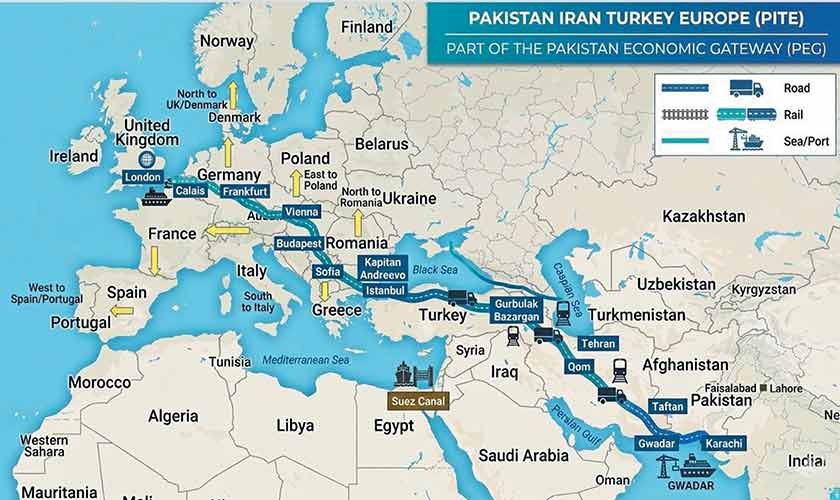
The PIL is only one piece of a larger puzzle. Given the advantages, Pakistan should pursue comprehensive trade talks with the EU and the UK to give exporters a competitive edge, particularly via trucking. Islamabad must also lead efforts to bring other countries into the network.
A beginning has already been made. In April 2026, Pakistan opened six land transit routes to Iran as an emergency land bridge to bypass the blockade of Iranian ports and the Strait of Hormuz, clearing over 3,000 stranded containers. Third-country goods now enter Iran via Balochistan using Karachi, Port Qasim and Gwadar. Key routes include Gwadar-Gabd (cutting travel time from roughly 18 hours to just 2-3 hours), Karachi-Khuzdar-Taftan, and Gwadar-Taftan via multiple alignments. Though it is early to say, operationalising these routes to Iran has made a beginning—however modest—toward activating the proposed western corridors.
The writer is a senior The News staffer based in Karachi.