Print Story
X




‘Fair, Fierce, Fleeting’ is a meditation on the seasons through Michelle Farooqi’s eyes
| F |
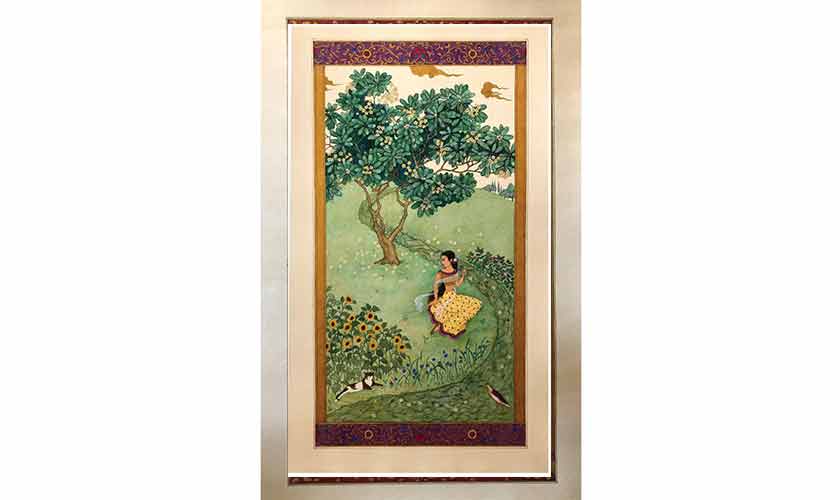
Fair, Fierce, Fleeting opened on May 1 at Tagh’eer Lahore. The exhibition is curated by Nashmia Haroon. Michelle Farooqi’s four seasons are the central theme of the show. Four miniature-style watercolour paintings, each depicting a different season, invite the viewer to ruminate on the passing of time through the life cycles of the animal and plant worlds. Each carries its own distinct, self-contained narrative that lends itself to a grander narrative that mirrors the way seasons shift, one folding into the other organically without fanfare. Human celebrations that mark the changing of seasons – solstices, equinoxes – may signal a shift, but nature is never that neat. There are always remnants of the season that has passed and a hint of the season to come.
Being attentive to these cycles of birth and renewal requires a certain way of seeing, as suggested by American author Annie Dillard in Pilgrim at Tinker Creek: we see the world with eyes, the tangibles becoming clearer to us with every passing moment, but then we see without eyes. It is in this second seeing that we open ourselves for the world to rush in through us, through every pore in our body. We see the air rushing through trees; we see the melodies of the natural world around us solidify, as they ride the waves of the air rushing through these trees. Seeing becomes a revolutionary act; it invites us to stillness and rest in a world that refuses to be still.
This communion with Nature is what Farooqi represents in her Seasons Quartet. The attention to a contemplative seeing is evident. Each painting depicts a solitary woman who guides us on our journey.
Spring invites us in. A flaming red Indian coral tree is a promise of a vibrant future to come. A magpie rests on a branch; a hummingbird seeks nectar. There is a small nest on the top – a promise of new life.
Summer is an almost hedonistic celebration of life – a life lived with abandon, relishing in the abundance and the fecundity. Our guide sits between sunflowers and lilies under the shade of a huge champa tree. One can almost smell the rich, heady scent of summer and feel the heat.
Autumn shifts the perspective, as life finds refuge in the hidden crevices of the world, waiting for spring. There is a signal to slow down. Trees lose their foliage, barely clinging to the last of the dried leaves that will eventually provide nutrients for future blooms.
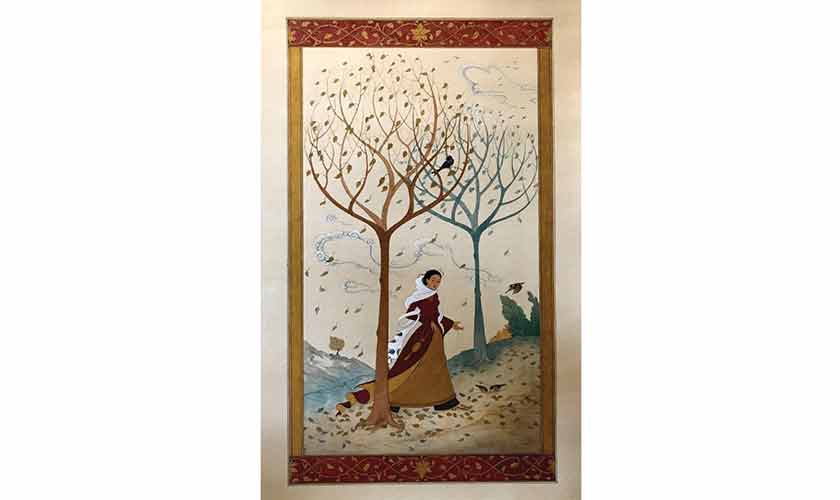
Winter is a sparse world, stripped back, revealing the layers underneath the skin. This one is an unlikely favourite of mine, partial as I am to what spring represents. There is a quiet beauty at play here: in the bare branches that will bear life soon; in the weak sun that provides just enough light for there to be continued life; in the mist that envelops our solitary observer, obscuring the past and clearing space for a more determined future.
Louise Glück, the late American poet, says somewhere, “We look at the world once, in childhood. / The rest is memory.” I often return to these words and am reminded of them now, as Michelle Farooqi invites us to look at the world again with an amazement that is often missing from adult lives. What is wonder and awe if not the vision of a child, unencumbered by ‘real’ world expectations?
Looking at the world through new eyes requires us to delve into the sensorial, as per Annie Dillard. Tagh’eer provides that experience through a two-part sound installation that accompanies Farooqi’s miniatures: one a recording of the Raga Bahar by flutist Haider Rahman, the other a recording of the Raga Megh (Malhar) recorded by artist Aizaz Sohail.
The viewers are invited to listen to them both while viewing Farooqi’s narrative. Haider Rahman’s rendition of the Raga Bahar is an absolute burst of joy. Through a deftly played flute, the melodies invoke images of spring bringing life to the world: bare branches sprouting leaves, buds ready to bloom, birds making their way back home and myriad creatures coming up from their underground slumber. Aizaz Sohail’s version of the Raga Megh (or Megh Malhar) – a monsoon-themed raga – transports one to that layer between summer and autumn, the season of violent romance, as the world gets ready for sleep. Descriptions of the ragas are on hand for those uninitiated in the subtleties of South Asian classical music.
There is also Sehr Jalil’s video, Sukh Chain aur Sakanjabeen, a response to Farooqi’s quartet. The seven-minute-long video ponders over questions of nostalgia, the messiness of language and life in various cities. To me, the stark contemporary nature of the video felt a bit jarring alongside the romantic, cohesive melodies of the watercolours and the ragas.
Curating a small show can be a challenge. The visuals speak for themselves, but a curator deepening that experience through companion pieces allows for the work to speak multi-dimensionally. Here, Nashmia Haroon’s background in music comes to play as the ragas truly elevate the experience of looking at the seasons through Michelle Farooqi’s eyes.
The writer is a literary editor, publisher and photographer from Lahore. He is the co-founder of The Peepul Press and the managing editor at The Aleph Review