Print Story
X




Ijaz’s latest collection offers flashes of boldness even as it searches for greater depth
| T |
he recent collection of stories by Lahore-based Ijaz, who goes without a family name, feels like a breath of fresh air, both in terms of the topics and the flow of language. The author has clearly tried to step outside the average Punjabi prose writers’ comfort zone. On the western side of the border, the process was started by Nain Sukh. A number of Ijaz’s stories engage in the history of violence and its byproduct: the lingering fear. Sonar Bangla, TenuN DhaakaN Yaad KareNdiaN, Kali Kartoot, SameyaN Toe Paar, and Nari Waad are all centred around violence and fear, both self-generated and the kind the environment unleashes on a person.
Sonar Bangla, in my judgment, is the weakest story in the collection. I may be on shaky ground here but it seems that the story has resulted from unintentional influences by two fathers-in-law – mine and his - Col Nadir Ali and Jameel Paul. Most Pakistani writers, by and large, have failed to engage with the brutality of violence suffered by their Bengali brothers and sisters. Jameel Paul wrote at least one story that deals with what led to the creation of Bangladesh. Most of Col Nadir Ali’s fiction deals with the trauma of having witnessed that catastrophe. However, his fiction deals with it psychologically, not physically. Ijaz gives Sonar Bangla a nightmare treatment. It barely works with tired cliches like laal laal dhabbay and library books with holes, words in the colour red. TenuN DhakaN Yaad KareNdiaN similarly tries too hard to be an effective, nightmarish, surreal story with a headless man in search of his severed head. Here, we see a glimpse of Ijaz trying to probe South Asia’s colonial past. Despite its weaknesses as a story, it’s a daring attempt to look at our colonial legacy from the angle of a white man gone native in a post-colonial setting.
The collection picks up in strength third story onward. It shows the author’s interest and range in a variety of themes, such as the elusive graffiti artist who’s hell-bent on mocking the country’s ruling elite, its armed forces and prime minister. The middle-aged woman in Collage opens up about her deep emotional relationship with the art of painting. In ValganyaN Vich Ghirya Jeevan, Ijaz show his maturity as an observer of complicated human behaviour, as he inserts himself as a character called Ravi, sharing Dilbeer and Nirmal’s take on relationship, sex, friendship, society, abortion and a child born outside wedlock.
Vedan Kahiye Kis, which refers to a verse by Baba Farid, is reminiscent of stories of Prem Prakash, which Rishum Jameel Paul has transliterated into Shahmukhi. It’s a well-written story about an old man lamenting his losses: missing his wife and village life. A similar terrain is explored in Kali Kartoot, but adding an element of fear via stories surrounding seven murders. These stories don’t really push the envelope. Younger generations of Punjabi writers should ride new waves and reach alien shores. They should avoid simply adding colour to an old, redundant canvas.
Despite having enjoyed the book for the most part, one must say that it leaves the reader hungry for something deeper.
SamayaN toe Paar and Naari waad are perhaps the best pieces in the collection. Perhaps the book should’ve opened with one of these. SamayaN toe Paar is the story of a man in search of lost time and the past. Having been raised by a kind woman after his parents’ death in a car accident, he is dealing with an onslaught of nightmares, suspicion and uncertainty while wondering with deep ache in his heart why his seven surviving sisters never reached out to inquire about his life or well-being. Naari Waad explores the brutal act of lynching a man named Jeevan, who pays a heavy price for falling in love with the wrong person, as per the neighbouring community’s code of honour. Ijaz makes the story worth reading beyond the point of basic inhumanity by excavating via the narrator’s voice the life of the lynch, from early childhood to orphanhood to adulthood. There is a subtle feminist touch to the narration.
Despite having enjoyed the book for the most part, I must say that it leaves the reader/ critic in me hungry for more. Perhaps the fault lies with me, as I continuously read fiction translated into English, so that my mind cannot stop comparing. Comparing is arguably good: one should know about international standards so that Punjabi fiction can catch up in breadth and scope. Barring a few exceptions, most of what I have read in Punjabi over the last decade pales in comparison.
On a positive note, Ijaz’s prose keeps improving. One hopes that his future work will be even better. Pakistani Punjabi writers should look higher; gaze at the stars and converse with the likes of Dostoevsky, Flaubert, Balzac, Faulkner, Baldwin, Morrison, Herman Broch, Robert Musil, Clarice Lispector, Hilda Hilst, Juan Goytisolo and Saramago. They should internalise the standards international writers have been chasing. The satisfaction that comes from having touched greatness, even for a page or two, will make up for the pain of having gone through arduous days and nights to produce fiction worthy of appreciation beyond the circle of family friends and colleagues.
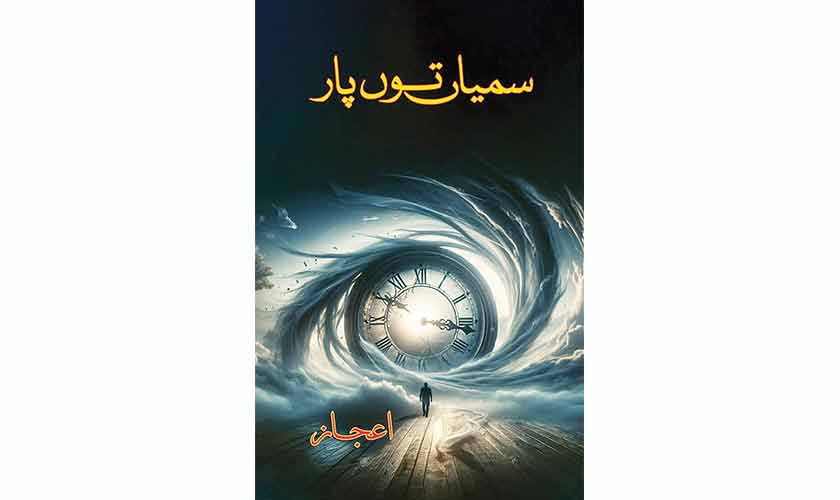
SameyaN toe paar
Author: Ijaz
Publisher: Punjabi Markaz, Lahore Price: Rs 1,200
Pages: 144
The reviewer is a librarian and a writer based in San Francisco.His last two novellas were A Footbridge to Hell Called Love and Unsolaced Faces We Meet In Our reams. His third novella, We Don’t Love Here Anymore, has just been released.