Print Story
X




Maha Khan Phillips re-imagines the genre with a flawed, deeply human investigator at the centre of a mystery
| T |
he problem with most conventional serialised detective fiction is that it treats the sleuth as a mere cypher — a neutral observer tasked with unravelling a tangled web of secrets, lies and conspiracies. Post-modern detective stories deviate from the tradition by humanising investigators, reminding readers that they, too, are shaped by personal chaos and often struggle to extricate themselves from their inner demons.
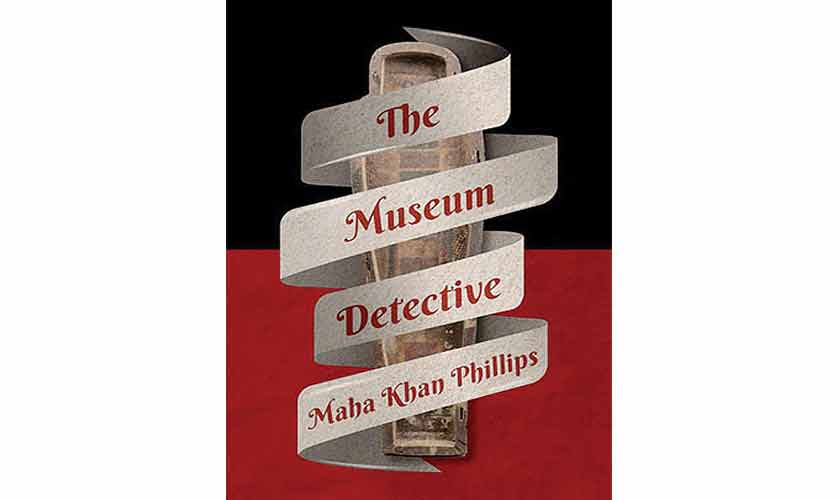
The Museum Detective by Maha Khan Phillips comfortably inhabits the terrain of post-modern detective fiction. It features an unlikely, sharp-witted yet deeply human sleuth. Dr Gul Delani, a Karachi-based archaeologist and curator at the fictitious Museum of Heritage and History, resists the archetypal image of the hawk-eyed, emotionally detached private eye. From the opening sentence of her third novel, Phillips establishes her protagonist’s central vulnerability: Delani’s lingering anguish over the disappearance of her niece, Mahnaz. As she grapples with personal dilemmas, Delani is drawn into a bone-chilling investigation that requires her to remain level-headed and exercise her keen gift for deductive reasoning. The case, which involves the discovery of a life-sized mummy during a narcotics raid, falls squarely within her field of expertise. It transforms her into a person both admired and condemned. At its core, the discovery threatens to upend mainstream historical accounts while also attracting unwarranted attention from dubious actors, including an enigmatic drug lord known as Saayaa (‘shadow’).
Through a richly imagined narrative, Phillips steers readers towards a denouement in which Delani’s personal and professional worlds converge, leaving destruction in their wake. The novel culminates in the startling realisation that even the past can become a site of exploitation at the hands of criminal forces.
The Museum Detective owes an immense artistic debt to an antiquities scandal that grabbed headlines in October 2000. In an insightful author’s note, Phillips outlines the details of the case and, thereby, confirms her long-standing fascination with history. Nearly a decade ago, she published her second novel, The Curse of Mohenjodaro, which combines the mysteries surrounding a forgotten Subcontinental civilisation with a contemporary tale. Laced with secrets, cryptic dream sequences and dramatic confrontations, her second novel draws on historical fact but also carries the spirit of a grim fantasy.
In her latest work, the author sustains her intimate, intricate relationship with history. However, The Museum Detective invokes the distant realities of the Achaemenid Empire and interweaves them within a modern-day Karachi setting. The pairing of such disparate eras may initially seem farcical, but it is firmly grounded in fact, making it all the more intriguing.
For most of us, history textbooks present the past as a dull record of events. The author resists such staccato renderings and instead animates a bygone era by infusing it with rich detail. In Phillips’s hands, history becomes a plaything rather than a revered artefact. With a storyteller’s eye for intrigue, the author treats the past as a lump of clay that can be moulded at will to propel the narrative forward. In this way, she stumbles upon the make-believe character of a lost princess, who eventually becomes a metaphor for the protagonist’s own despair. The purpose, of course, isn’t to discredit or blithely distort historical accounts; instead, Phillips bends historical precision to extend the boundaries of what a compelling narrative can achieve.
Beyond its historical focus, The Museum Detective stands out for its motley cast of quintessentially Karachi characters. In a welcome departure from the predictable parade of terrorists, target killers and Sind Club socialites who populate fictional narratives set in the city, we are introduced to the lesser voices. Many of these voices run the risk of extinction in the rapidly evolving realities of the megacity. For instance, Delani derives emotional support from a Goan Christian woman, Mrs Fernandes, who habitually calls everyone Charlie. She also visits the library of Mr Davar, an elderly man who resides in the practically forgotten locality of Karachi’s old Parsi Colony.
Above all, the city comes alive in the pages of Phillips’ third novel, not just through its boulevards or backstreets, but as a setting for an unusual and intriguing crime thriller. For decades, Karachi has predominantly been depicted as a site for militancy, ethnic strife and political wrangling. The Museum Detective doesn’t insulate itself from these portrayals of the city, but instead seeks to break new ground within its complex urban landscape.
A detective story is enriched by the crippling ills that plague society. These dynamics allow authors to explore how characters react in idiosyncratic ways to pressure and conflict. Patriarchy emerges as the true villain of the piece. Delani not only rubs shoulders with self-righteous, domineering male colleagues at work, but also has to contend with her fair share of weak-willed men among the people she is expected to trust.
The narrative also draws attention to the subtle means through which women are pushed to the margins and are seldom allowed to exercise their agency. Mercifully, it is the women characters who emerge as veritable saviours, working behind the scenes to stave off catastrophes ushered by their male counterparts.
The triumph of The Museum Detective lies in its deft storytelling, which drives readers to keep turning the page. The novel is largely free of noticeable flaws. Be that as it may, the author often relies on long, expository passages that disrupt the flow of the narrative and take readers into dense layers of context and backstory. This technique can make the novel seem like a game of snakes and ladders, where readers are pulled down unexpectedly rather than being propelled forward. Even so, they are urged to persevere as this expansive chain of background information allows the novel to mirror the psychology of the protagonist, who herself is suspended between past and present.
At the heart of a good mystery novel lies a memorable sleuth — an attribute The Museum Detective possesses. Phillips should develop Delani as a recurring character in a series of Karachi-based mystery novels. Realistic, earnest and pragmatic, she has the makings of a compelling protagonist who readers will find endearing.
The Museum Detective
Author: Maha Khan Phillips
Publisher: Liberty
Publishing
Pages: 326
The reviewer is a freelance journalist and the author of No Funeral for Nazia.