Print Story
X




Zehrah Nigah’s work resists spectacle, choosing a gentler register instead
| F |
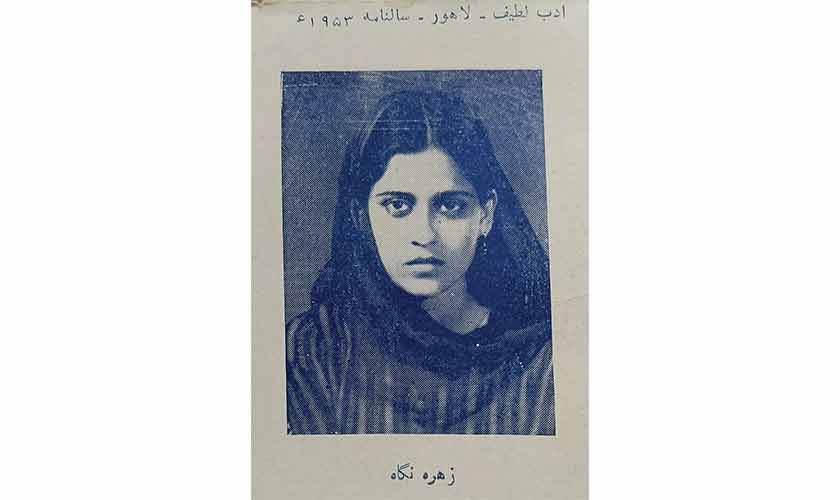
or some poets, recognition and fortune arrive slowly. Others enter the literary world and are, almost immediately, written into its history. Zehra Nigah, who turns 90 on May 14, belongs to the latter group, her reputation taking shape as soon as she stepped onto the literary stage.
Writer Intezar Hussain once described an early mushaira at which she received an extraordinary ovation. To those present, it felt as though a new star had risen on the horizon of Urdu poetry.
He recalled a packed hall at Punjab University, with crowds gathered outside and disorder inside, heightened by the presence of Jigar Moradabadi. In the midst of the commotion, an unfamiliar name was announced: Zehra Nigah.
She appeared as a slight, composed figure, her presence understated but assured. As she began to recite her ghazals, the noise in the hall subsided, the restlessness eased and the audience grew attentive — soon responding to each verse with admiration.
The mushaira left a strong impression. It soon became clear that, alongside the beauty of her rhythm, there was a freshness of experience and a maturity of expression. Together, these qualities marked the distinct individuality of Zehra Nigah even at that early stage.
Zehra Nigah was born in Hyderabad Deccan in 1936 to Qamar Maqsood Hameedi and Afsar Khatoon. Her family hailed from Badaun in northern India.
Several among her ten siblings achieved distinction in various fields. They included television writers Fatima Surayya Bajia and Anwar Maqsood. One of her sisters, Sarah Naqvi, was associated with the BBC.
Zehra Nigah began composing verses at the age of six. She first recited her poetry in public while studying at New Town School in Karachi.
In 1958, she married Muhammad Majid Ali. Owing to her husband’s employment, she lived for extended periods in Abu Dhabi and London. After he passed away in 1995, she has mostly resided in Karachi.
Her first collection of poetry, Shaam Ka Pehla Taara (The First Star of the Evening), was followed by Varq (Page) and then Firaaq (Separation). The three collections were later brought together in a single volume published in Lahore. Her fourth collection, Gul Chandni (The Rose Moonlight), appeared subsequently. Recently, her Kulliyat (collected works) was published under the title Lafz (Word) by the Anjuman Taraqqi Urdu in New Delhi. Her fifth collection, Tarasheedam (I Carved), was published last year.
Her work unfolds with a certain gentleness and deliberation, carrying a melodic quality through its texture.
As her poetic journey continues, readers await more.
After early acclaim, Zehra Nigah appeared to have receded from the literary scene. This phase marked a transition in her poetry, after which she re-emerged with a more assured voice.
In his introduction to her first collection, Faiz Ahmad Faiz noted that she had quickly moved beyond the “mushaira period.” The devices used to draw applause at such gatherings, he observed, were mastered quickly — and should be set aside as quickly.
Faiz described the subsequent phase as one of romantic realism. Gradually, she moved beyond what he termed a “star-filled city” of imagery, adopting a style that engaged with the emotional textures of everyday life as well as the impact of political events. It was through this interplay of experience and observation that the foundation of her later poetic voice were established. During this period, she increasingly turned to poems.
Zehra Nigah’s poetry is marked by simplicity and great craftsmanship. She does not rely on an overtly distinctive tone, nor does she choose her subjects for their dramatic effect. Instead, her work unfolds with a certain gentleness and deliberation, carrying a melodic quality through its texture. This softness endures even when she engages with the anxieties and afflictions of the modern age.
While early recognition came through her ghazals, the more mature phase of her work is dominated by her poems. In Gul Chandni, the image of a tender, prayerful mother acquires a symbolic resonance. In Samjhautay Ki Chaadar (The Shawl That Is Compromise), she weaves a poem of remarkable delicacy. Even a slight excess could have unsettled its effect. Yet the poem maintains its poise. It is free from both sentimentality and bitterness, its emotional condition realised through measured expression.
Her range is impressive. She can build an entire poem around something as small as an ant, or capture a city like Karachi in a single line. Elsewhere, she writes of a child’s helplessness in the aftermath of the bombing of Afghanistan, and the vulnerability of human life in the wake of the 2005 earthquake. Across these works runs a current of collective sorrow — grief distilled into a restrained, lucid voice.
This tone and sensibility is her unique contribution to Urdu poetry. As she marks another year, one can only hope that her voice continues to endure and evolve.
Raza Naeem, an award-winning researcher and translator based in Lahore, is the president of the Progressive Writers’ Association. He may be reached at [email protected]. He tweets at @raza_naeem1979.