Print Story
X

| T |
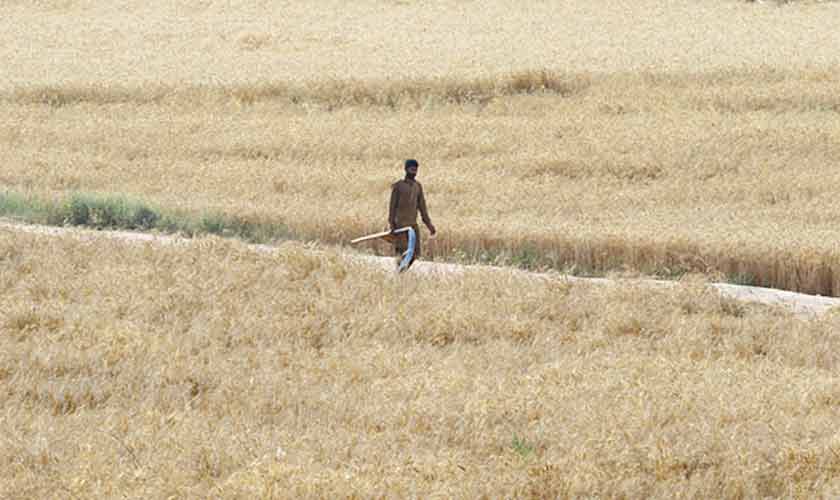
he Punjab is harvesting wheat. Thousands of acres of it are moving under harvesters in the kind of quantity that should, on paper, make everything simpler. The province grows roughly three quarters of Pakistan’s wheat, with the soil, the irrigation, the institutional memory of cultivation all there.
You drive an hour outside Lahore and you’ll see a sea of those fields doing what they have always done, with wheat as far as you want to look.
Yet in Lahore, a 20-kg bag of atta cost between Rs 2,430 and Rs 2,470 this past week. A man at a chakki in Mozang asked for five kilogrammes when he had come for ten. The price had moved again. He lifted the smaller bag and was on his way home.
This paradox is not new, but it is worth sitting with for a moment. A province that is, by any agricultural measure, a goldmine, has a city where the daily question of roti keeps getting harder. The harvest and the household exist in the same geography and almost completely separate economies.
How does that happen?
The distance between the two realities, more than geographical, is the distance a grain of wheat travels through a system that has a remarkable talent for making abundance disappear.
Part of the answer is structural and old. The Ghalla Mandi (grain market) is a place where information asymmetry does most of the actual work. The small farmer who arrives at harvest season is not arriving with leverage; he has already borrowed for inputs. He has paid for the diesel that runs the tractor and the tubewell. He has bought bags of fertiliser and gone through the kind of anxiety that he has to pose as patience. He needs to sell, and the buyer knows this.
The beoparis (traders) who occupy the space between the farmer and flour mill have understood this dynamic for decades. They understand the system, in many cases better than the system understands itself. So when the wheat moves up the chain, and by the time it arrives as flour in Lahore, it seems to carry no memory of the price it started at.
A province that is, by any agricultural measure, a goldmine, has a city where the daily question of roti keeps getting harder.
This is not entirely anybody’s fault and not entirely nobody’s fault. The farmer, often isn’t prospering. The margin between what it costs to grow wheat and what the market pays for it has, in bad years, been negative. The government sets a support price, steps away, steps back in, sometimes panicked. The policy oscillates but the middleman stays.
The person most affected by this is not the one buying the branded bag at a superstore. It is the daily wage earner in Mughalpura or Shahdara who sends someone out for a kilo of atta at a time, because that is what the day’s cash allows. For that household, roti is not one line on a grocery list, it is basically the whole list.
This is where something more fundamental than policy sits. Pakistan has never quite decided whether food is a public good or a private commodity. The farmer is expected to accept the government rate when the government needs grain. The consumer absorbs market prices when the government steps back. The middle, as always, holds.
The farmer on the other end of this is not necessarily prospering. Last year, some farmers were reportedly selling below their cost of production. This year’s attempted price floor is at least an acknowledgment of that injury.
We need a multi-faceted solution for this: storage infrastructure that reduces artificial scarcity; and transparent procurement that doesn’t run on sifarish and gunny sack connections. We need a price policy that doesn’t swing between neglect and criminalisation depending on which pressure is loudest that week.
In a few weeks the harvest will be over. The stubble will burn, the smoke will drift towards the city. Lahore will go back to not thinking about where its roti comes from. A man at a chakki will keep calculating how much less he can afford. The farmer will start preparing for the next cycle, still not entirely sure what he’ll be paid for it.
This is the Punjab during harvest season: the fields an hour away are full, the plates in the city, not quite.
Kiva Malick is an academician and a writer