Print Story
X




A surface water project aims to solve the drinking water crisis for a mountainous community
| I |
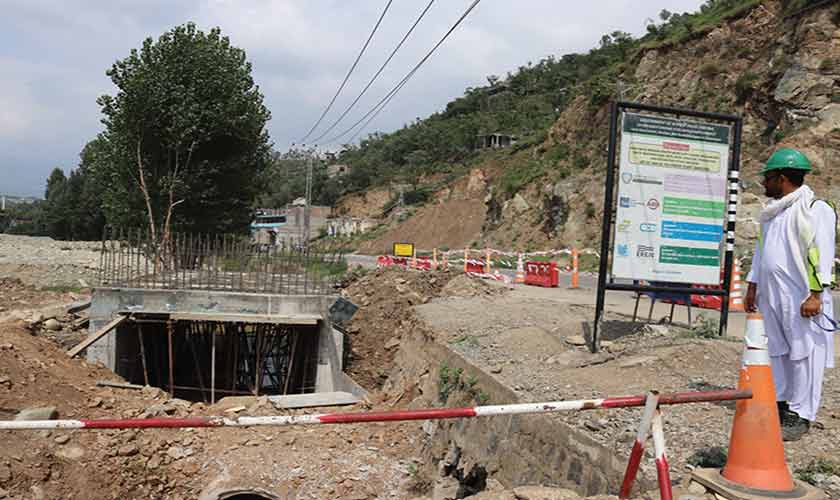
n the heart of Mingora, where rapid urban expansion and rising temperatures are straining basic services, authorities are racing to complete a massive surface water supply project aimed at rescuing the city from a worsening drinking water crisis driven by falling groundwater levels and climate change.
For decades, the city has relied almost entirely on underground aquifers accessed through tube-wells. Officials say that system is no longer sustainable as population growth, erratic weather patterns and declining natural recharge continue to push groundwater reserves to critical levels.
Mingora, the economic hub of Swat, has witnessed rapid population growth over the past decade. Residents of hilly suburban areas say that over the last decade groundwater levels have dropped by more than 50 meters in some places.
Swat has a population of 2.3 million. According to open source data, the Water and Sanitation Services Company, serves around 0.37 million people across 25 neighborhood councils, covering 52,581 households. The utility manages more than 30,000 water connections through 69 tube wells, 49 water tanks and a 475-kilometer pipeline network.
The city currently extracts nearly seven million gallons of groundwater a day, far below the estimated demand of 11 million gallons per day. During summer months, shortages become acute, forcing authorities to appeal for reduced water consumption.
Adnan Bacha, a resident of Mingora, says that in summers, residential areas near the mountains are deprived of safe drinking water.
“Tube-wells are typically operated for eight to ten hours a day. However, at the height of summer, they cannot run for even six hours, as they begin to discharge sand along with water,” a senior WSSC Swat says. “This damages pumping machinery and clogs up the pipelines.”
To address the crisis, the provincial government, through the WSSC and the Khyber Pakhtunkhwa Cities Improvement Project is constructing a major water treatment plant, near the Swat River in Khwazakhela. Once operational, the project is expected to supply 30 million gallons of treated water per day to Mingora and surrounding urban areas through an extensive pipeline network.
Officials describe the initiative as one of the largest urban water infrastructure projects undertaken in the region and a critical climate resilience intervention for Swat’s growing population.
“The vision behind the Greater Mingora Water Supply Scheme is not simply to build a treatment plant, but to fundamentally transform the city’s water supply system from a stressed and fragmented arrangement into a modern, sustainable urban water utility,” says Zeeshan Pervaiz, acting chief engineer for KPCIP-Swat.
He says that Mingora’s dependence on groundwater has become increasingly risky as aquifers continue to shrink under rising extraction pressure.
“For decades, Mingora relied on groundwater accessed through tube-wells. While this system served the city for many years, rapid urban growth, rising demand and falling groundwater levels made it increasingly unsustainable,” he says.
According to data obtained from the WSSC, groundwater levels across several cities in Khyber Pakhtunkhwa have been steadily declining and may soon fall beyond natural re-charge capacity if urgent corrective measures are not taken. Officials warn that the combination of climate change and urban expansion is intensifying the crisis.
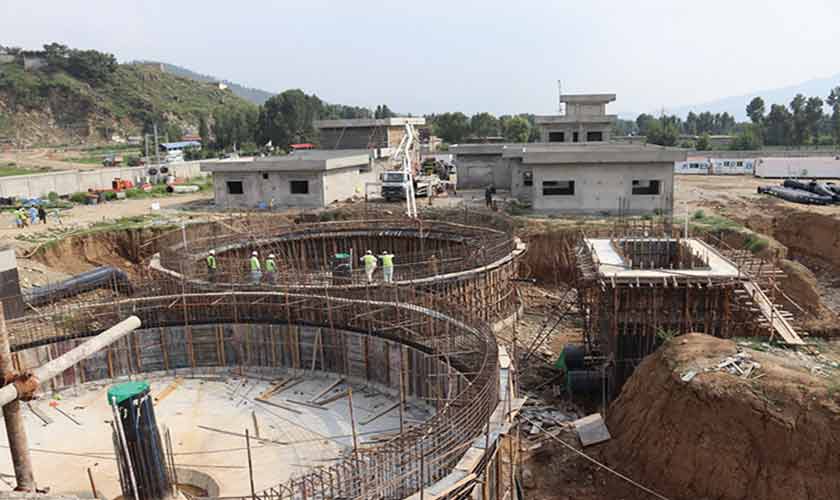
The new water treatment plant aims to reduce dependence on underground aquifers by shifting the city toward surface water drawn directly from Swat River.
Pervaiz says planning and design work for the project has been going on since 2019. He says the stakeholders have include the provincial government, the local government, Elections and Rural Development Department, the WSSC Swat, the Asian Development Bank and the Asian Infrastructure Investment Bank.
“This is not a standalone project. It is a part of a major institutional and infrastructure investment.”
The treatment facility will draw water from Swat River through an intake system at Khwazakhela before passing it through several purification stages, including screening, coagulation, sedimentation, rapid gravity filtration and chlorination.
Authorities say the treated water will then travel through a 17-kilometer transmission pipeline to overhead reservoirs before being distributed through approximately 485 kilometers of distribution network. Officials believe the project will eventually serve nearly 850,000 residents.
The water crisis, however, extends beyond the shortages. Officials and residents say unreliable supply has affected households, schools, businesses and public health.
“Water scarcity affects much more than household convenience,” Pervaiz says. “It impacts daily domestic routines, public health, schools, commercial activity and urban productivity overall. Reliable access to water is not just a utility — it is a foundation for health, education and economic activity.”
He says climate change has complicated the situation by disrupting traditional rainfall patterns and reducing winter snowfall in upper catchment areas that historically contributed to groundwater recharge.
“In recent years, that seasonal recharge mechanism has weakened considerably,” he says. “This challenge is not only about rising demand; it is also about changing hydrological realities.”
Under KPCIP, WSSCs are installing flow meters, replacing rusted pipelines and introducing Supervisory Control and Data Acquisition systems to monitor water extraction and distribution in real time. Officials say the upgrades are aimed at reducing “non-revenue water” lost through leakages, theft and waste.
The introduction of metering and digital monitoring systems is expected to reduce over-extraction, improve operational efficiency and lower energy costs associated with pumping groundwater.
“Infrastructure projects of this scale naturally involve challenges,” Pervaiz says, citing utility shifting, right-of-way issues, underground service networks and the need to minimise disruption to residents during construction.
“This is not a single-structure project; it is an integrated city-wide system. This makes coordination as important as engineering,” he says. Despite the obstacles, officials remain optimistic that the project will fundamentally reshape Mingora’s water future.
With a design capacity of 30 million gallons per day, authorities say the scheme has been planned to meet the projected water demand for nearly 30 years.
“The cities continue to grow,” Pervaiz says. “This project is designed to resolve the current crisis and hopefully provide long-term water security.”
The writer is a multimedia producer. He tweets @daudpasaney