Print Story
X




Quwwat-e-Niswan Boot Camp transforms women’s empowerment into real-world strength
In a country where conversations around women’s safety often remain confined to policy debates and social media outrage, something far more tangible unfolded in Peshawar, something resolute, physical, and deeply transformative. The “Quwwat-e-Niswan Women’s Self-Defense Boot Camp” was not just an event; it was a quiet revolution, one that replaced fear with preparedness and vulnerability with strength.
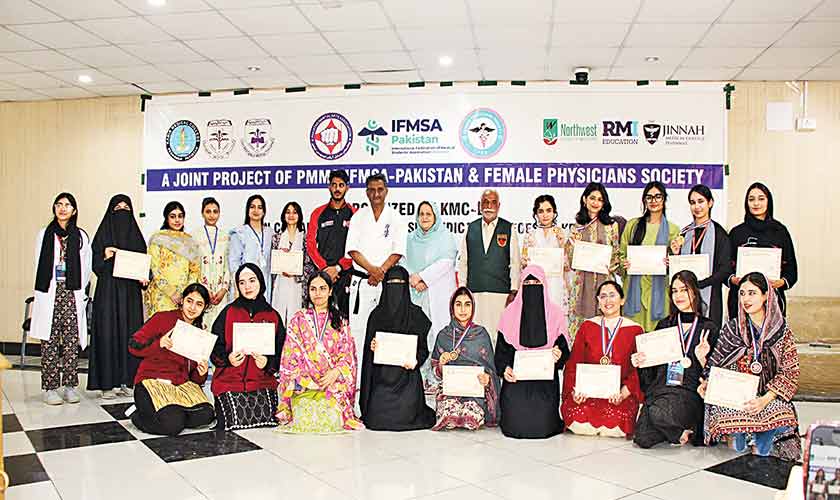
Hosted at Khyber Medical College, this landmark initiative brought together over 200 women, medical students and professionals, from across Khyber Pakhtunkhwa. Organized through a collaboration between the Pakistan Martial Arts Association and IFMSA-Pakistan, the boot camp marked a decisive shift in how empowerment is defined, delivered, and experienced.
Because empowerment, as this gathering proved, cannot remain an abstract ideal. It must be practiced, embodied, and, when necessary, defended.
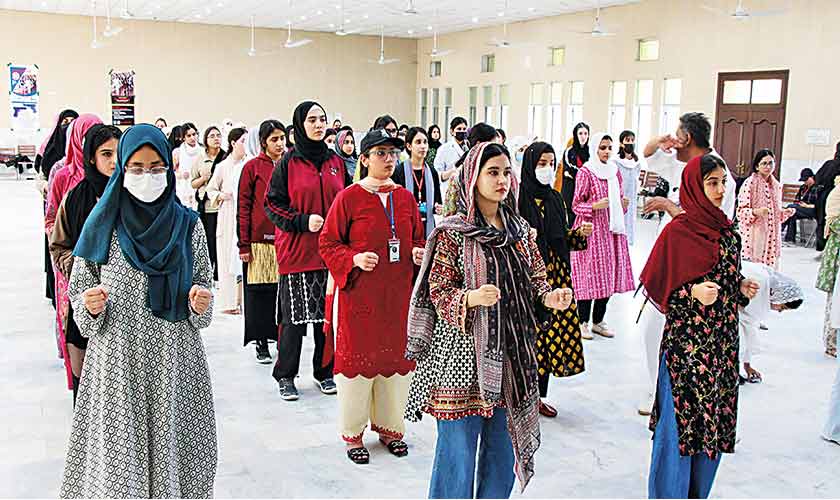
Participants arrived from institutions spanning the province, future doctors, healers, and caregivers who are often trained to save lives, yet rarely equipped to protect their own. Over two days, these women stepped out of their conventional roles and into a space that demanded resilience, alertness, and courage. What they encountered was not merely a set of physical drills, but a comprehensive framework for survival in real-world scenarios.
Under the guidance of seasoned trainers led by Sensei Anwar Mohiuddin, alongside instructors Chaudhry Hanzla, Sumaiyya Mohiuddin, Maheen Shoaib, and Hooria Faisal, the training transcended traditional martial arts instruction. It ventured into the psychology of threat response, teaching participants how to think under pressure, how to anticipate danger, and how to act decisively when seconds matter most.
From countering physical assaults to navigating weapon-based threats, hostage situations, and unsafe public transport encounters, the curriculum was as intense as it was necessary. Each drill, each simulation, was a reminder that safety is not guaranteed, it is cultivated.
What made this initiative particularly compelling was its context. In Pakistan, discussions around women’s safety often oscillate between caution and constraint, what women should avoid, where they should not go, how they should behave. Rarely does the narrative shift toward equipping women with the tools to confront danger head-on. The Quwwat-e-Niswan Boot Camp disrupted that narrative.
Here, the message was clear: women are not passive recipients of protection, they are active agents of their own security. This philosophy aligns closely with the forward-looking vision of Muhammad Zaid, whose roadmap aims to train 10,000 medical students and professionals by 2028. It is an ambitious target, but one that reflects a growing recognition that empowerment must be scaled, structured, and sustained.
Plans are already underway for a larger training initiative in Lahore, expected to gather around 500 participants. Such expansion is not merely logistical, it is symbolic. It signals that this is not a one-off event, but the foundation of a movement. And movements, by their very nature, are built on collective energy.
The diversity of participants, from multiple medical colleges to practicing doctors and members of organizations like “Da Hawwa Lur”, created an environment that was as collaborative as it was empowering. There was a palpable sense of solidarity in the training hall, a shared understanding that each woman’s strength contributed to a larger, collective resilience.
This spirit was echoed by Aliena Badshah, who described the boot camp as a historic milestone. Her observation was not just about the scale of the event, but about its intensity, the sight of women training rigorously for hours, refusing to yield to fatigue, and embracing the discipline required to master self-defense. It is this discipline that transforms empowerment from a slogan into a skill.
Recognition of excellence came in the form of gold medals awarded to standout performers, individuals who demonstrated exceptional commitment and capability. Yet, the true achievement of the boot camp cannot be measured in medals or certificates. It lies in the intangible shifts, the confidence gained, the fears confronted, the mindset redefined. Because the most profound victories are often internal.
The presence of Muhammad Zakariya Khan as chief guest further highlighted the significance of the occasion. His role in distributing awards was not just ceremonial; it was a validation of the participants’ efforts and a reinforcement of the importance of such initiatives within Pakistan’s broader sporting and social landscape. However, beyond the applause and accolades, a critical question emerges: what comes next?
For initiatives like Quwwat-e-Niswan to have lasting impact, they must evolve into sustained programs. Training must be continuous, accessible, and integrated into institutional frameworks, particularly in universities and professional bodies. There is also a need for policy-level support, ensuring that self-defense training becomes a standard component of educational curricula rather than an optional add-on.
Moreover, societal attitudes must evolve in tandem. Empowering women to defend themselves should not absolve society of its responsibility to create safer environments. Instead, it should complement broader efforts toward accountability, awareness, and systemic change.
Yet, even within these complexities, there is reason for optimism. What unfolded in Peshawar was more than a workshop, it was a statement of intent. It demonstrated that when women are given the tools, the training, and the trust, they rise, not just as individuals, but as a collective force.
The “Invictus Women” are not defined by invulnerability, but by their refusal to be defined by fear. And perhaps that is the most powerful transformation of all.