Print Story
X




A historic clean sweep in duo categories signals Pakistan’s emergence as South Asia’s undisputed ju-jitsu powerhouse
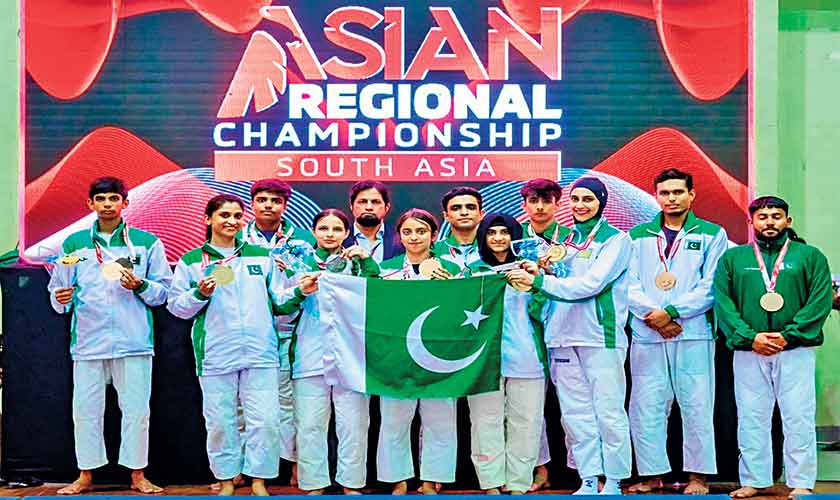
There are victories, and then there are statements. What Pakistan achieved at the South Asian Ju-Jitsu Championship 2026 in Digana was not merely a triumph, it was a declaration of supremacy, a moment that redefined the country’s standing in regional combat sports.
For years, Pakistan’s sporting narrative has oscillated between flashes of brilliance and prolonged periods of underachievement. But in the disciplined, demanding world of ju-jitsu, the script is being rewritten, and rewritten emphatically.
At the heart of this transformation stands the Pakistan Ju-Jitsu Federation, whose athletes delivered a performance that will be remembered as one of the most dominant displays in South Asian sporting history. In an extraordinary clean sweep, Pakistan secured both gold and silver medals across every duo category, an achievement so rare that it borders on the unprecedented. This was not just winning. This was ownership.
In the duo system, arguably the most technical and synchronized discipline of ju-jitsu, Pakistani pairs did not merely outperform their rivals; they outclassed them to such an extent that the final battles for gold and silver were often contested between teammates. While other nations fought for survival on the podium, Pakistan’s athletes competed for supremacy among themselves.
Such dominance does not happen overnight. It is the product of years of meticulous training, relentless discipline, and an evolving ecosystem that prioritizes technical excellence and mental resilience. The medal tally, 12 gold, 5 silver, and 5 bronze in duo categories alone, only tells part of the story. The real narrative lies in the precision, coordination, and confidence with which these athletes performed.
Names like Muhammad Ali Rashid, Yousuf Ali, Isra Waseem, and Kainat Arif have now become synonymous with excellence. Their performances were not just about executing routines; they were about embodying a philosophy of partnership, trust, and near-flawless synchronization.
Take, for instance, the mixed duo combinations where adaptability is key. Pakistani athletes demonstrated an uncanny ability to anticipate each other’s movements, turning complex sequences into seamless displays of control and technique. It was artistry, executed with the intensity of combat.
Yet, the story does not end with the seniors. What makes this achievement even more compelling is the depth of talent emerging from Pakistan’s youth ranks. In the under-16 and under-18 categories, young athletes like Sundus Ali, Zunaira Zulfiqar, and Muhammad Abdullah Ali announced their arrival with authority. Their gold medal performances were not just victories, they were promises of continuity, assurances that Pakistan’s dominance is not a fleeting phase but a sustained trajectory. This blend of experience and youth is what transforms a successful team into a formidable system.
Beyond the duo categories, Pakistan’s fighters also made their mark in the Fighting and Show System disciplines. Athletes like Kainat Arif and Muhammad Ali Rashid extended their excellence into individual categories, securing crucial medals that contributed to Pakistan’s overall second-place finish in the championship standings.
But numbers, as impressive as they are, cannot fully capture the significance of what unfolded. “This is not just a victory; it is a statement to the world,” remarked Pakistan Ju-Jitsu Federation Founder Khalil Ahmed Khan. His words resonate because they reflect a deeper reality, Pakistan is no longer participating in South Asian ju-jitsu; it is defining it.
Equally telling was the assertion by Pakistan Ju-Jitsu Federation General Secretary Tariq Ali: “When you control the entire podium in any category, you control the sport.” It is a bold statement, but one that is difficult to dispute given the evidence.”
However, beneath the celebration lies a paradox that Pakistani sports know all too well. Despite such extraordinary achievements, athletes continue to grapple with financial constraints and limited institutional support. The acknowledgment by federation officials that this success came “despite financial restraints” is both a proof of the athletes’ resilience and a stark reminder of systemic challenges.
Imagine what could be achieved with consistent investment, world-class facilities, and structured development pathways. And yet, perhaps it is this very adversity that has forged the character of these athletes. Training in less-than-ideal conditions, competing with limited resources, and still emerging as champions, it adds a layer of grit to their achievements that statistics alone cannot convey.
The emotional dimension of this journey was perhaps best captured by Isra Waseem, who spoke about facing her own teammate in a gold medal contest. It is a scenario that encapsulates both the beauty and the intensity of Pakistan’s dominance, where competition exists within, driving athletes to elevate their standards continuously.
Looking ahead, the federation’s plans to recommend gold medalists for national honors and to prepare rigorously for the Asian Games and World Championship qualifiers are steps in the right direction. But they must be accompanied by a broader commitment from stakeholders to nurture and sustain this momentum. Because moments like these are rare. And when they arrive, they must be seized, not just celebrated.
Pakistan’s performance in Digana is more than a sporting milestone; it is a blueprint. It demonstrates what is possible when talent is identified, discipline is enforced, and belief is instilled. It challenges other sporting bodies to rethink their approaches and invest in long-term development rather than short-term gains. Most importantly, it offers inspiration.
In a country hungry for sporting heroes, these ju-jitsu athletes have provided a narrative of excellence, resilience, and unity. They have shown that with the right mindset, even the most daunting challenges can be overcome, and that Pakistan can not only compete but dominate on the international stage. This was not just a championship. This was Pakistan tightening its golden grip on South Asian ju-jitsu, and refusing to let go.