Print Story
X




Traditionally Pakistani cricket has produced world-class batsmen and bowlers, but fielding has often been treated as secondary.
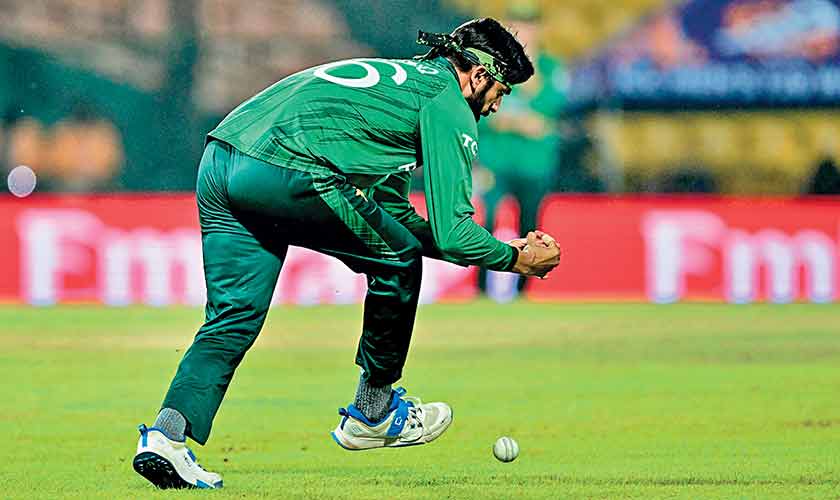
In cricket, the importance of fielding cannot be overstated. While batting and bowling often dominate headlines, it is fielding that frequently determines the outcome of matches. A spectacular catch, a sharp run-out, or a diving stop can swing momentum, lift team morale and ultimately decide the winner.
Former South African player Jonty Rhodes has been regarded as the greatest fielder ever. He revolutionised fielding standards in the 1990s with explosive agility, especially at point. His run- out of Inzamam in the 1992 World Cup is iconic.
Other than Rhodes, Ricky Ponting, AB de Villiers, Virat Kohli, Steve Smith, Kane Williamson, Ravindra Jadeja Glenn Maxwell are the world’s best fielders. But in the current squad, No Pakistani player can be rated among the top fielders.
It exposed more in the ongoing Pakistan Super League (PSL) Season 11, one glaring issue has overshadowed many matches: the standard of fielding by Pakistani players. Time and again, lapses in catching, misfields and slow ground coverage have cost the teams crucial runs, often tipping the scales in favour of the opposition.
From the very first games of PSL 11, fans and analysts have noticed a disturbing pattern. Drops of straightforward catches, misjudged boundaries and missed run-out opportunities have been alarmingly common.
In a tournament that prides itself on producing world-class cricket and showcasing Pakistan’s finest talent, the substandard fielding is a cause for concern.
Pakistan’s players, despite their prowess in batting and bowling, are far behind the fielding standards seen in leagues like the other leagues.
One notable example came during a high-stakes match between Islamabad United and Karachi Kings. Islamabad United’s fielder dropped a sitter in the covers that would have sent a set batsman back to the pavilion. That single missed opportunity allowed the batsman to add a quick 35 runs to the total, ultimately contributing to Karachi Kings’ narrow victory.
Islamabad skipper Shadab Khan was given an early lifeline when Quetta Gladiators’ spinner Usman Tariq dropped a simple caught-and-bowled chance while he was on just 9. He went on to score 69 off 39 balls and earned the Man of the Match award, leading his team to victory.
In another game, Lahore Qalandars lost momentum due to a misfield in the deep, enabling the opposition to convert what should have been a routine single into a crucial boundary. Such instances, repeated across matches, underline how poor fielding is directly translating into match losses.
Analysts often compare these performances to international standards. World’s best fielders anticipate every shot, cover ground quickly, and maintain a high success rate in catching and throwing while in contrast, Pakistani players in PSL 11 seem to struggle with basic drills under pressure, frequently allowing easy runs and missing opportunities for wickets. Even the occasional brilliant individual effort is undermined by the overall inconsistency and lack of coordination in fielding units.
One contributing factor appears to be insufficient focus on fielding in domestic training and preparation. Traditionally, Pakistani cricket has produced world-class batsmen and bowlers but fielding has often been treated as secondary. While batting and bowling skills are honed with rigorous practice and expert coaching, fielding training has sometimes been limited to warm-up drills or casual practice sessions.
The consequences are evident in the ongoing PSL matches where split-second errors can cost games. Furthermore, the tournament format, with tight schedules and multiple back-to-back games, leaves players with less time to practice and improve fielding, especially if they are returning from injuries or international duty.
Another issue is athleticism and fitness. Effective fielding demands not just skill but also speed, agility and endurance. Several Pakistani players in PSL 11 have displayed difficulty in covering ground quickly, resulting in dropped catches or failure to save boundaries.
Comparatively, international teams often recruit specialist fielders or train players intensively in movement, reflexes, and anticipation. The lack of emphasis on such athletic training in Pakistan might explain why the fielding standards lag behind global counterparts.
Psychological factors also play a role. Fielding requires mental alertness throughout the innings, as one lapse can change the course of the match. Pakistani players, under the high-pressure environment of PSL, sometimes exhibit signs of concentration lapses or hesitation during critical moments.
For instance, in a match between Multan Sultans and Peshawar Zalmi, a misjudged throw at the stumps in the final over allowed the batsmen to score the winning runs. While the team’s bowling was disciplined, the fielding error proved decisive, reinforcing how fielding is not just a physical skill but a mental one too.
So, how can Pakistani players improve the standard of fielding to match international benchmarks?
Firstly, cricketing boards and franchises must treat fielding as a core component of preparation, rather than an afterthought. Regular, structured fielding drills focusing on catching, ground fielding, throwing accuracy, and anticipation should be mandatory. Using technology such as slow-motion video analysis can help players identify weaknesses in their technique and refine their approach.
Secondly, fitness and agility training should be prioritived. Sprint drills, lateral movement exercises, and plyometric training can enhance reflexes and speed, enabling fielders to cover more ground and make those crucial stops. Many international teams employ specialized fielding coaches whose sole focus is improving players’ movement, catching, and throwing.
Pakistan teams could benefit from hiring more of such specialists and integrating their sessions into daily practice routines.
Thirdly, cultivating a culture of accountability and concentration on the field is essential.
Fielding is a team effort, and players must communicate effectively, anticipate each other’s movements, and maintain focus throughout the match. Mental conditioning, including visualisation exercises and pressure-simulation training, can prepare players to handle high- stakes situations without lapses in concentration.
Lastly, learning from international examples can be highly beneficial. Watching footage of elite fielders and analyzing their positioning, footwork, and decision-making can provide practical insights. Players like Jonty Rhodes, AB de Villiers, and Ben Stokes have redefined fielding standards globally. Emulating their techniques while adapting them to the Pakistani playing style can elevate fielding standards in the PSL.
It is worth noting that fielding improvements do not happen overnight. They require consistent practice, professional guidance, and a cultural shift that recognizes fielding as equally important as batting or bowling. Pakistani cricket has always produced prodigious talent in all departments, and the raw athleticism exists. The challenge lies in refining these skills under pressure, enhancing consistency, and developing the mental toughness to seize every opportunity.
The low standard of fielding in PSL Season 11 has been a visible and costly issue, often influencing match outcomes unfavorably for Pakistani teams. Drops, misfields and poor coordination have repeatedly allowed opposition teams to gain the upper hand. Compared to international standards, Pakistani players lag behind in technique, fitness, and mental alertness on the field. However, with structured training programs, improved fitness regimes, specialised coaching and a renewed focus on fielding as a critical component of cricket, there is no reason why Pakistan cannot catch up.
The Pakistan Super League is more than just a showcase of batting and bowling talent; it is an opportunity for Pakistani cricket to demonstrate all-around excellence, and improving fielding standards must become a priority if teams aim to consistently win and compete on the international stage.