Print Story
X




PMAA launches major women’s self-defence initiative combining martial arts, empowerment and national spirit
In Pakistan, conversations about women’s empowerment often begin with education, employment or representation. Rarely do they begin with self-defence. Yet perhaps they should.
Over the past few years, the country has witnessed an undeniable rise in discussions surrounding women’s safety, harassment in public spaces, cyber abuse and the psychological pressure many young girls experience simply while navigating daily life. Amid these conversations, an important reality is slowly gaining recognition: empowerment is not only intellectual or economic, it is also physical and psychological.
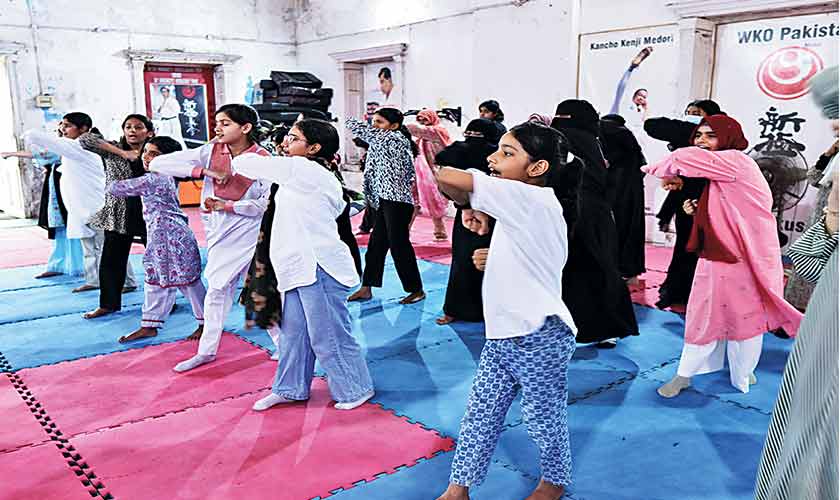
That is why the recent “Marka-e-Haq Women’s Self-Defence Workshop” organised by the Pakistan Martial Arts Association (PMAA) in Lahore carried significance far beyond a routine martial arts event. At first glance, it appeared to be a ceremonial workshop held to commemorate the anniversary of Marka-e-Haq. But beneath the symbolism and speeches was something much deeper: a growing movement attempting to redefine how Pakistani society views women’s strength, safety, and confidence.
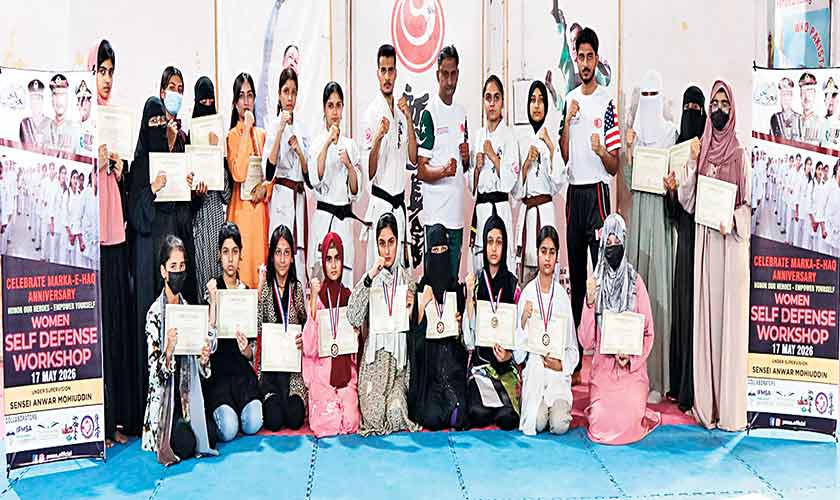
For decades, martial arts in Pakistan remained largely male-dominated and competition-focused. Combat sports were associated with medals, tournaments, and elite athletes rather than social development. Women’s participation existed, but often on the margins. Today, however, the purpose of martial arts is evolving.
Self-defence is no longer being presented merely as a sport or hobby. It is increasingly being viewed as a survival skill. That distinction matters. When young girls learn self-defense, they are not simply learning how to throw a punch or escape a physical grip. They are learning situational awareness, emotional control, decision-making under pressure, and perhaps most importantly, confidence in their own physical presence. Confidence changes behavior. And behavior changes vulnerability.
One of the strongest aspects of the PMAA workshop was its practical approach. Rather than limiting the event to motivational speeches or symbolic demonstrations, trainers focused on real-world scenarios that women and adolescent girls may encounter in public spaces, educational institutions, workplaces, or even online environments.
Participants were taught how to identify threatening behavior, maintain awareness in unfamiliar surroundings, and react quickly during moments of danger. These are not cinematic combat techniques designed for entertainment. They are preventative and defensive strategies rooted in awareness and survival. That is exactly where the conversation around women’s empowerment in Pakistan needs to move.
Too often, society places the burden of safety entirely on caution. Women are repeatedly told where not to go, what not to wear, when not to travel, and how not to behave. Rarely are they taught how to actively respond if danger does emerge. Self-defence training changes that narrative. It transforms women from passive observers of their own safety into active participants in it.
Importantly, martial arts also address another issue that is less visible but equally damaging: fear. Fear shapes the lives of countless women long before any incident actually occurs. Fear influences mobility, confidence, ambition, and independence. A young girl who constantly feels vulnerable may hesitate to participate fully in society. Over time, that hesitation quietly becomes limitation.
Martial arts training challenges this mindset at its core. The discipline required in combat sports builds mental resilience alongside physical ability. Students learn focus, patience, emotional control and self-belief. The transformation is often psychological before it is physical. Many participants walk into training sessions uncertain and hesitant, but gradually begin carrying themselves differently, with confidence, awareness, and composure.
This is one reason why schools and universities should begin treating self-defence education more seriously. The collaboration between PMAA, IFMSA-Pakistan, and The Trust Schools demonstrates how institutions can play a constructive role in promoting women’s safety without turning the discussion into fear-driven rhetoric.
Instead of focusing only on threats, these programs focus on preparedness and empowerment. That is a healthier and more sustainable approach. There is also a broader cultural significance to this growing movement. In many societies, physical strength has historically been associated with masculinity, while women were encouraged to embody softness and restraint. Martial arts disrupt those stereotypes. They show that discipline, resilience, courage, and physical capability are not gendered traits. This does not mean encouraging aggression. In fact, most martial arts systems emphasise restraint, control, and defensive response rather than violence. The true objective is confidence and preparedness, not confrontation.
The symbolism of connecting Marka-e-Haq with women’s self-defense was also noteworthy. Organisers attempted to draw a parallel between national defense and personal defense, the idea that resilience at a national level must also exist at an individual level. Whether one agrees fully with the symbolism or not, the larger message remains relevant: societies become stronger when individuals feel secure, capable, and empowered.
Pakistan’s women are increasingly demanding that empowerment move beyond speeches, hash-tags, and ceremonial campaigns. They want practical tools that improve everyday life. Self-defense training is one such tool. Of course, martial arts alone cannot solve the deeply rooted social issues surrounding harassment, violence, or gender inequality. Stronger laws, better law enforcement, educational reform, and cultural change remain essential. But self-defense programs can still become part of a broader solution by helping women build confidence and preparedness in environments where insecurity remains a reality.
The most encouraging aspect of the PMAA initiative was not the medals, certificates, or ceremonies. It was the sight of young women stepping onto training mats with seriousness, determination, and purpose. That image reflects a changing Pakistan.
A Pakistan where martial arts is no longer confined to sports arenas. A Pakistan where women’s empowerment is beginning to include physical confidence alongside educational and professional growth. And perhaps most importantly, a Pakistan where more young girls are learning that strength is not something reserved for others, it belongs to them too.