Print Story
X




A remote necropolis in Thano Bula Khan reveals rich craft etched in stone
| T |
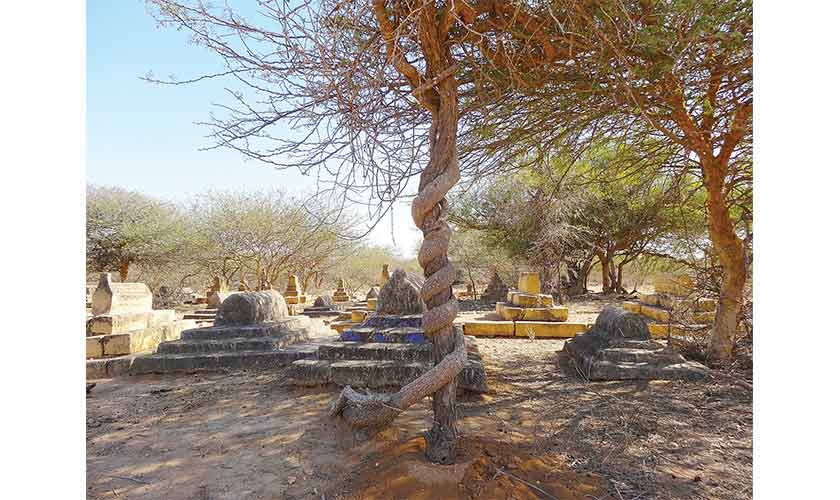
hano Bula Khan taluka in the Jamshoro district is renowned for its historical graveyards featuring intricately carved stone graves. Since 1998, I have been exploring and documenting these significant sites. One particularly notable cemetery, known locally as Mor Muradio or Mor Muradi, lies along the right bank of the Thado ephemeral river in Union Council Mol. It is nearly 12 kilometres from Bandecha Stop in Gadap taluka and can also be accessed from Sari town in Thano Bula Khan, the shortest route being from Bandecha Stop.
This graveyard is near the confluence of the Thado and Gandako hill streams. The Gandako hill stream, a tributary of the Thado ephemeral river, is also home to several rock art sites. In addition to the ancient graveyards, both the Thado and Gandako hill streams feature rock carvings dating back to prehistoric and historic periods.
I first visited this necropolis with late Gul Hasan Kalmatti, late Gondar Abbas and Ghulam Qadir Baloch in 2014. Later, in 2017 and 2018, I returned to the cemetery when I was conducting research on rock art in the Sindh-Kohistan region of Sindh. This graveyard contains simple, plastered and stone-carved graves, some dating back to the 18th Century. The stone-carved graves are not very old. From the carvings, it appears that most were erected during the Talpur (1783-1843) and colonial eras (1843-1947) and a few during the Kalhora period (1700-1783).
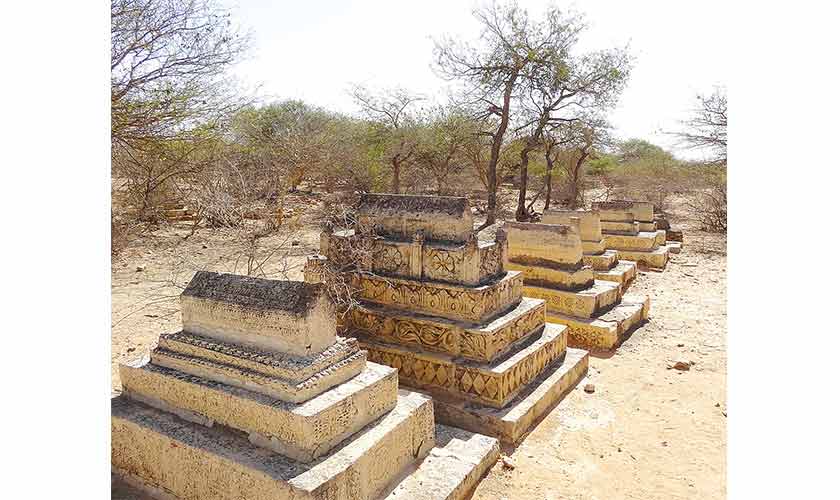
From the interviews with local people and researchers, I learned that dignitaries of the Bura community are interred in these graves. Later, during an in-depth interview with Muhammad Asharf Jokhio, a teacher at Government Boys Primary School in Sohrab Faqeer Jokhio village in Gadap taluka, I learnt that, apart from Bura dignitaries, several other clans are buried in this graveyard. According to him, people from prominent villages in both Malir and Jamshoro districts are buried in this necropolis. The most prominent villages include Faiz Muhammad Buro, Ghazi Buro, Abdul Karim Buro, Haji Nabi Bakhsh Buro, Tahir Muhammad Buro, Ali Akbar Buro, Bachu Faqir, Mooso Shoro, Nawaz Ali Gondar, Rozi Gondar, Hayat Gondar, Nausherwan Gondar, Mir Khan Gondar, Imam Bakhsh Gondar, Ramazan Gondar, Pathan Gondar and Nindo Gondar.
These graves are multi-tiered. Some are six-tiered, others are two-or three-tiered. One of the graves in the necropolis is noted for its cross motifs. This is a single-chamber grave with two covering slabs topped by a headstone. At the centre of the northern slab of the chamber, a rectangular framed panel is clearly defined by a raised border. Within this frame, there are three vertically aligned cross designs. Outside the central framed panel, vertically aligned pecked marks extend from the base to the top on either side, producing a subtle chevron-like effect.
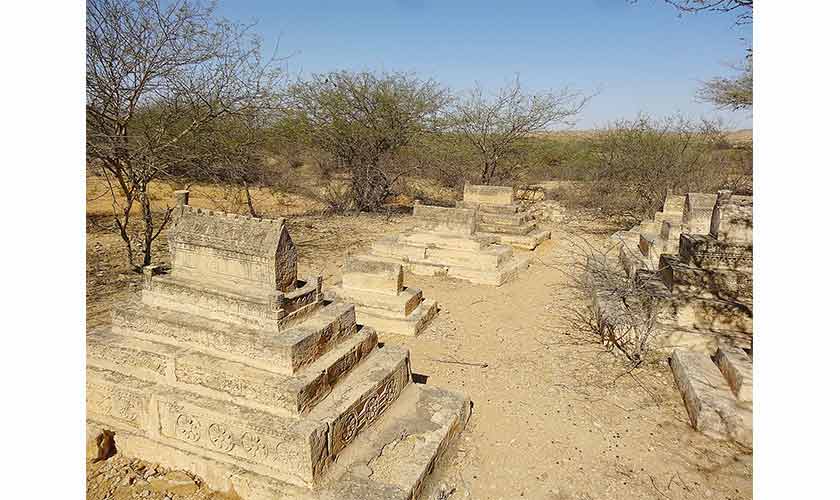
Most stone-carved graves in Mor Muradio necropolis are known for their unique decorations that often include floral, figural and geometric motifs. One of the grave slabs features a depiction of a gun and two circular motifs. Additionally, there is a rectangular slab with a groove on the northern side and a semi-circular design on the southern side, resembling a kharoth, a type of mosque traditionally constructed in Sindh-Kohistan, following a similar pattern. These mosques are built using small stones that may be either dressed or undressed, and typically have an entrance and a mihrab. This pattern on the grave slab resembles kharoth. So, it is a mosque motif. Two circular signs, slightly depressed, are made to contain water for birds. The gun motif reflects that this grave belongs to a male member of the Bura community. Female graves are represented and distinguished by jewellery depictions.
Another grave in the cemetery is noted for rich ornamentation from base to top. This is a four-tiered or four-casket grave. Each tier or casket is decorated with rosettes and geometric designs. The headstone is surrounded by a stylised balustrade. The western and eastern faces of the headstone represent a stylised sun motif. The sun motif is found in several other graves in Thano Bula Khan. This inspiration is undoubtedly taken from rock art in nearby valleys. The artists who made these graves were skilled and keen observers who noticed motifs in rock art and carved them on the slabs used for these graves. One of the slabs has broken, causing the grave to lean slightly to the right. The finely carved vegetal scroll on the headstone reveals the artisan’s exceptional command of stone carving and points to a deep continuity of artistic knowledge shaped by centuries-old decorative traditions in Sindh.
These images are not merely decorative; they evoke aspects of everyday life, identity and social memory.
As one walks through the necropolis, one comes across many stone-carved graves depicting firearms, cosmetic symbols and motifs of adornment. One of the gravestones in the cemetery depicts a particular necklace that women wore in the past. The idea was to show that the grave belongs to a woman. Another grave showcases not only various jewellery items but also a mirror and a comb. The representations of a mirror and a comb were commonly carved on graves that emerged in the late Nineteenth Century. This motif continued to appear on graves in the second quarter of the Twentieth Century. However, this does not indicate that stone carvers stopped using these symbols; rather, it reflects a decline in the patronage of stone graves. This tradition of stone-carved graves continues in the Sindh-Kohistan area, particularly in Thano Bula Khan and the Gadap areas. The most recent carvings of a comb and a mirror can be seen in the graveyard of Lalanis in Thano Bula Khan taluka.
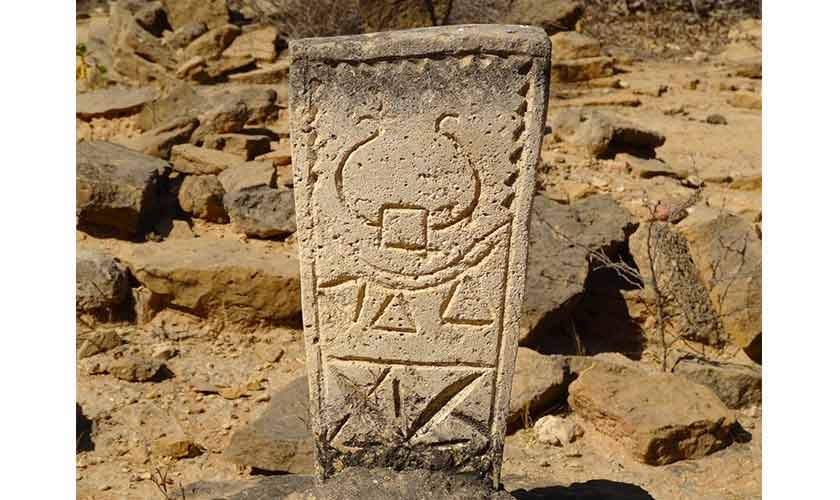
On the headstones of a few graves in Mor Muradio graveyard, one finds an ewer and a rosary, with the rosary enclosed in a mosque motif. These symbols are also common on stone-carved graves seen at various cemeteries in Thano Bula Khan. However, the most magnificent depictions are those of surma daani with an antimony rod (surhai). One of the graves depicts a comb, surma (surmey) daani, along with a comb and a razor. This grave belongs to a man. Generally, a double-sided comb is carved on the graves of women. On the contrary, man graves depict single-sided combs. I have seen representations of a double-sided comb at several graveyards in Thano Bula Khan. Some of the best specimens can be seen in the graveyards of Lakhan Kanaro and Umer Boro in Thano Bula Khan. Apart from combs, mirrors and surma daani pots, one can also find depictions of guns and swords on a few tombs at Mor Muradio graveyard. On the headstone of one of the tombs is carved a gun and a sword together. The distinctive feature of this multi-tiered stone-carved grave is the stylised railing that surrounds its headstone. The nearby stone-carved grave is also surrounded by a railing. This grave belongs to a woman, as one finds jewellery depictions on its southern slab.
One of the most impressive stone graves in the cemetery is that of a woman. It is a six-tiered tomb, crowned with a headstone enclosed by a stylised balustrade. From bottom to top, the grave is exquisitely carved with a rich combination of floral and geometric designs, culminating in the headstone, which is divided horizontally into two panels, each adorned with intricate motifs. The surrounding railing further enhances its architectural elegance.
Such a finally carved grave is unparalleled in the nearby graveyards of Union Council Mol in Thano Bula Khan, underscoring its uniqueness and the remarkable craftsmanship involved. The grave is likely from the first or second quarter of the Twentieth Century. The northern face of the headstone, along with the northern slabs of railing, is depicted with engravings of the Kalima Tayyiba, jewellery and Bismillah, respectively.
Several graves in the cemetery bear inscriptions that preserve personal histories within the funerary landscape. One grave records the name of Umer Buro, son of Yousaf; another bears the name of Salih Muhammad and a date. According to the inscription on his grave, he died on Dhul Hijjah 9, 1364 AH (November 13, 1945). Among the most elaborately carved graves is that of Izzat, daughter of Rajo, from the Bura community.
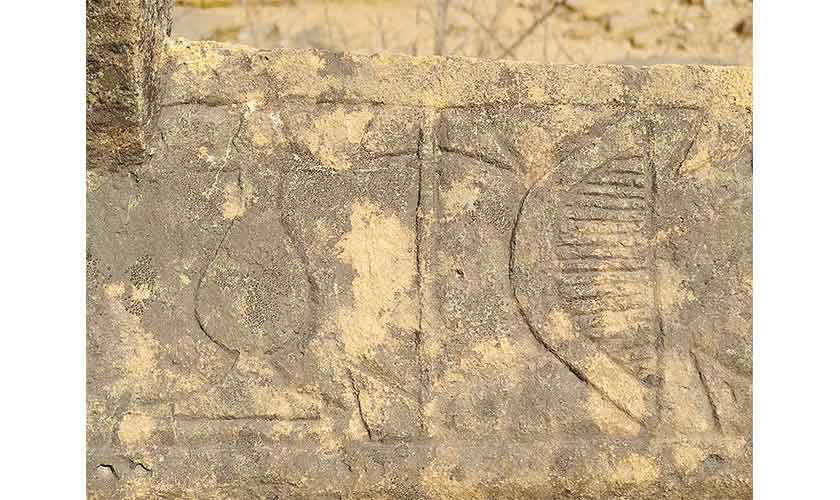
Moving through the graveyard, one is struck by the presence of motifs drawn from modern material culture, cosmetic objects, mosque motifs, weapons and symbols of adornment, carefully engraved on stone. These images are not merely decorative; they evoke aspects of everyday life, identity and social memory. At the same time, they reflect the creative agency of local artisans, who, while rooted in a long-standing tradition of stone carving, continue to reinterpret that tradition by incorporating contemporary forms and meanings.
The writer is an associate professor and anthropologist at the Pakistan Institute of Development Economics, Islamabad. He has authored 18 books on Pakistan’s cultural heritage and anthropology. He tweets @kalhorozulfiqar. He may be contacted at [email protected]