Print Story
X




A ride on Lahore’s Orange Train becomes a journey through the city’s heritage and history

| I |
t was evening when I entered the city. The famous Canal Road was bustling with traffic. It was a cloudy day. The evening light cast a beautiful hue across the clouds. Amidst motorbikes carrying loads the size of a sedan, noisy three-wheelers and trees lining the road: I could feel the vibe of the city.
Lahore is a city loved by many and hated by almost none. Despite its unplanned growth, the city has something that attracts tourists from across Pakistan and around the world. Fifteen million people live and breathe here, despite some of the poorest air quality in the world. The majority seem not to care.
“Lahore is not a city, it is a feeling,” one of my friends remarked as we walked along Canal Road one evening while the sun was setting. I could not agree more.
Lahore stands out for its art, culture and architecture. It has something for everyone. From food to history, the city delights and indulges all who visit it. Born and raised here, I consider myself fortunate. Living in one of Lahore’s most historically rich areas, close to the old city, provides countless opportunities to experience its unique vibe. However, the deterioration of significant historical sites and buildings over time saddens me.
Modern construction projects have had a considerable impact on historically important sites. The Orange Train Project has drawn significant attention from both Lahoris and non-residents. The project began in 2015 and was completed in 2020. It has a length of 27 kilometres. I sometimes take the train simply for sightseeing and visiting historical sites.
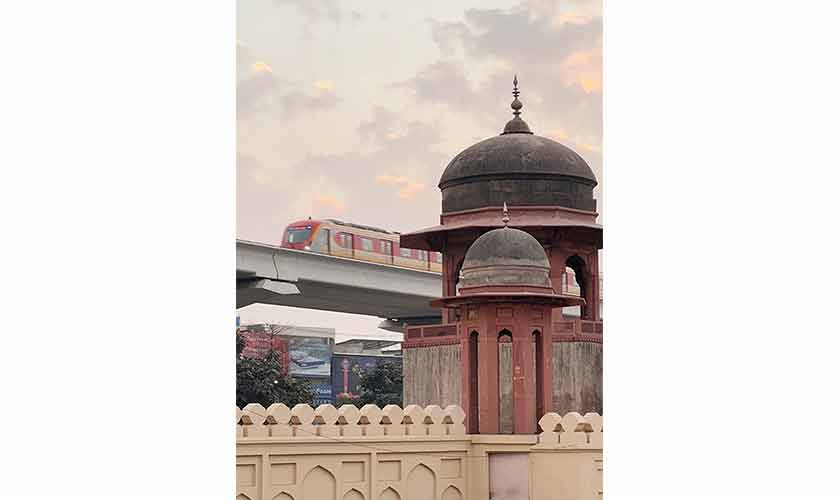
Many people affected by the project protested against their displacement from ancestral homes and commercial areas. Some of the strongest opposition came from those who cherish Lahore’s history and architecture. Some of them filed court cases. Riding the train through some of the most congested areas in Lahore, I can understand why the project remained controversial. The route’s proximity to historical sites was a serious concern. There were fears that it could endanger monuments and heritage spaces. Yet it has also made visiting these places far easier.
The two terminal stations of the Orange Train, named after localities in the east and west of the city, are Dera Gujjaran and Ali Town. Beginning the journey from the eastern terminal at Dera Gujjaran, one can still enjoy a sense of openness growing scarce in the megacity.
As the train glides above the Grand Trunk Road, the first historical site along the route is the famous Shalimar Gardens. From the nearest station, the entrance gate can be reached within a couple of minutes.
The main entrance has been reconstructed to facilitate the visitors. The old entrance was through a tiny wooden door in the southern wall. I still remember my childhood visits, when that small doorway felt like an entrance to a fantasy world, with rows of gushing fountains and enormous trees towering above the grassy lawns. Before the construction of the Orange Train’s massive pillars, the garden’s walls and security towers were the most prominent structures in the area.
The gardens once had an elaborate system of fountains spread across their terraces and lawns. The water supply system was located just beyond the southern boundary wall. Without the use of electric motors or pumps, 17th Century engineers had devised an innovative method to allowing fountains across the length and breadth of the gardens to function flawlessly. It must have been a marvel at the time.
Damage caused by the expansion of the Grand Trunk Road placed the gardens on UNESCO’s List of World Heritage in Danger in 2000. Preservation and restoration work, launched in 2006 and 2007, helped restore much of the structure. However, the water storage and supply building was razed to make way for the Orange Train.
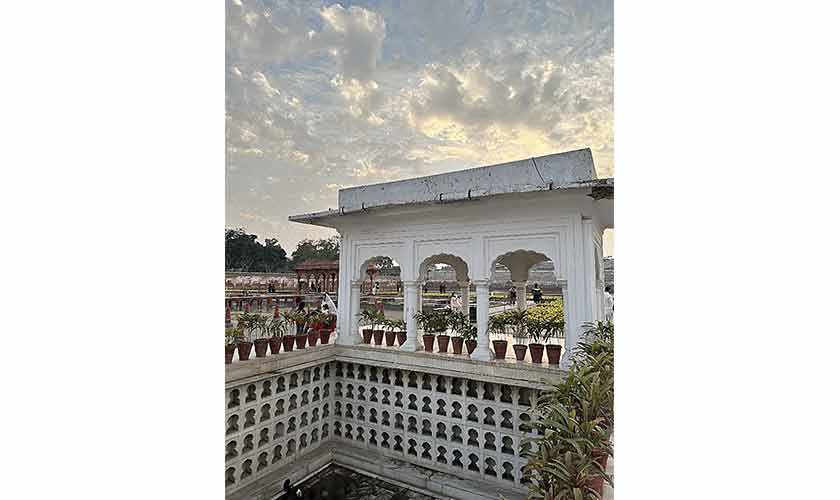
Morning or evening walks on the lawns of the gardens are highly recommended for anyone wishing to enjoy the calm punctuated by birdsong. The gardens have much to offer. One evening, just before sunset, beneath a sky filled with scattered clouds glowing with golden light, I again found myself there. I knew professional photographers often visited the site, but it was still surprising to see so many of them busy capturing not only the architecture, but also newlywed couples in wedding attire posing in the baradari pavilions and across the lawns. The gardens had transformed into a royal studio for happy couples.
About a 20-minute walk through a bustling bazaar from Shalimar Garden Station lies the shrine of Madho Lal Hussain. The place is steeped in tales of love, devotion and dedication. Every March, a three-day annual festival called Mela Chiraghan or the Festival of Lamps is held there. I still remember from my childhood the Lucky Irani Circus and the so-called well of death (Maut Ka Kuan), magic shows and malangs (mendicants) in traditional orange and red attire.
Decades ago, the festival was vibrant. Rows of temporary sweet and souvenir stalls stretched for several kilometres. The Grand Trunk Road was much narrower then, crowded mostly with horse-driven carts and bicycles. Today, both these forms of transport have become near extinct. The festival is now confined mostly to the immediate surroundings of the shrine complex. Although candles are still lit in a pit, and people continue to apply the soot to skin, believing it possesses healing powers, much of the festival’s former grandeur has faded away.
The stretch of the Orange Train from Shalimar Garden Station through the next few stops is surrounded by historic sites and striking scenes. At times, I feel that this part of the journey should be declared a heritage ride. Both sides of the route are lined with buildings and landmarks that history enthusiasts should not miss.
“Lahore is not a city, it is a feeling,” one of my friends remarked as we walked along Canal Road one evening while the sun was setting. I could not agree more.
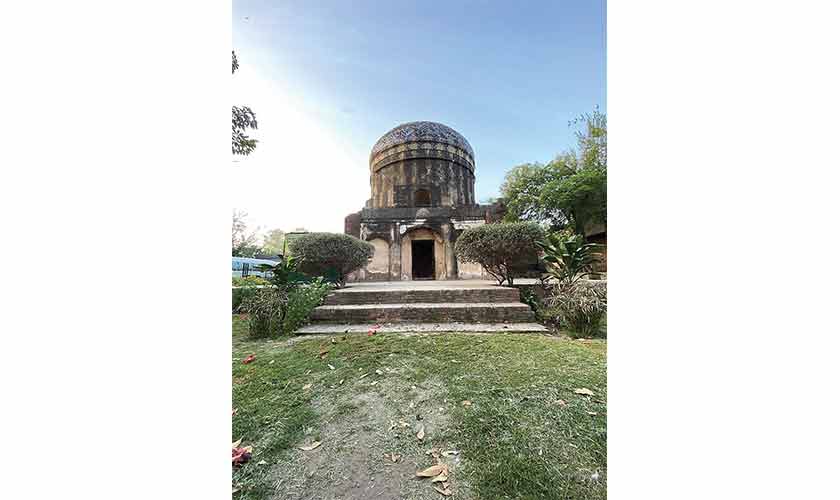
Baghbanpura, literally the Gardeners’ Town, is the next station. From there, visitors can either walk for about 15 minutes or take a two or three-wheeler ride to the Cypress Tomb (the Saru-wala Maqbara), an early 18th-Century mausoleum. The structure houses the tomb of Sharf-un-Nisa Begum, sister of Nawab Zakariya Khan, the governor of Lahore province during the reign of the Mughal emperor Muhammad Shah Rangeela. In keeping wih her will, she was buried at the spot where she used to recite the Holy Quran.
The building came to be known locally as the Cypress Tomb because of the ceramic tiles depicting cypress trees, along with other floral patterns adorning its exterior walls.
As one moves through the area, one comes across many buildings showcasing Mughal and Sikh architecture. Within a kilometre of the tomb are several other sites of interest for history lovers, including the Begumpura Mosque and a gateway distinguished by Sikh-style plasterwork and intricate brick detailing. A few Sikh-era havelis now stand hemmed in by modern structures to such an extent that locating them without the help of elderly locals or Google Maps has become near impossible.
Our Orange Train journey has more wonders ahead. Just opposite the University of Engineering and Technology, Lahore, a station offers access to the tomb of Dai Anga, a structure with a beautiful façade adorned with floral motifs and arches. Standing beneath the heavy concrete pillars of the train line on the Grand Trunk Road, the building readily catches the eye.
The monument was built to honour of Dai Anga, the wet nurse of Shah Jahan and the wife of Murad Khan of Bikaner. Passing through its decorative gateway, visitors enter the garden surrounding the tomb. Over the centuries, neighbouring structures have encroached upon the site, leaving only a narrow strip of the garden between the gateway and the mausoleum itself. Even so, the building retains the elegance of classic Mughal architecture.
The garden was recently renovated by the Walled City of Lahore Authority and the Defence Housing Authority. Although much of the fresco work and floral decoration has disappeared, traces can still be seen on the walls and ceilings. The main chamber was once surrounded by intricate calligraphy, but time and neglect have taken their toll, leaving the artwork in poor condition.
The building serves as a reminder that everything fades with time unless it is preserved with care. People only seek to preserve what they consider important. Living close to these historical sites, I have realised that many of my relatives and friends have never visited them. Perhaps they do not value these magnificent structures the way I do.
Just ahead, an isolated tomb known as Buddhu Ka Aawa stands along the Grand Trunk Road. It is easily spotted from the Orange Train. A signboard offers only a vague account of its history. Fortunately, the building hardly needs a lengthy explanation for anyone who appreciates classic Mughal red-brick architecture, with fragments of fresco work still surviving on its walls.
One can only imagine how magnificent the structure must have appeared in its prime, surrounded by gardens and open space, in stark contrast to its present condition, where motor mechanics’ workshops and piles of metal scrap crowd around it.
Moving on, the Orange Train passes close to old British-era railway buildings, as well as abandoned wagons and bogies that serve as reminders of the dilapidated state of Pakistan Railways. Wild overgrowth and heaps of metal scrap surround the area. The railways’ days of glory seem long gone.
A British-era clock tower, its hands frozen in time, still rises above the worn-out buildings. The train moves quickly through this stretch, and the moment one catches sight of the tower, it is already disappearing from view. Once a proud landmark, the tower retains a distinct character that sets it apart from its surroundings.
Next, the train passes another beautiful structure located among the railway employees’ quarters and workspaces: the Dai Anga Mosque. The moment one sees it, there is an immediate urge to take a closer look. Visitors can disembark at the railway station and walk east for a few minutes to reach the site.
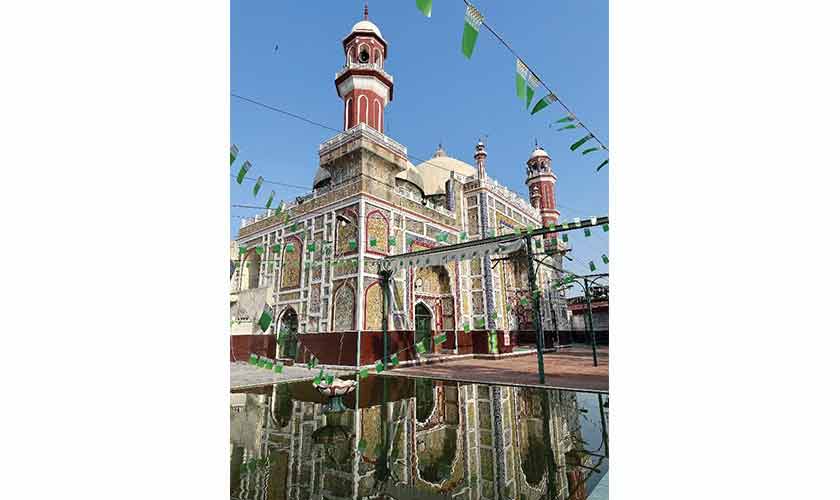
The mosque is believed to have been built in 1635 to honour Dai Anga, the wet nurse of the Mughal emperor Shah Jahan. It is often described as a scaled-down version of larger Mughal mosques such as the Badshahi Masjid. The mosque still has a functioning ablutions pond that reflects its striking façade. The central section is richly decorated with Kashani tile work in shades of blue, orange and yellow.
The interior once displayed exquisite frescoes. Many of those have unfortunately been replaced with modern tiles. Despite modifications and unsystematic alterations, some of the mosque’s grandeur has survived.
There were once two cinema houses in the vicinity of Boharwala Chowk. Those have been replaced by shops and shopping complexes. Lahore seems to be fast losing touch with its past.
From here, one can easily walk to the City Railway Station. The building immediately evokes the British colonial era, when railway lines were laid across the subcontinent. Its red-brick façade stands prominently, impossible to ignore amid the surrounding urban landscape.
This station has witnessed much history, from the horrors of Partition to the production of the 1956 Hollywood film Bhowani Junction, starring Ava Gardner and Stewart Granger. MGM Studios filmed several major scenes here, transforming the platforms into the fictional town of Bhowani during the final days of the British Raj.
The station remains a must-visit destination for anyone interested in architecture, history or photography.
After the Railway Station stop, the next station is named after one of Lahore’s most famous food hubs: Lakshmi Chowk. Surrounded by restaurants and eateries, the area is also home to old buildings reflecting Sikh, Hindu and British architectural styles. Walk in any direction and you will encounter a striking blend of architectural styles.
Beyond its historical significance, Lakshmi Chowk is now best known for its food. Standing in the middle of the chowk, with the Orange Train track suspended overhead, one can almost feel the city changing in real time. Change, truly, is the only constant.
After a day spent absorbing Lahore’s sights and history, this is a place filled with the possibility of indulgent cuisine. It deserves to be explored slowly. One can wander along Abbott Road or simply enjoy the familiar taka-tak — the metallic rhythm of blades striking the pan during food preparation.
The Orange Train continues onward, carrying passengers towards many more attractions at the next stations. But for now, at Lakshmi Chowk, one should pause to savour the taste of Lahore while reflecting on the journey of the day. Lahore is, without doubt, the beating heart of Pakistan, a city worthy of both time and attention.
The writer is a professor at the National University of Sciences and Technology.