Print Story
X




A major drawing show in Lahore revisits the medium as both method and meaning
| I |
n the preface to The Enigma of Arrival, VS Naipaul outlines the mechanics of his writing. The book revolves around his stay in Salisbury for eleven years: “I made no notes, I depended, as so often, on memory… I began to write this book when the experience was over,” reconfirming that “every experience has come to me ready-shaped.”
Reviewing an art exhibition also requires distance, in time (hours, days, weeks) and place. This is especially true of a large show with 19 participants, as seen in Traces: Drawing Practices Now (March 27-June 30) at the COMO Museum of Art. Curated by Hassan Sheikh, the exhibition brings together artists working across different practices, concerns and histories. What connects them is the element - rather, the word - drawing.
Drawing carries a particular connotation in art history and discourse. For centuries, it was treated as an initial recording of impulse, a response to immediacy; but in recent times, it has acquired an independent identity, importance and stature. Once considered a preparatory stage for other work, it is now treated as a separate entity. The shift can be compared, somewhat uncannily, to the possibility of a first draft of a book reaching the market before the edited version is printed, bound and launched. However, there is a significant difference between the two.
Art, whether a sculpture, a painted canvas, a photograph, a sketch, a page of miniature painting, an installation or a video projection, is, by and large, collected by a single individual, business group or institution; a book, by contrast, is owned by thousands, even millions. An author’s words are multiplied through editions as well as translations into other languages.
The exclusiveness of art is evident in Traces: Drawing Practices Now, where no work feels like a midway journey; each conveys a sense of arrival. Some take long, complex and time-consuming routes, while others suggest uneven, rough passages. Put another way, some works read as sophisticated inquiries, while others remain raw fixations. Perhaps the most reliable way to distinguish between the two is through the memory of the viewer, returning, at a distance, to what lingers.
Viewed formally, the exhibition appears to bring together two kinds of mark-making. One is constructed through a strict layout, with careful attention to how lines intersect, overlap and sit alongside one another; space is measured, colours are arranged and tones remain controlled. This mode suggests a kind of softened speech. The other is more expressive and intuitive, engaging with uncertainty (aside from a few pieces that feel forced or contrived).
This division also reflects differing approaches to image-making, though it is not especially important. An artist, when true to themselves, expresses what comes naturally, often without regard for, or even awareness of, category, style or format. In that light, the work of Muhammad Ali Talpur, Ali Kazim, Ayesha Quraishi, Babar Gull and Musawir Shabbir can be seen as excursions into mark-making and shifting focus.
Talpur, in his ink-on-paper work, introduces another facet of drawing: text. Handwritten (or typed) phrases become combinations of marks that carry meaning for those who share that linguistic code. In his recent work, he adds yet another layer. The flow of lines recalls the structure of a page, but beneath each bold line sits a finer one, a kind of subtext or translation running alongside the original. A similar subversion of script appears in Pinhan (2025), a small ink and collage work on archival paper by Ghulam Mohammad. On closer inspection, the tiny marks begin to resemble fragments of a forgotten language, some of those rendered in reverse.
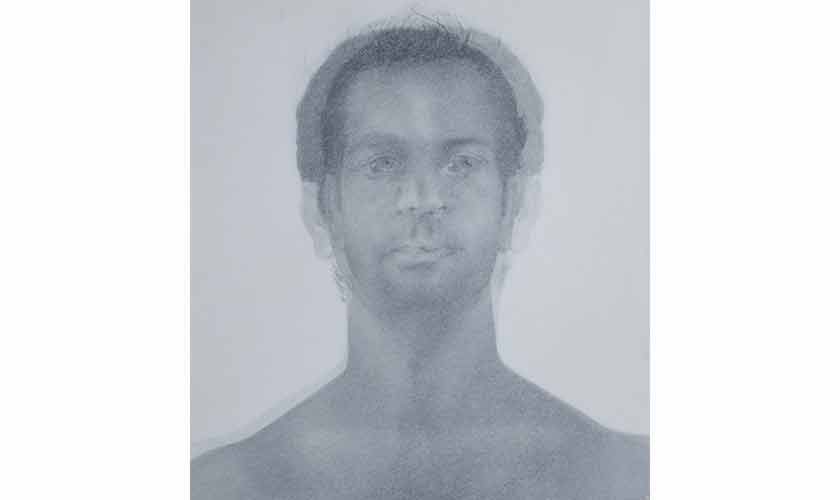
The unravelling of familiar ways of seeing is taken further in Ali Kazim’s Untitled (Self-Portrait, 2012). The image, framed in two layers, suggests multiple folds of a person, or, more precisely, a personality. The uncertainty and diffusion visible in the face, that supposed site of identity, echo the condition of a contemporary individual, stretched across locations, time zones and roles. Beneath this is a quieter search for a more stable sense of self, something often experienced by those who have left home to study, work, build a life, or who find themselves displaced.
Names begin to shift: Rizwan becomes Rizz, Saqlain turns into Sak, Nasheed into Nash. In much the same way, the individual, regardless of profession, becomes a translator, constantly converting thought from a mother tongue into the language of an adopted place.
The act of recognising extensions of one’s inner self is evident in the sensitive dry-points (Fragments II, III, IV, V, 2026) by Musawir Shabbir. Partly echoing a physical form and partly tracing moments of reflection and action, his marks unfold a degree of aggression, in sharp contrast to the temperament of the artist himself, as those who know him would attest. Seen more broadly, the work suggests fragments of a single being and a desire to come to terms with them.
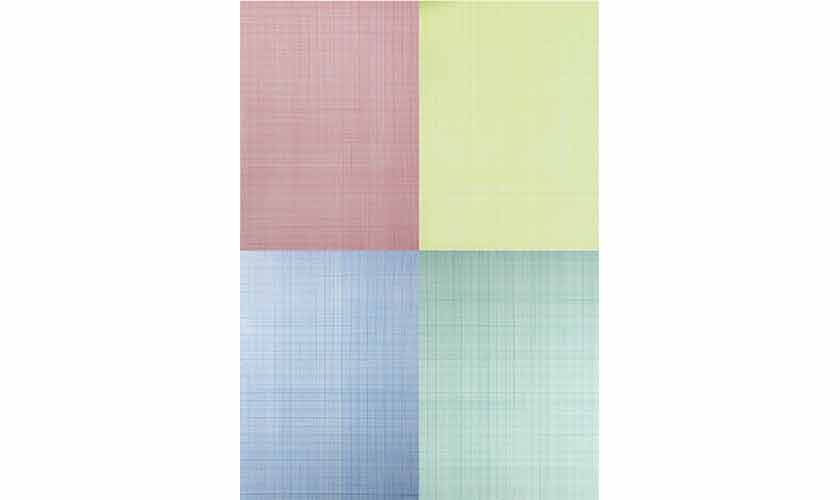
Another route to acceptance lies in formalising the world around us into words, shapes and geometry. In her large-scale acrylic and ink works on paper, Ayesha Quraishi creates the illusion of an unbroken surface: concealed, yet accessible through the minute, almost uncountable gaps between lines. The result is that the conventional distinction between object and background begins to dissolve. A related body of work, What Remains I, II, III (acrylic and ink on paper, 2023), points to how the folds of paper can open into something more elusive, accentuated in one piece by fine lines bending gently downwards. In its restraint, vocabulary and minimalism, her work recalls the language of another reclusive yet committed artist, Lala Rukh.
The exhibition also includes approaches that draw on recollection, of impressions, encounters and lived experience, particularly in the work of Nisha Hasan and Hafsa Nouman. Both artists retrace the surfaces of derelict structures: patchy plastered walls, rusted iron windows, worn door railings. These images point to an absence, the traces of lives once rooted in these spaces.
One may visit a large exhibition once, twice, perhaps several times, spending hours within it. Yet, on leaving, only fragments remain. It is through these fragments that drawing, as an old device, reveals itself again, through investigation, invention and intuition.
The writer is a visual artist, an art critic, a curator and a professor at the School of Visual Arts and Design, Beaconhouse National University, Lahore. He may be reached at [email protected].