Print Story
X




Karachi Kings rise to the top as batting dominance defines ongoing season

The Pakistan Super League has never been short of drama, but PSL 11 feels different. It is not just a tournament unfolding, it is a narrative being written in real time, shaped equally by breathtaking cricket and unsettling controversies. Yet, perhaps the most defining feature of this season is its resilience. Despite noise off the field and uncertainty beyond the boundary ropes, the league continues to command attention, proving once again that cricket in Pakistan is not merely a sport, it is a pulse.
At the heart of the competition stands Karachi Kings, a team that has quietly but firmly climbed to the summit of the points table. With three wins from four matches, Karachi lead the standings with six points, setting the early benchmark in a season where consistency has been rare and momentum fleeting. Multan Sultans follow closely with two wins, while teams like Peshawar Zalmi, Islamabad United and Lahore Qalandars remain in contention, their campaigns shaped by flashes of brilliance and moments of vulnerability.

Debutants Rawalpindiz and Hyderabad Kingsmen, meanwhile, are still searching for rhythm in a tournament that has offered little room for adjustment. Yet, if the points table tells one story, the matches themselves tell another, one dominated by bat over ball.
PSL 11 has, so far, been a festival of runs. Totals once considered match-winning are being chased with calculated aggression. Karachi’s pursuit of 197, Multan’s record chase of 226, and earlier games breaching the 200-mark with ease all point to a tournament tilting heavily in favor of batters. It raises an inevitable question: is this evolution or imbalance? The answer lies somewhere in between.
On one hand, the modern T20 game thrives on entertainment, and PSL 11 has delivered that in abundance. Players like Azam Khan have turned power-hitting into spectacle, his 74 off 34 balls against Rawalpindiz not just an innings, but a statement. Alongside him, David Warner’s composure has provided Karachi with stability, while Sahibzada Farhan’s unbeaten century for Multan Sultans stands as the defining knock of the tournament so far, an innings blending control with calculated aggression.
The numbers reinforce this dominance. The list of top batters is already stacked with high-impact performers: Sahibzada Farhan leading the charge with consistency, David Warner anchoring innings with experience, and Azam Khan redefining finishing roles. The tournament has also witnessed a surge in six-hitting, with over 150 maximums already recorded in the early phase, an indicator of both fearless batting and increasingly flat surfaces.

But where does that leave the bowlers? For many, PSL 11 has been unforgiving. Even quality attacks have struggled to defend totals exceeding 200, exposing a growing imbalance between bat and ball. Hasan Ali’s disciplined spells for Karachi and Shaheen Shah Afridi’s fiery bursts for Lahore Qalandars have been exceptions rather than the norm. Too often, bowlers have found themselves reacting rather than dictating, a reversal of roles that has defined this season.
Yet, cricket is never just about numbers. It is also about moments, and PSL 11 has had its share, both inspiring and controversial. From the much-debated ball-tampering incident involving Fakhar Zaman to the social media controversy surrounding Naseem Shah, the league has found itself navigating turbulent waters. The decision to uphold Fakhar’s two-match ban has sparked debate about consistency and transparency in disciplinary actions, while Naseem’s fine over a digital misstep has reignited discussions about players’ responsibilities in the age of instant communication.
Add to this the curious case of the “color-changing ball,” reportedly affected by dye from team kits, and the use of artificial crowd noise during broadcasts, and the league’s off-field narrative becomes as compelling as the cricket itself.
These incidents, while concerning, also highlight a deeper reality: PSL is growing, and with growth comes scrutiny. The challenge for the Pakistan Cricket Board is not merely to manage these controversies, but to learn from them, to ensure that the league’s credibility evolves alongside its popularity.
Amid all this, there remains the question of the fans. From April 8, the tournament shifts to Karachi, where matches will be played until April 19. The move is significant, not just logistically but symbolically. Karachi, a city synonymous with cricketing passion, now carries the responsibility of sustaining the league’s momentum. However, uncertainty looms. With the ongoing oil crisis impacting daily life, the extent of crowd attendance remains subject to the broader national situation and approval of government.
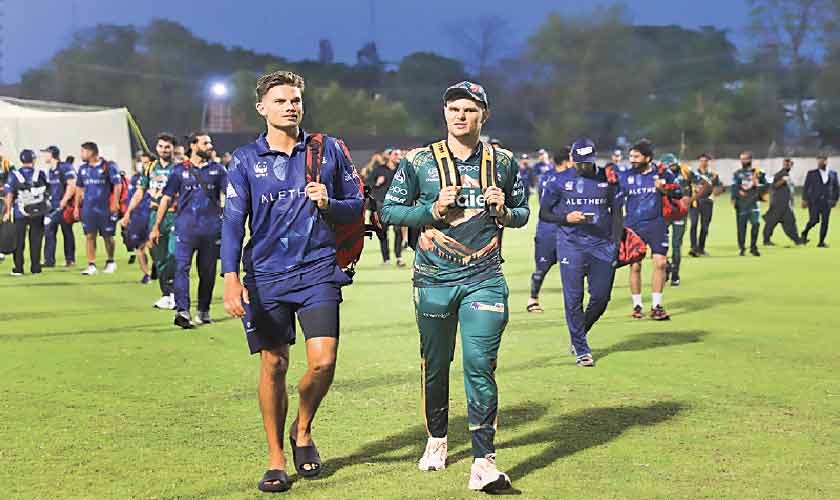
And yet, if PSL history has taught us anything, it is that Pakistani fans find a way. Whether in packed stadiums or through television screens, their connection to the game remains unshaken.
What, then, defines PSL 11 at this stage? It is a tournament of contrasts. Of high scores and low discipline. Of emerging heroes and established stars. Of packed highlights and problematic headlines. But above all, it is a proof of cricket’s enduring appeal.
Because even amid controversies, the league continues. Matches are played, heroes emerge, and narratives evolve. Karachi Kings’ rise, Multan Sultans’ resilience, Lahore’s bowling pride, and the unpredictability of teams like Zalmi and Hyderabad, all contribute to a season that refuses to be defined by a single storyline. Perhaps that is the true beauty of PSL 11.
It is imperfect, unpredictable, and at times, overwhelming. But it is alive, pulsating with energy, driven by passion, and anchored in a nation’s love for the game. And as the tournament moves forward, one thing is certain: the story of PSL 11 is far from over.