Print Story
X




Fast bowler fined largest financial penalty in Pakistan cricket history for a tweet
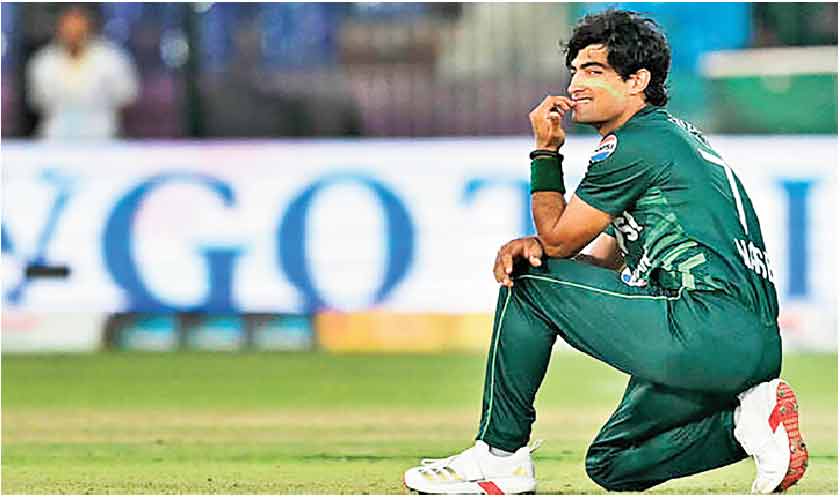
The Pakistan Cricket Board (PCB) has imposed a hefty fine of PKR 20,000,000 on fast bowler Naseem Shah, sparking widespread debate among fans and analysts. While disciplinary action is not uncommon in cricket, the magnitude of such a penalty raises an important question: is this punishment justified, or is it excessively harsh?
To evaluate this, one must first consider the nature of the alleged offense. In cricket, fines are generally imposed for breaches of discipline, including violating team protocols, engaging in
Mis-conduct, dissent against umpires, or bringing the game into disrepute. If Naseem Shah’s actions involved serious violations-such as breaching contractual obligations, participating in unauthorised leagues, or repeated disciplinary issues-the PCB may argue that a strict penalty
is necessary to maintain order and professionalism within the team.
The Pakistan Cricket Board (PCB) has imposed a fine of Rs20 million on Pakistan fast bowler Naseem Shah for violating multiple clauses of his central contract and the board’s social media guidelines.
According to reports, the disciplinary action was taken after the 23-year-old pacer posted a message on the social media platform X questioning the presence of a political figure at the opening match of the Pakistan Super League (PSL-XI). The tournament is currently being played behind closed doors as the country faces an ongoing fuel crisis.
The PCB issued a show-cause notice to Naseem Shah and later referred the matter to a three- member disciplinary committee in Lahore. After reviewing the case, the committee found the player guilty of breaching the terms of his central contract.
The board, which is chaired by Interior Minister Mohsin Naqvi, subsequently imposed a financial penalty reportedly worth Rs20 million (around $71,488). Local media described the sanction as the largest financial penalty in Pakistan cricket history and roughly equivalent to
eight months of the player’s central contract salary.
During the hearing, Naseem Shah appeared before the disciplinary committee and offered what the PCB described as an “unconditional apology” for his actions. The cricketer also deleted the controversial post from his account following the board’s notice.
The incident highlights the PCB’s strict stance on players’ conduct on social media and adherence to contractual obligations. In recent years, the board has taken disciplinary measures against players for statements or actions considered to be in violation of its code of conduct.
In a similar case last year, Pakistan all-rounder Aamer Jamal was fined $4,000 for displaying a slogan in support of former a former prime minister during an international match.
Jamal turned up for a Pakistan training day during the home Test series against England in December last year with “804’ written on the underside of his floppy hat. Aamir Jamal was in training kit and not during a match day expressing a political message, it was not an ICC violation. But the PCB’s code of conduct mirrors that of the ICC.
Jamal had been fined under clause 2.23 of that code which states: The clause notes that players cannot comment on any sensitive, communal, racial, sectarian, political matter.
Earlier, in February 2020, former Pakistan middle-order batsman Umar Akmal was suspended by the Pakistan Cricket Board (PCB) for breaching its anti-corruption code after failing to report corrupt approaches.
In April the same year, the PCB banned Akmal from all forms of cricket for
three years after he pleaded guilty to the charge. Akmal later appealed against the ban, and in July 2020 the punishment was reduced to one- and-a-half years, with the suspension running from February 2020 to August 2021. The PCB subsequently challenged the reduction at the Court of Arbitration for Sport (CAS), while Akmal
also appealed seeking to overturn the ban.
In February 2021, the CAS reduced the suspension further to 12 months and imposed a fine of PKR 4.25 million (approximately $27,000) on the cricketer.
The PCB has reiterated that centrally contracted players are expected to maintain professional conduct both on and off the field, including on digital platforms.
However, PKR 20 million (approximately USD 70,000) on Nasim Shah is an unusually large fine in the context of cricket. Even at the international level, fines are typically calculated as a percentage of a player’s match fee rather than fixed multimillion-rupee penalties.
The International Cricket Council (ICC), has a structured Code of Conduct that categorises offenses into four levels. Penalties range from warnings and demerit points to fines of 50% to 100% of a match fee, and in extreme cases, suspension from matches.
For instance, Level 1 offenses-such as excessive appealing or minor dissent-usually attract fines of up to 50% of the match fee. Level 2 offenses, including serious dissent or inappropriate
physical contact, can lead to fines of up to 100% of the match fee along with suspension points.
More severe Level 3 and Level 4 offenses-such as threatening an umpire or physical
assault-can result in bans ranging from several matches to months, alongside financial penalties.
There are several notable examples in international cricket. In 2018, Australian captain Steve Smith and vice-captain David Warner were banned for one year by Cricket Australia for their roles in the ball-tampering scandal, in addition to losing match fees and sponsorships. Similarly,
India’s Virat Kohli has been fined multiple times-usually 25% to 50% of his match fee-for excessive aggression or dissent. In 2023, England’s Ollie Robinson was fined for using inappropriate language, but the penalty was limited to a portion of his match earnings.
Even in franchise leagues like the Indian Premier League (IPL), fines for code-of-conduct breaches rarely reach such high amounts. Players are typically fined 10% to 100% of their match fees and even then, suspensions are more common than massive financial penalties.
Given this global context, the PCB’s alleged fine appears disproportionate unless the offense involves significant financial or reputational damage to the board.
Critics argue that such a large fine could set a troubling precedent, potentially discourage players or creating tensions
between athletes and management.
On the other hand, supporters may contend that strict enforcement is essential to uphold discipline, particularly in a high-pressure environment where players are role models for millions.
Ultimately, the justification of this fine depends on transparency. If the PCB clearly outlines the reasons and demonstrates consistency with its code of conduct, the decision may gain acceptance.
Cricket, like any professional sport, thrives on discipline-but it also demands fairness. Striking the right balance between the two remains the real challenge for governing bodies worldwide.