Print Story
X




PMAA-UHS launch transformative self-defence drive for adolescent girls
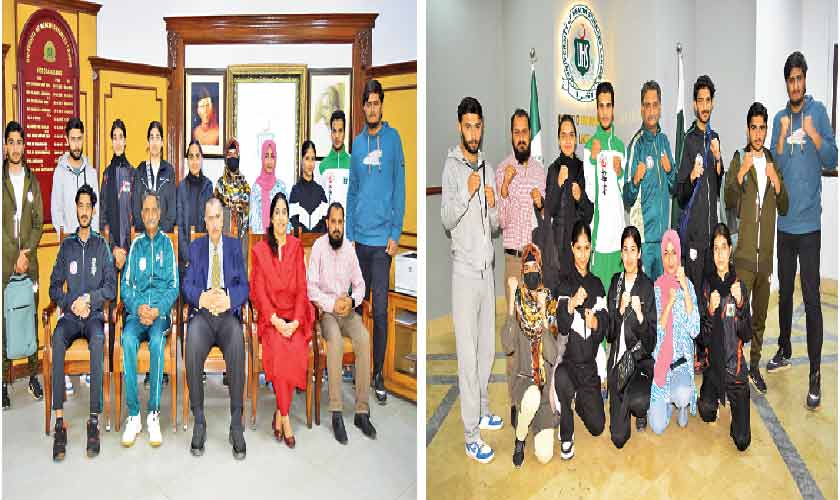
In a country where conversations around women’s safety often oscillate between policy promises and public outrage, a quieter, more profound revolution is taking shape, one that does not wait for change but trains for it. The collaboration between Pakistan Martial Arts Association (PMAA) and University of Health Sciences (UHS) Lahore is not just another institutional programme; it is, in essence, a redefinition of empowerment through the language of sport, specifically, martial arts.
The Adolescent Self-Defence Workshops Program is being rolled out across Lahore, Sheikhupura, and Kasur, and already, more than 2,500 schoolgirls from 30 institutions have stepped onto mats not merely as students, but as individuals reclaiming agency over their own safety. In a society where fear often dictates movement, this initiative introduces a counter-narrative: preparedness over paralysis. But to reduce this effort to a “training programme” would be to miss its deeper significance.
Martial arts, historically viewed as competitive sport or physical discipline, is being recontextualised here as a social equalizer. The workshops are not about choreographed kicks or stylized sparring, they are about instinct, awareness, and decision-making under pressure. They are about teaching a young girl that her body is not a vulnerability, but a resource.
Under the supervision of Chief Trainer Anwar Mohiuddin and a diverse team of instructors, the sessions blend technical drills with situational simulations. This dual approach is critical. It ensures that self-defence is not memorised, it is internalized. In these sessions, confidence is not motivational rhetoric; it is muscle memory.
What makes this initiative particularly compelling is its positioning within the broader framework of sports development. Pakistan has long struggled to fully integrate women into competitive and recreational sports ecosystems. Yet here, martial arts emerges as an accessible and transformative entry point. It does not demand expensive infrastructure or elite pathways, it demands commitment, discipline, and intent.
UHS Vice Chancellor Professor Dr. Ahsan Waheed Rathore’s emphasis on aligning the initiative with a larger provincial vision underscores an important truth: meaningful change requires institutional will. However, the real success of this programme lies beyond official endorsements. It is visible in the subtle but powerful shift in posture, a girl standing straighter, speaking firmer, reacting faster.
Equally significant is the perspective shared by Professor Dr. Sidrah Saleem, who frames self-defence as an essential component of adolescent development. This is where the conversation evolves from safety to identity. Martial arts training, particularly at a formative age, cultivates resilience that transcends physical encounters. It shapes leadership, sharpens focus, and embeds discipline, qualities that extend far beyond the training floor.
The overwhelming response from students, parents, and school administrations further reinforces the urgency and relevance of such programs. In many ways, this enthusiasm reflects a societal readiness, perhaps even a hunger, for solutions that are practical, immediate, and empowering.
Chief Trainer Anwar Mohiuddin’s assertion that “martial arts is a life-saving necessity” may sound dramatic at first glance, but within Pakistan’s socio-cultural context, it rings with uncomfortable truth. Safety, for many young girls, is not guaranteed, it is negotiated daily. And in that negotiation, skill can often mean the difference between vulnerability and control.
Yet, the long-term impact of this initiative will depend on its sustainability and expansion. Scaling such programs across Punjab, and eventually nationwide, requires more than goodwill. It demands structured integration into school curricula, continuous instructor development, and perhaps most importantly, a cultural shift that normalizes girls in combat sports spaces.
This is where the sports community, policymakers, and educational institutions must converge. Martial arts should not remain an intervention; it should evolve into an expectation. Because at its core, this is not just about self-defence.
It is about rewriting the narrative of what it means to be a young girl in Pakistan. It is about replacing fear with readiness, hesitation with instinct, and limitation with strength. And perhaps most importantly, it is about ensuring that empowerment is not just taught, but practiced, perfected, and owned.