Print Story
X




Across centuries, artists have continued to return to the night as a space of imagination
| N |
ight is one of the few certainties of human existence, alongside death. The two are often equated in common discourse, literature, myth and the visual arts. Just as a person is aware of their mortality, they are also conscious of the approach of night, a brief period in which they experience a temporary demise in the form of sleep.
It is possible that the concept of reincarnation emerged from observing how a living being loses the power of speech, the ability to move, the capacity to see and perform other physical functions, yet appears ‘alive’ again each morning. The body in sleep and the body in death resemble one another. For our archaic ancestors, it was easy to conflate the two ‘deaths.’
Due to this association, night is often seen as fearful, shaped also by a prehistoric memory of darkness concealing an approaching enemy, a ferocious beast or a poisonous reptile. At the same time, night offers a quiet refuge for writers, intellectuals and other creative people, who produce their work in its stillness.
Many novels, short stories and poems have been written while most of humanity was asleep. This brings to mind Amos Oz, who, living in a small apartment on an Israeli kibbutz, worked in the fields by day and wrote at night – sitting alone on a toilet seat while his wife and daughters slept in the only room.
There is, indeed, a long history of night literature, spanning cultures and centuries. Since ancient times, stories have been told in the darkness to ward off demons and unknown threats. This enduring pattern continues even today. Grandmothers still discourage storytelling during the day, lest travellers lose their way.
Night, however, while preferred for producing fiction and lyrics, poses a problem for painters. An artist works with colour and creates images meant to be seen in daylight. The craft of painting depends on optical perception.
Whether in a studio or outdoors, daylight allows the artist to study the saturation of colours, distinguish between hues, notice subtle shifts in shade and appreciate the vividness of pigments. Night diminishes these nuances. One may still paint under a streetlight, with powerful bulbs, candles or oil lamps, but when the work is examined the next day, it often brings disappointment, even a sense of defeat; unless one possesses an unusually strong imagination. There have, after all, been examples of paintings made at or about night. Before electricity, painters worked in darkness, relying on conventional sources of light, with all their limitations of intensity, direction and steadiness.
Even before the invention of electricity in 1878, works were created in dim light or in places without sunlight altogether, such as the caves of Lascaux and Altamira and the Ajanta caves.
What is lost at night is often compensated for by the illumination of imagination. A large body of work painted at night, or about night, reflects a parallel reality, a blend of observation and fantasy. Such works rarely attempt to capture shifting light or changing shadows.
In the paintings of Rembrandt, light does not appear to come from an external source; instead, it seems to emanate from within the canvas, as seen in The Night Watch and The Man with the Golden Helmet. Standing before the Dutch master’s work, one discovers details that emerge gradually through layers of dark brushstrokes.
Thus, regardless of when these works were made or what they depict, they are often perceived as contemporary, much like the night itself.
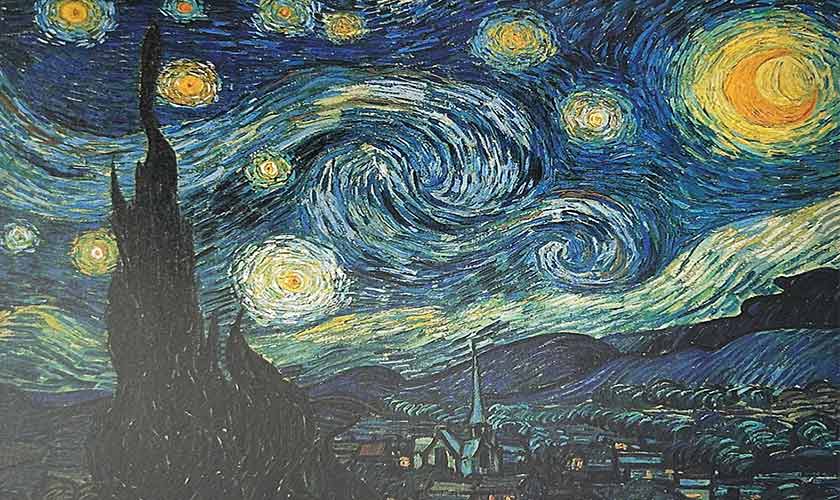
Vincent van Gogh was another Dutch artist bewitched by the night. Compared with his fellow impressionists and post-impressionists, who sought to capture light on canvas, Van Gogh, in a number of works, turned instead to the night, as in The Night Café and The Starry Night. These are not simply depictions of a phase in the 24-hour cycle, but emotional renderings of both the external world and the inner self.
Night is never an absolute loss. For each individual, and for every painter, it becomes a different kind of terrain: for some, a time to rest; for others, a time to wrestle.
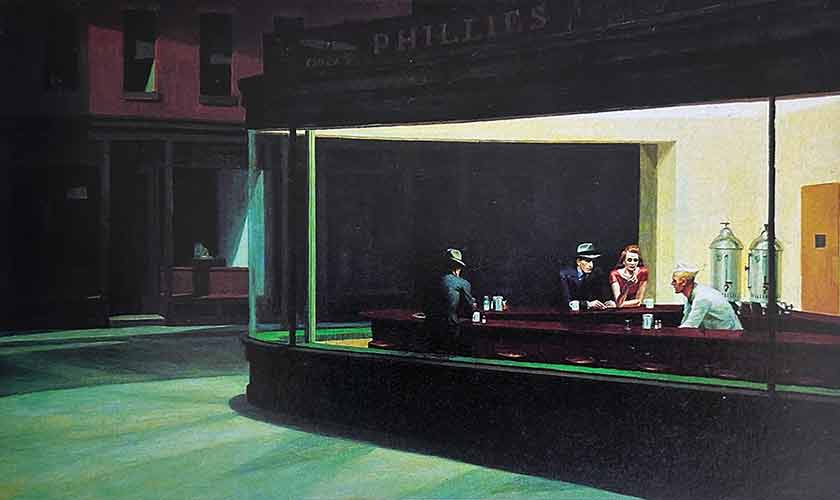
A similar approach, in which night ceases to be a matter of clock time, appears in the work of Edward Hopper. His paintings present haunting glimpses of American urban life: a solitary woman seated at a table in an empty eatery in Automat, or a few figures gathered in a bar in a deserted neighbourhood in Nighthawks.
Other American artists have also explored night in its social, psychological, cultural and sexual dimensions, most notably Eric Fischl in Sleepwalker.
Like Eric Fischl’s canvas, much imagery of the night engages with carnal themes, as night is often associated with procreation and sensual pleasure. It is also a distinct time for certain groups: night watchmen, call-centre employees and workers on overnight shifts in multinational companies. It offers opportunity to thieves and robbers, becomes a disquieting hour for the disturbed and provides the setting in which sex workers conduct their trade, since, in many brothels, the day effectively begins at dusk.
The French painter Henri de Toulouse-Lautrec depicted many women from Parisian bordellos, rendering them in reflected light that also revealed their uneasy state.
Iqbal Hussain pursued a similar imagery and subject. Belonging to a family from Lahore’s red-light district, he had close access to women engaged in what is sometimes called the oldest profession. He portrayed their miseries, aspirations and confrontations – exchanging money with clients, negotiating with pimps, bargaining with constables – much of it unfolding in the cover of night.
Hussain also painted nightscapes of his surroundings. In these views of alleys, shops and balconies lit after dark, one recognises that this is not an ordinary part of Lahore, where residents retire after dinner, but an area that awakens in another time zone.
For a visual artist, night is not simply the movement of hands on a clock or the passing of time; it marks a shift from one way of living, believing and experiencing to another. It brings with it a sense of mystery that fades with the first light of dawn.
In practice, however, night is often painted during the day. Artworks are usually viewed in exhibitions that open in the early afternoon and continue until around 5 or 6pm.
Some artists have, nonetheless, engaged with night more directly. Rashid Rana, for instance, in Dis-Location I, assembled snapshots of a building in Lahore taken every second over 24 hours to create a single, large image. Viewed up close, one sees fragments; from a distance, the complete picture emerges, including moments from the late hours. It suggests that night does not, in fact, blind one.
Contrary to common assumption, and in line with collective experience, night does not cast a black sheet before our eyes; it is not a state of complete darkness. As Jorge Luis Borges observed while reflecting on his failing sight, blindness is not total darkness but a hazy middle ground. In that sense, night is never an absolute loss. For each individual, and for every painter, it becomes a different kind of terrain, for some, a time to rest; for others, a time to wrestle.
Thus, night, like the condition Borges describes, is not an unbroken black expanse. It has its gradations, its points of brightness, its luminous stretches and distinct moments. As Joseph Brodsky wrote of St Petersburg’s white nights: “It is the most magic time in the city, when you can write or read without a lamp at two o’clock in the morning… It’s so quiet around that you can almost hear the clink of a spoon falling in Finland.”
The writer is a visual artist, an art critic, a curator and a professor at the School of Visual Arts and Design, Beaconhouse National University, Lahore. He can be contacted at [email protected]