Print Story
X




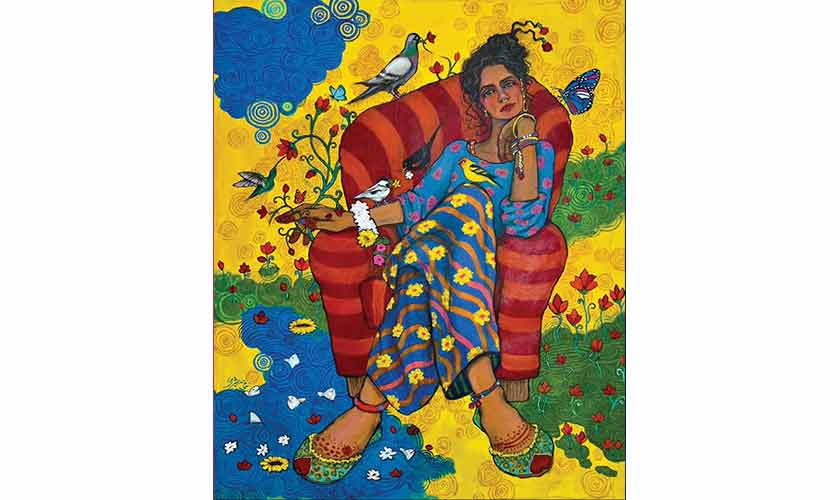
In Hum Gunahgar Aurtain, the artist has created a place where male presence is not needed
| I |
n one of his books, Giorgio Agamben, the Italian philosopher, mentions that there is an Eleventh-Century silver reliquary in a Leon church “on whose side scenes from the book of Genesis are sculpted in relief. One of the panels shows Adam and Eve shortly before their expulsion from Eden. According to the biblical narrative, they have just realised that they are naked.” The next scene represents the verse from Genesis 3:21 “(And God made for Adam and his wife tunics of skin, and clothed them). The unknown artist illustrates Adam already dressed… [but] depicts Eve with her legs still naked, while the Lord appears to be putting the tunic on her by force. The woman... resists this divine violence with all her might.”
This example reiterates how women, from then till now, have been repelling attempts to control their bodies: what to wear, how to sit, where to go, when to work, who to speak with. Many patriarchal societies declare codes of morality for women, their dressing, behaviour, expression and social interaction. The aim is usually to suppress them by conditioning them as unequal and weak.
In 1977, there began a period in Pakistan when Islamic law and tradition were interpreted from an authoritarian male perspective. A woman’s evidence in a court was to count for half in comparison to a man’s. The female presenters on TV were asked to cover their heads; flight attendants and government employees complied with similar policies; other women were also encouraged to follow a similar custom in public. Women were encouraged to remain within a house, to look after men of the house and to raise children.
The dictatorship lasted for eleven years. Those who witnessed that period still recall the atmosphere. In some ways, its influence has lingered to this day. Women defied the attempts to control them in diverse ways: participating in public processions, filing court cases and challenging individual and group prejudices towards females.
Several women artists of that period courageously debunked what was expected, accepted and required from them. Their practices were a form of rebellion. They weaved narratives around their freedom, depicted female bodies and occasionally nude figures. Images of females, whether posing naked, in sleeveless shirts and trousers or under burqas, were a rebuttal of the ‘religiously oriented’ male-dominated dictatorship. The resilience of women artists was not limited to their canvases. In 1983, 15 female artists signed the Women Artists’ Manifesto in Lahore, noting in the first line: “the decline in the status and conditions of Pakistani women.”
Hamama Tul Bushra grew up in that atmosphere. From 1984 to 1988 she studied graphic design at the National College of Arts, Lahore. The institution was on the hit list of the fundamentalists, who once stormed it, as, according to them, it was a den of immoral practices. Art was generally believed to be an irreligious activity. Drawing the human body, particularly females, was reason enough for immediate punishment.
In a solo exhibition that ran from March 26 to April 6, at O’ Art Space Lahore, Hamama Tul Bushra seemed to respond through her paintings packed with certain clues. The exhibition’s title, Hum Gunahgar Aurtain, comes from a popular poem by Kishwar Naheed, penned during the military dictatorship. The verses, from 1983, are a proclamation of women’s defiance.
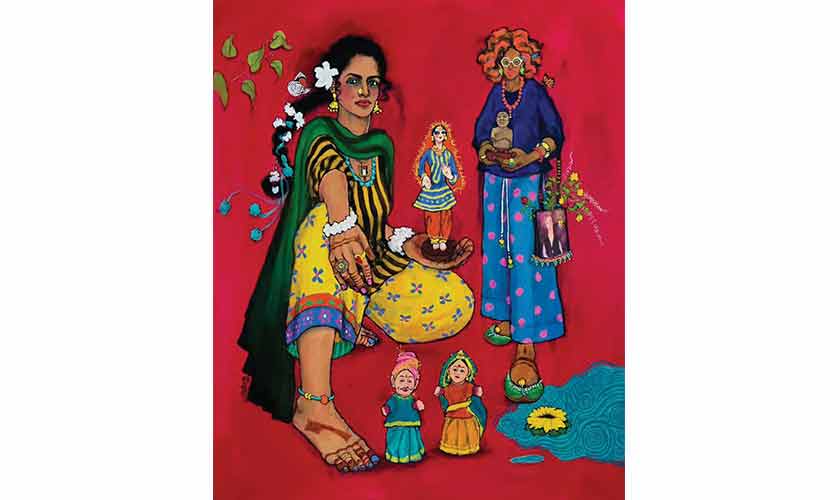
The world imagined by Bushra is populated by women who possess a rare sense of freedom. They spend their time in ways that please them.
Bushra, in all of her paintings from the show, represented a league of women who had constructed their individual, adorable and personal environments. These spaces varied, but in each, the main protagonist, by and large, remained the same, though clad in different costumes and engaged in diverse activities. Sharing symbols of holy entities next to Arundhati Roy’s autobiography Mother Mary Comes to Me; drinking a cup of tea, smoking a cigarette, having a glass of wine, resting on a couch, sitting around plates full of delicious desi dishes, these characters rendered in strong hues (acrylic on canvas) are situated in a range of backdrops, for example encircled by birds, flowers, food, cosy interiors.
Bushra had created a perfect place, where male presence was not needed. Happy, relaxed and joyous, the women in attractive attire portrayed an ideal territory in which men and women could be comfortable companions; not clinging to one another, as is the case in some conventional households where women depend on men for their financial and social survival and are often objects of bullying, criticism, and mental and physical cruelty.
The world imagined by Bushra, a mother of two daughters, was populated by women who possessed a rare sense of freedom, spending their time in ways that pleased them. Such an environment would be unthinkable in settings such as Afghanistan under the Taliban.
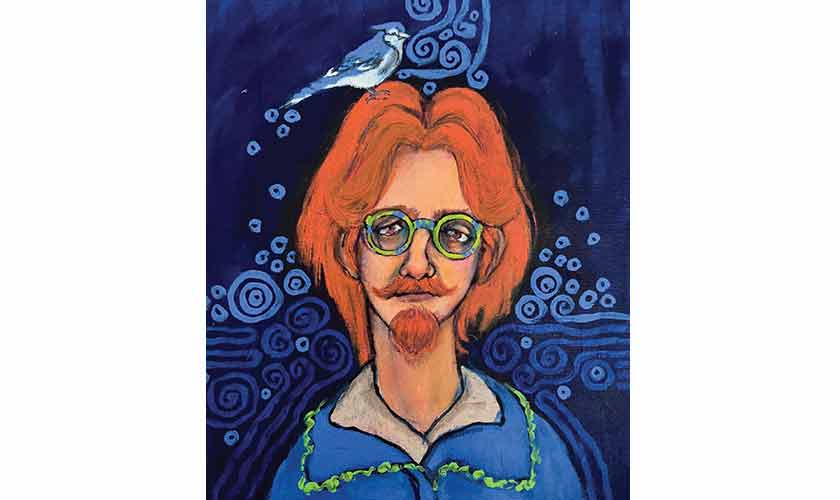
Bushra’s art is not hedonistic. It assembles elements that reveal a deeper meaning and wider context. Birds are a recurring motif in her work: pigeons parrots, ducks, crows and sparrows. Then there are butterflies. Besides beauty and innocence, these creatures - rooted in literature, folklore and popular sayings - signify freedom. They cannot be caged. They move, fly or float; symbolising the possibility of discarding or disregarding ties that might bind them to a clan, customs, conventions, cultures or locations.
In some of Bushra’s work, echoing the aesthetics of Henri Matisse, space is built through patches of pure colour, arranged so that the viewer senses depth even in the absence of a conventional two-point perspective. Drawing on a keen painterly instinct, despite her training in graphic design rather than fine arts, she introduces small but telling details: the titles on books, the textures of food, the surfaces of pottery, motifs on drapery, patterns on butterfly wings, the intricacy of ornaments and the delicate rendering of flower petals.
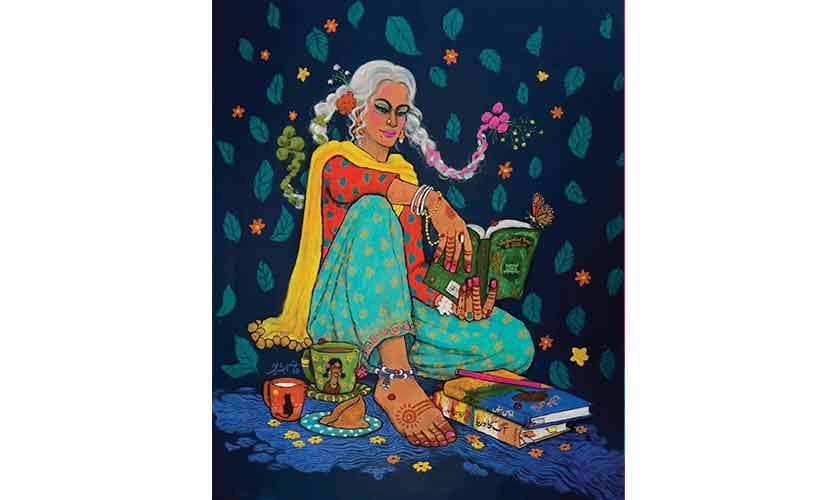
The reality fabricated by Bushra consists of bliss, repose and self-containment without the intrusion or interference of others. In that sense, the seemingly jolly surfaces are endowed with a feminist subtext. These announce how a woman can survive on her own. She can reclaim her space and it is not then invaded by outsiders. Only those she permits enter it; for instance, pets.
The woman in her paintings, whether dressed in South Asian style or European fashion; with long hair or close-cropped; busy in some chore or at ease; appears to be the same person in varying compositions, circumstances and situations. She reflects a familiar reality: a woman is expected to perform certain roles, i.e., mother, wife, sister, daughter. Hamama Tul Bushra’s paintings indicate hope, possibility and a path to liberation - a paradise on earth for Eve’s daughters.
The writer is a visual artist, an art critic, a curator and a professor at the School of Visual Arts and Design, Beaconhouse National University, Lahore. He can be contacted at [email protected].