Print Story
X




Babar’s suitability for the T20I format has increasingly come under scrutiny, as he hits only 80 sixes in 136 innings.
In modern T20 Internationals (T20Is), the batting role is defined by tempo control, boundary efficiency, and situational awareness rather than mere accumulation. The format compresses decision-making and shot execution into 120 balls, so output per ball (strike rate) becomes the primary performance currency.
Modern teams increasingly prefer batters who can combine volume scoring over strike rate of 140+. The modern game has reduced tolerance for anchors striking below 130 unless they compensate with match-winning consistency.
T20I evaluation today is driven heavily by strike rate and phase dominance, not classical consistency. Recent T20I batters must clear ropes consistently from power play to death overs.
Pakistan veteran batsman, Babar Azam is one of the most technically complete batters in world cricket. He is one of the technically best batsmen in the Test and One-day Internationals.
Babar’s pattern is to starts cautiously, builds innings through timing and placement and accelerates later. That approach works in ODIs, but in T20Is, the power-play is often the best scoring window.
Compare to world’s explosive betters like, Abhishek Sharma, Travis Head, Dewald Brevis, David Miller and Shimron Hetmyer, Babar relies more on cover drives, flicks between the gaps that makes him elegant but not explosive. Elite T20 batters often maintain strike rates above 140-150, reflecting the aggressive tempo while with only 80 sixes in 136 innings, Babar’s reliance on singles and doubles slows down Pakistan’s scoring momentum.
Babar has seen a dip in his batting form across all formats and has failed to score an international fifty in his last 10 innings.
Babar Azam has been a consistent performer across formats. However, his suitability for the T20I format has increasingly come under scrutiny.
Babar’s struggles in the ongoing ICC Men’s T20 World Cup have once again sparked debate about his effectiveness in the shortest format, with former cricketers pointing to concerns over his strike rate, tempo and ability to adapt.
After first game against New Zealand washout, Pakistan lost to two-time champions England in the high-stakes Super Eights match of the ongoing ICC Men’s T20 World Cup at the Pallekele International Cricket Stadium.
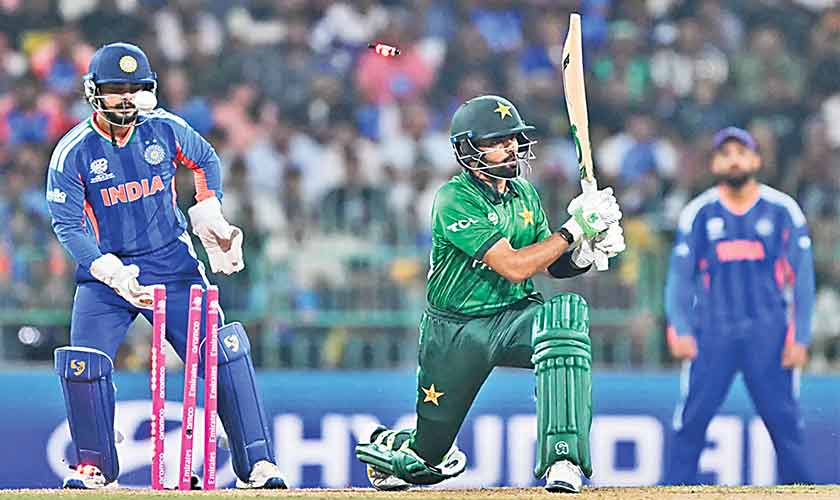
After losing two early wickets, Sahibzada Farhan attempted to accelerate the scoring rate at the other end, but Babar Azam managed just 25 off 24 deliveries - a strike rate of 104 - before being bowled by Jamie Overton.
Babar form wanes in 2025, questions loom over his place in the team and whether Pakistan’s selectors can afford to drop their biggest star.
The statistics paint a worrying picture of Babar’s recent struggles. In the early stages of the Pakistan Super League (PSL) 2025, he registered a series of uncharacteristically low scores, including scores of 0, 1, and 2 in consecutive T20 matches.
This dip in form continued into international cricket. During the ODI tri-series in February 2025, he managed just 62 runs in three matches at a sub-par average of 20.67.
Similarly, his tour of the West Indies in August 2025 saw him post scores of 47, 0, and 9 in the three-match ODI series. While these figures are a temporary blip on an otherwise stellar career, they indicate a player struggling for confidence and rhythm.
Babar was dropped from the Asia Cup 2025, as head coach Mike Hesson described
the exclusion of Babar as “Tough decision” acknowledging the right-hander’s stature but underlining the need for improvement.
Babar has been informed of the selectors’ decision. “The team requires him to enhance his strike rate and strengthen his game against spin,” Hesson said.
The decision comes in the aftermath of Pakistan’s early elimination from the 2024 T20 World Cup, which followed their humbling defeat in the 2022 final.
However, the veteran batter was surprisingly selected for the ICC Men’s T20 World Cup 2026 despite showing no noticeable improvement in his recent performances.
Babar Azam’s returns in the first six matches of the ongoing ICC tournament are significantly below the performance benchmarks expected of a modern T20 player. He managed only 91 runs, averaging 22.75 and a low strike rate of 112.23.
Pakistan’s former skipper Rashid Latif in a TV programme said bluntly Babar is “no longer a player of this format”, questioning why he was brought back after being dropped over strike-rate concerns six months ago.
Latif recalled that team management had earlier stated Babar would return once his scoring rate improved. “Where did it improve? Why did you bring him back” he asked, calling the decision an injustice by the board and coaching staff.
He also criticised Pakistan’s batting tempo, saying modern T20 cricket demands players who can shift gears and control the chase. According to him, when a batter consumes 20-25 balls without accelerating, pressure builds on the other end and forces incoming players into risky shots. He added that set batters must take responsibility and bat deep when partners struggle to score.
Since 2020, Pakistan’s top three batters have faced nearly three-quarters of the team’s deliveries-the highest proportion among full-member nations.
However, with Pakistan team’s performances coming under increasing scrutiny, particularly following disappointing showings in global tournaments, relying on past glories is a luxury the selectors may not have.
The team management is caught in a dilemma-while they recognise the need for a strategic change, they are hesitant to replace a crucial player without a dependable alternative. This situation underscores the depth issues within Pakistan’s cricket pipeline and highlights the difficulty in finding someone who can match Babar’s skill, temperament, and leadership qualities.
Currently, there is no viable replacement for Babar Azam in Pakistan’s middle-order especially in the longer version of the game. The depth of talent required to fill his shoes is lacking, as no emerging or established cricketer has demonstrated the same level of consistency and composure.
The debate surrounding Babar Azam’s form and future is a microcosm of Pakistan cricket’s enduring selection challenges.
Dropping him carries the risk of losing a world-class anchor, while keeping him in poor form could jeopardise the team’s balance and results.
Babar has struggled to maintain his form, even in Test cricket. His performance in the home Test series against Bangladesh was particularly disappointing, wherein he managed only 64 runs (0, 22, 11, and 31) across four innings. He has not scored a half-century in his last 16 Test innings.
Before the last game of Super Eight against host Sri Lanka, Babar played 145 T20Is, scored 4,596 with a good average of 38.94 including three centuries and 39 fifties. But the issue is his strike rate of 128.18 is modest compared to modern T20I standards.
Despite opening in 87 innings, his cautious approach often leaves Pakistan struggling to capitalise on the power-play overs, where maximising runs is crucial.
World’s leading explosive batsmen are known for their power-hitting in both the power- play and death overs, crucial moments in T20 cricket. Babar’s ability to accelerate in these phases has often been questioned, making him less effective in situations that require big shots at the end.
The absence of a clear successor puts additional pressure on the squad and coaching staff, especially during important series. It also emphasises the importance of nurturing young talent and ensuring a smooth transition when experienced players face a dip in form. For now, Pakistan continues to hope that Babar Azam regains his top form, but the search for his effective replacement remains a pressing concern.
Babar Azam’s elegance and consistency are undeniable, but T20 cricket demands power-hitting and rapid acceleration. His statistics reveal a player better suited to ODIs and Tests, where his technique and temperament shine. Unless he adapts his strike rate and boundary- hitting, the argument that Babar Azam is not fit for the T20I format remains statistically valid.