Print Story
X




Destiny demands that Kabul and Islamabad overcome distrust, forgo short-term tactical gains and forge a shared strategic vision
| T |
he suicide bombing in Qasr-i-Khadijat-ul Kubra mosque in Islamabad is a heinous crime of unmitigated proportions and the string of earlier terrorist attacks across Balochistan an abomination. As Pakistani authorities have rightly noted, the growing numbers and brazen nature of such attacks cannot be considered in isolation from what has transpired in Afghanistan in recent years. The successful Taliban takeover of the country has inspired and emboldened terrorism in Pakistan.
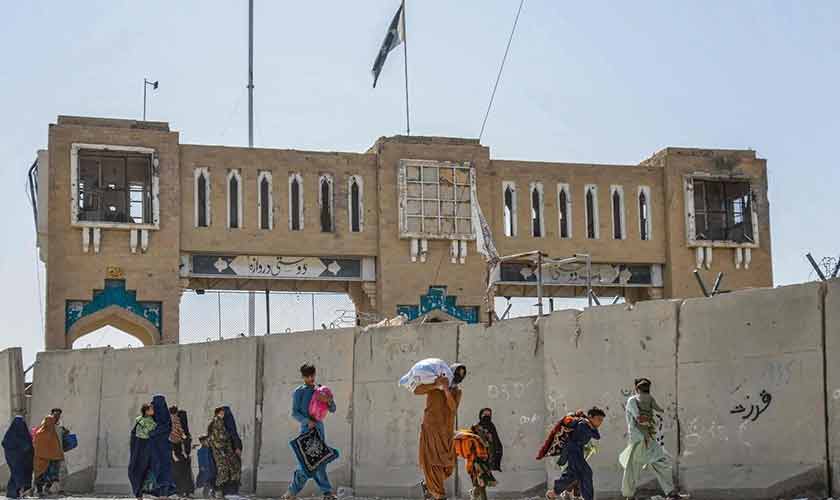
Formal Afghanistan-Pakistan relations seem to have hit one of the lowest points. The border has remained closed for months, which is an extraordinary development in view of enormous trade and innumerable other neighbourly ties between the two nations. Pakistan has accused the Taliban regime of sheltering terrorist groups; the Taliban’s media campaign has sought to promote the self-contradictory notion that Pakistan is supporting the Daesh (Islamic State of Iraq and Syria). The hostility has manifested itself in numerous cross-border skirmishes. For the first time in its history, there were Pakistani airstrikes last year in Kabul.
This situation is the natural outcome of a lack of strategic foresight. For decades, propaganda, demonisation and misguided policy have informed the approaches of successive governments in both countries. We need a fundamental shift in discourse to end these recurrent destructive tendencies. We must move toward a shared vision, breaking from the zero-sum games that successive governments have played for nearly eighty years.
A change for the better is possible. However, it requires a broadening of the perspectives and approaching bilateral issues with an open mind. This begins with a critical evaluation of the entrenched perceptions holding our nations hostage to irrational acrimony. Fortunately, there are signs– regardless of what regime is in power — of a growing realisation among many in both countries that we must reform our outlook to reset relations for a better future.
Afghanistan’s policy of irredentism from the inception of Pakistan was a historical error. Rather than welcoming a new state representing the aspirations of millions of Muslims in colonial British India, Afghanistan, driven by misguided ideas of racialised nation-building, attained the notorious distinction of being the only country to oppose Pakistan’s territorial integrity and UN membership. From that point, it encouraged and supported secessionist tendencies and movements in Pakistan.
Given the opportunity by Afghanistan’s internal ideological rivalries and factionalism, Pakistan responded in kind. It utilised support and subversion through groups that challenged Kabul’s central authority. This included crucial support for the Taliban.
Four years after the Taliban’s return to power, the initial triumphalism in sections of Pakistani establishment and media in the victory of their favourite group in Afghanistan has been replaced by disappointment and a bitter sense of betrayal as the ‘Islamic Emirate’ has inevitably reverted to Afghanistan’s traditional policy of seeking favour with rival India and supporting anti-state groups in Pakistan.
If the first Taliban regime (1996-2001) had increasingly become a liability for Pakistan, its second incarnation post-2021 has become a threat to its stability. By now, it must be abundantly clear that Pakistan cannot attain stability or realise its full potential without genuine friendship from Afghanistan. Likewise, Afghanistan cannot attain lasting stability or achieve its goals without genuine friendship from Pakistan.
Four years after the Taliban’s return to power, the initial triumphalism in sections of Pakistani power establishment and media over the victory of their favourite group in Afghanistan has been replaced by disappointment.
While words like “friendship” and “brotherhood” have never been in short supply in official statements, they have often been used to gloss over deep-seated distrust and acrimony. Both sides at the broadest expanse of political elites, when in power, have for too long remained obsessed with outmanoeuvring the other for perceived tactical gains, always to the detriment of the security, prosperity and dignity of our peoples.
The obsession with tactical gains has allowed the proverbial chickens to come home to roost. Roles have reversed: whereas Afghanistan once complained of terrorist sanctuaries in Pakistan, Pakistan now makes the same complaint against Afghanistan. Whereas Pakistan once used ethno-religious parties to project power in Afghanistan, Kabul now uses ties with those same parties to peddle influence and threaten Pakistan’s security. It is a classic case of the tail wagging the dog.
Pakistan currently faces serious security challenges of terrorist attacks, ethnic secessionism and international sabotage aimed at weakening and eventually disarming it of its strategic assets. Conversely, it does not bode well for Afghanistan, ruled by a regime lacking popular legitimacy, to collude with Pakistan’s arch enemy to undermine the one neighbour with which our people share the greatest commonalities of identity and interest.
By its very nature, a Kabul regime imbued with a misguided sense of religious obligation and racial supremacy will never be able to divest from the idea of supporting their likeminded ‘brethren’ across the border in Pakistan.
Despite these challenges, however, Pakistan’s strategic standing remains significant. Its impressive military performance against India, robust strategic partnership with China, nuanced diplomacy with the United States, growing friendly ties with Bangladesh and promising defence cooperation with Saudi Arabia and Türkiye underscore its enduring importance as a Muslim majority country in a fast-changing global environment.
These developments have greatly raised Pakistan’s global stature. Its regional adversary knows from bitter experience that a frontal military assault is counterproductive. Consequently, they have redoubled efforts to exploit the “weak link” along its western border by encouraging ethno-secessionism and weaponising grievances born out of decades of selfish and irrational hostility between sections of the ruling elites in both countries.
In this context, Pakistan’s overreaction, manifested in the expulsion of millions of Afghan refugees and an unhelpful media campaign that does not distinguish between the ruling regime and the people of Afghanistan at large, plays directly into the hands of the regional enemy and its unsavoury allies beyond the region. These actors have unleashed massive communication campaigns designed to increase ill-will among our peoples.
There is no denying the fact that a legacy of troubled relations has left a somewhat bitter taste on both sides, but we can no longer afford to continue along the failed path that has led us to our current predicament. The world has changed, but we remain stuck in the past. For too long have our vast potentials been stunted and our resources wasted in mutually assured destruction.
We must overcome distrust and grievance, forgo short-term tactical gains and forge a shared strategic vision and irreversible realignment that guarantees stability, strength, dignity and prosperity for both our nations in the evolving global environment. I know that broad swaths of our people in Afghanistan are ready — many have indeed expressed a desire — to rethink and reform our relations in positive strategic terms with Pakistan. But as the saying goes, it takes two to tango. We need likeminded partners from Pakistan to forge ahead with a common vision, strategic realignment and a better future for us all.
The writer was a member of Afghanistan’s parliament during the era of the Republic. Previously, he had served as military attaché to Russia and Tajikistan. Earlier, he was a close aide and chief of military operations for Ahmad Shah Massoud, the late mujahideen commander