Print Story
X




Sanitation workers are the backbone of urban hygiene. Yet they remain exposed to injury, humiliation and job insecurity
| S |
uthra Punjab is one of the flagship initiatives of the provincial government. However, the welfare and protection of the nearly 150,000 sanitation workers, the men and women who have a pivotal role in keeping the province neat and clean, has been overlooked.
The sanitation workers continue to face many challenges, including health hazards, job insecurity and mistreatment.
Launched by Chief Minister Maryam Nawaz, the Suthra Punjab initiative has been widely celebrated for improving urban cleanliness across the province.
City streets once overwhelmed by garbage now appear cleaner. The improvement has been recognised nationally and internationally.
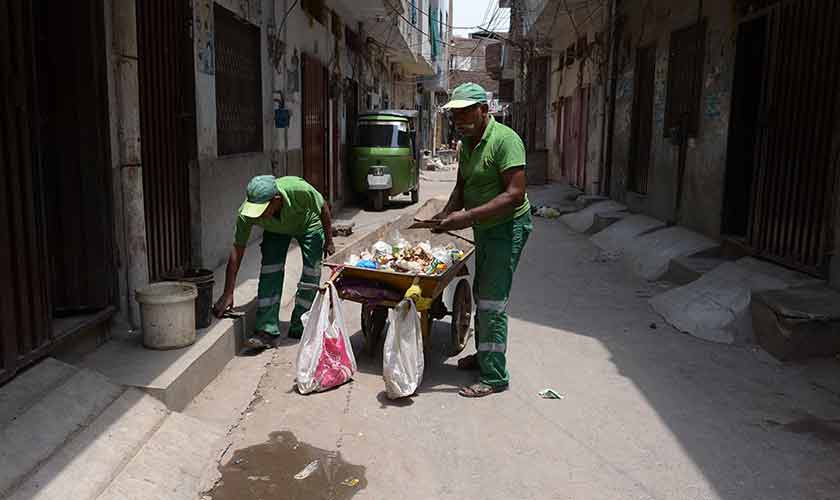
The sanitation workers behind this transformation work from dawn to dusk, often spending 12 hours a day or more on the streets sweeping and collecting garbage for a salary of Rs 32000-45,000 a month.
The workers complain that their salaries do not meet even their basic needs.
Lubna, a mother of three, begins her working day before sunrise.
“My duty starts at 6 in the morning. It ends at 4pm. I struggle to help my children prepare for school before I leave home for work,” she says. She says they often eat their breakfast on a roadside to eat and that their ‘house’ has no washroom.
Mukhtaran, another Lahore-based sanitation worker whose husband passed away four years ago, says she continues to work to support her children. “I don’t want my children to have to do this work. I have no choice,” she says. “We eat next to drains and garbage… I wish people throw their waste in proper garbage bags. That can make my job slightly easier and safer.”
Life is not much easier for their male colleagues.
Sharif leaves home at dawn to report for duty at 6 in the morning. “Some people throw broken glass in garbage bags. This causes us injuries. If we get sick and cannot work our supervisors mark us absent and make deductions from our salaries,” he says.
Irrespective of the weather - scorching heat, torrential rain or freezing temperatures – the waste picking goes on.
Allah Ditta says winters are particularly harsh. “We are given no masks, no gloves and no safety kits. We have to work even in severe cold, without any protection.”
He also highlights social discrimination and frequent humiliation.
“If we are thirsty and ask for a glass of water, people hesitate to give us even that. Some people think that it is wrong to share a utensil with a choora [a derogatory slur often used against sanitation workers in the region.]
The threat of job loss prevents many workers from raising a voice for their rights and better working conditions.
Medical experts say that public hygiene workers face significantly higher health risks than the general population. Prolonged exposure to waste increases the risk of catching respiratory infections, eye allergies and skin diseases.
Workers assigned to clean manholes also encounter threat to life. Toxic gases can accumulate in confined spaces and cause fatal suffocation to the unwary. If immediate treatment is not available, says Dr Fahad Qaiser, the threat to life gets aggravated.
Limited access to hygiene facilities during working hours compounds the health risks.
Mary James, the founder of Sweepers Are Our Superheroes, has been advocating for sanitation workers’ rights since 2019. She acknowledges symbolic gestures of recognition but stresses that most structural issues remain unresolved.
The draft Punjab policy acknowledges that sanitation workers are low paid and looked down upon. Yet it does not provide a concrete plan to improve their working and living conditions.
It is encouraging to see government leaders publicly recognise these workers and promise dignity, she says, but some of the fundamental issues are still being ignored. Many workers lack permanent employment. Also, the provision of safety kits is inconsistent.
According to a Human Rights Commission of Pakistan report from 2024, a vast majority of sanitation workers come from Christian or Hindu communities. It is estimated that more than 80 percent of the sanitation workers belong to the Christian community despite their share of no more than 5 percent of the total population. This points to historical and systemic discrimination.
Sanitation workers face significant health risks due to the nature of their job. They are regularly exposed to various occupational and environmental hazards, such as direct contact with faecal sludge and wastewater. Their tasks frequently involve using equipment for the emptying, conveyance and treatment of these materials; and they frequently work in confined and potentially dangerous spaces.
Despite technological advancements in waste and sanitation management, sanitation work in Pakistan often relies on manual methods. Workers, therefore, are in direct contact with solid waste and faecal sludge. To clear blocked gutters, they typically use bamboo poles. If these tools do not resolve the issues, workers have to enter the gutters to manually remove the sludge.
The HRCP reported three deaths of sanitation workers across the province while cleaning manholes that occurred due to the lack of proper safety equipment.
According to Amnesty International, sanitation workers across the Punjab continue to endure serious challenges:
In a survey, 44 percent reported experiencing humiliating or degrading treatment because of their profession.
55 percent suffer from health problems such as allergies, respiratory illnesses and chronic cough due to inadequate protective equipment.
Nearly 70 percent said they could not refuse hazardous work because they feared losing their jobs.
Many workers reported not receiving uniforms, gloves, masks or safety kits. Injuries caused by broken glass and sharp objects are frequent. Deep cuts, infected wounds and untreated illnesses have become routine occupational hazards
A draft policy proposed in 2015 has yet to be adopted by the government. The draft acknowledges that sanitation workers are low paid and looked down upon. Yet it does not provide a concrete plan to improve their working and living conditions. While the draft addresses certain welfare aspects for end-users, it entirely overlooks the gaps in the labour policy framework concerning sanitation workers.
A Lahore Waste Management Company manager, Nisar, told this scribe that nearly 40 percent of the workforce consisted of female workers. He said attendance is recorded at 6am. He said uniforms and safety equipment were checked regularly. He said the workers were entitled to a one-hour lunch break.
He said designated spaces, including washrooms for female workers were available at work sites. However several workers disputed this claim based on personal experience.
Lack of proper toilets is the most frequent complaint by women workers. Denial of leave, including maternity leave, is another. Many women said they had not received any appointment letters.
Sanitation workers are the backbone of urban hygiene, yet they remain exposed to injury, illness, humiliation and job insecurity.
Environmentalists say that for the long-term sustainability of the Suthra Punjab initiative, it is essential to provide the sanitation workers with more than symbolic recognition. They deserve protective equipment, accessible healthcare, permanent employment, respectful treatment and facilities such as safe eating areas and functional washrooms.
The writer is a journalist based in Lahore