Print Story
X




Tejaswini Apte-Rahm’s biography of her great- grandfather explores how private memory reshapes public history
| F |
Fiction is grounded in reality, even if writers tweak or embellish details for dramatic effect. TejaswiniApte-Rahm’s award-winning novel The Secret of More standtestament to this belief. Itis loosely based on the life of her great-grandfather, the respected entrepreneur VamanShridharApte – known to his family as Tatya. Published in 2022, the Frankfurt-based Indian author’s second book featured the compelling rags-to-riches story of Tatya, an entrepreneur who travels to Bombay at the turn of the 20th Century and triumphantly embarks on a series of business ventures.
The only difference between Apte-Rahm and other novelists who use life as a crutch for fiction is that the latter tend to disguise or prevaricate the root of their inspiration. Apte-Rahm is not afraid to acknowledge her inspiration and has recently penned a meticulous biography of her great-grandfather.
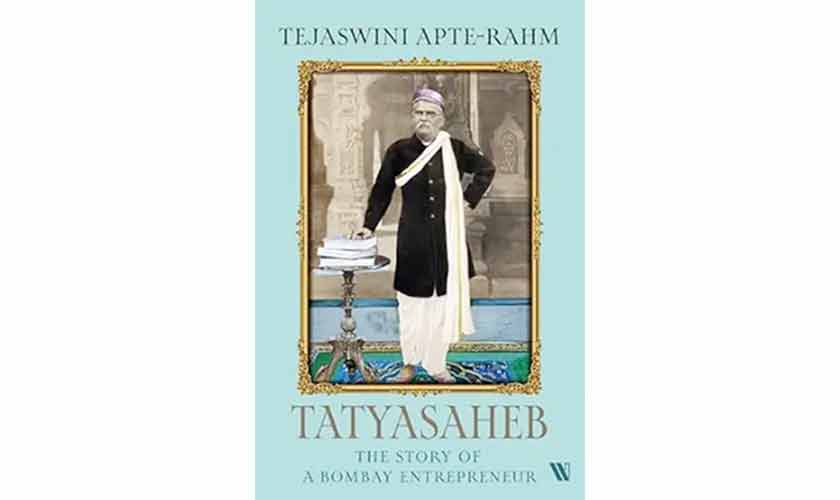
Tatyasaheb: The Story of a Bombay Entrepreneur is a product of many years of extensive research and reflects the author’s enduring interest in one of her most distinguished ancestors. Those familiar with Apte-Rahm’s earlier work would be tempted to view her third book as a ‘companion text’ to The Secret of More—a subtle exploration of how facts are reborn as fiction. However, readers approaching Tatyasaheb as a gateway into her oeuvre are advised to suspend cynicism. This is not a hagiographical family project, weighed down by personal details that would hold little or no interest for the general reader. The ‘real’ Tatya’s story intersects with major historical events in the Subcontinent. Apte-Rahm’s biography of her great-grandfather thus emerges as a vital personal history—a doorway into fresh insights that have yet to find their way into history textbooks.
The biography has been released by Westland Business, an imprint of Westland Books in India that focuses on non-fiction titles exploring the country’s corporate culture. Beyond its value as a historical text, Apte-Rahm’s biography traces the journey of an entrepreneur whose ingenuity and business acumen propelled him to success.
According to statistics released by the Indian Ministry of Commerce and Industry, 201,335 start-ups had been recognised as of December 2025. In this fertile business environment, many aspiring entrepreneurs are likely to find in Tatya’s story a blueprint for their own journey towards success. Some of them may even begin to regard him as a veritable role model for the modern businessman.
The biography unfolds in a linear fashion, somewhat unexpectedly opening in a hamlet on the Konkan coast where Tatya’s father, ShridharApte, worked as an agent in sea trade. Assailed by business setbacks, Shridhar moved his family to Bombay, which, by 1869, was “clearly the place to be to try one’s luck.” The city would later become the backdrop for Tatya’s numerous achievements as a multi-industry pioneer.
In crisp, immersive prose, Apte-Rahm reveals how Tatya deviated from the “scholarly career paths” adopted by his older siblings and secured a position as an unpaid trainee with a cloth business in Bombay’s MuljiJetha Market. Fate favoured him, catapulting him from modest beginnings in KhatryachiChawl in Girgaon to a position of prominence in the city’s business circles. His rise in social standing became possible through his work with the British-managed Kohinoor Mills.
Tatya’s story avoids nostalgic musings and emerges as a realistic, riveting account of entrepreneurial acumen and initiative.
Driven by ambition, diligence and his remarkable gifts as a polyglot, Tatya soon left an indelible mark on the textile business, which remained the foundation of his wealth. Apte-Rahm writes, “It was due to Tatya’s reputation and his knowledge of the business that he was able to acquire and successfully handle the selling agencies of multiple textile mills simultaneously.” Be that as it may, Tatya pursued a diverse menu of business ventures throughout his life.He also explored some unconventional spheres.
The most intriguing section of Tatyasahebturns an intimate gaze on the Bombay entrepreneur’s sixteen-year stint as a silent film producer and financier who ran the Hindustan Film Company. Indoctrination would have us believe that a staunchly conservative man like Tatya would be hesitant to enter the chequered world of films. However, he didn’t maintain a quiet distance from this glitzy business; unlike most film financiers, he was actively involved in the operations of the Hindustan Film Company. “Perhaps he was not all that reluctant to get involved,” Apte-Rahm concludes. “Or perhaps it could be that he was indeed a man who did not believe in half measures and, having found himself embarked upon the film business, decided to go at it with gusto and make sure he spun money out of it.”
The chapter on Tatya’s years in the film industry is filled with illuminating insights on his Hindustan Film Company partner, DadasahebPhalke, who is widely recognised as the father of Indian cinema. Apte-Rahm highlights key aspects about the business partnership and dispels unfounded claims that Phalke was disadvantaged in his dealings with her great-grandfather. In addition, the author implicitly challenges stereotypes about the respectability of the film business, emphasising that the fault lies in distorted perceptions rather than reality.
Tatya’s “pioneering move” to venture into sugar production is described in detail, with Apte-Rahm situating the decision in a historical context. She explains how the tariffs introduced under the Sugar Industry Protection Act of 1932 spurred the establishment of local sugar mills. Without this background, readers may not fully appreciate the full extent of Tatya’s entrepreneurial prowess.
Apte-Rahm doesn’t shy away from private recollections of Tatya, gathered from relatives she interviewed. She juxtaposes the public image of a hard-working, enterprising man with the private portrait of her great-grandfather as a devoted family man. He comes across as a reticent figure, averse to publicity, who enjoys his bidi and mangoes and is fond of his grandchildren. These glimpses provide a memorable lesson for aspiring entrepreneurs on maintaining a work-life balance.
Yet, Apte-Rahm’s biographical account of her great-grandfather doesn’t romanticise the past as an inherently “simpler time.” Consequently, Tatya’s story avoids nostalgic musings and emerges as a realistic, riveting account of entrepreneurial acumen and initiative.
Tatyasaheb
The Story of a Bombay Entrepreneur
Author: Tejaswini
Apte-Rahm
Publisher: Westland Business
Pages: 294
The reviewer is a freelance journalist and the author of No Funeral for Nazia