Print Story
X




When a daughter’s plea arrived in an unfamiliar language, it set in motion a search across decades, archives and borders
| I |
It is universally acknowledged that “a letter is a blessing, a great and all-too-rare privilege that can turn a private moment into an exalted experience.” This, then, is a story about a letter that was not addressed to me and was written in a language I do not understand. Yet the experience was exalted: it turned a private moment into a quest to discover who Mr Pinson was.
Last year, after a Board of Governors meeting of Sadiq Public School at the Governor’s House, Lahore, the principal, David Dowdles, asked whether I remembered a teacher by the name of Pinson. I had not heard the name, though there were a number of foreign teachers on campus in the 1960s and 1970s: Woodward, Palmer, Brown, Miller, DeSouza, Stirling Wyllie, Hopes, Blevans, Daniel, and the oldest of them all, Ms V Farrell.
At school we read Goodbye, Mr Chips, a novella by James Hilton that formed part of the syllabus. It told the story of an unassuming man who became a popular schoolmaster with a sense of humour. His lengthy tenure at Brookfield, a fictional boarding public school, was sufficient to outlast all his peers, until most of the facts about his personal life merged into myth. On Mr Chips’s retirement, Cartwright, the headmaster, delivered a farewell speech: “Brookfield will never forget his lovableness.” Yet the sentence that followed always troubled me when I read the novel: “… which was absurd, because all things are forgotten in the end.”
Dowdles had received a letter addressed to him, apparently written by the daughter of a Mr Pinson who had once taught at the school. The handwritten letter was in French, which placed the English gentleman at a disadvantage, and so it went unanswered. At my request, Dowdles passed a copy of the letter to me. Unable to decipher it and wary that it might be forgotten, I carefully placed the paper among the files in which I usually stored school documents. It was meant to fade from memory, but providence has strange twists and turns.
Bahawalpur was a princely state entitled to a 17-gun salute. Its benevolent nawab donated 450 acres of private land in 1953 to build a school on the model of Eton and Aitchison. On January 26, 1954, His Highness the Nawab of Bahawalpur held a royal durbar on the fledgling campus, attended by a handful of students. The founding of Sadiq Public School prompted a brain drain at Aitchison, as some of its best teachers chose to move to the new institution. Among them was Mr Khan Anwar Sikander Khan, vice-principal of Aitchison, who became the first principal of the new school.
The school was residential and co-educational at the outset. My elder brother, Suhail Siddiqui, was sent to Sadiq Public School in 1968. I followed a few years later. The years passed more quickly than we had anticipated and, absorbed in the rhythms of daily life, we scarcely noticed how swiftly the time came to leave the campus and pursue our careers.
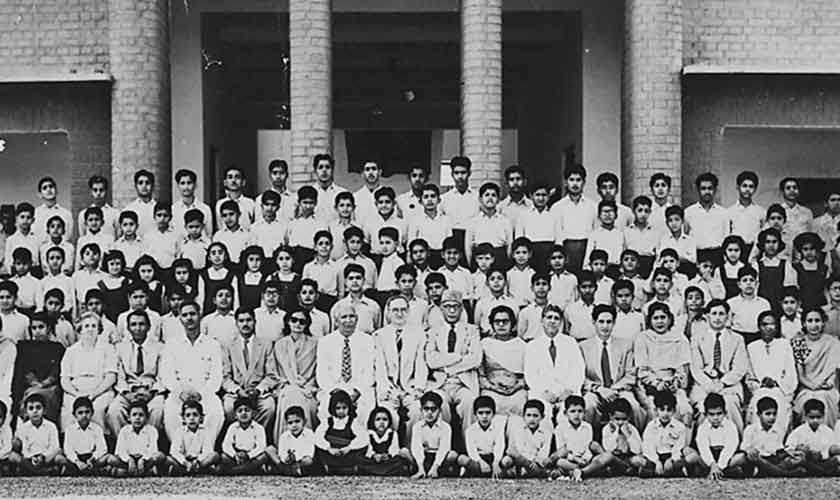
In 1990, I returned to my alma mater in search of a group photograph of the cricket team that had travelled to Aitchison College in 1974, of which I was the youngest member. A memorable innings as an opening batsman in that match had made me something of a campus hero.
Mr H Jivanandham, the school bursar and a keen photographer, had meticulously taken our group photographs year after year and stored them carefully in the record room. By then, however, Jivanandham was long gone. It was dismaying to discover that much of his archive had been unceremoniously dumped in the biology lab storeroom. I asked the principal to assign someone to help me bring the dusty cartons out into the open so that I could sort through them. His response was startling in its indifference: “The school does not need this junk. The cartons are all yours. Take them home and sort them at your leisure.”
So I took the “junk” home, where it gradually became part of me.
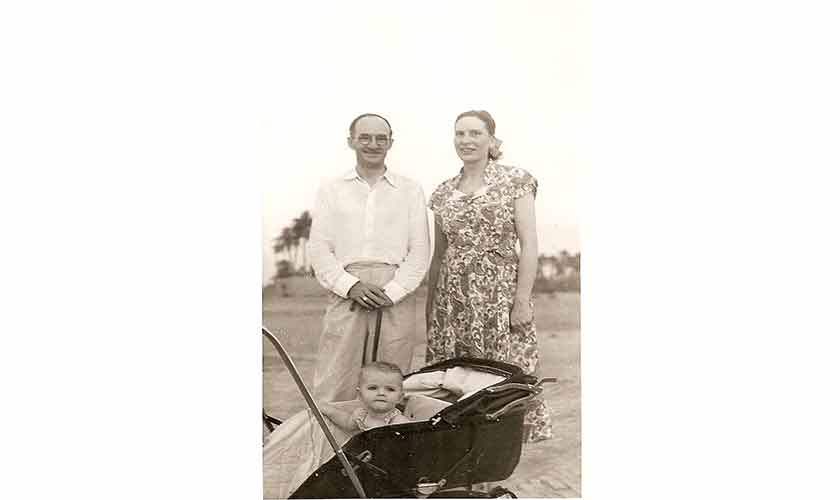
A few days ago, while rearranging this collection, which contains a photographic record of the school from 1953, when construction began, until 1980, I came across a black-and-white photograph of a young woman holding a toddler in her arms. The handwritten caption beneath it read: “Mrs MT Pinson.” So there had indeed been a Pinson family in the formative years of the school.
My mind returned to the letter, written in French, a copy of which lay in my files, still undeciphered. Could the toddler in Mrs Pinson’s arms have been the one who later wrote that letter?
My wife Afia’s social circle proved helpful. Her friend Moosna Qureshi, who teaches French at a local school, translated the letter for me. It was an emotional appeal from a daughter seeking to discover where her father was buried. The letter stated that Mr RG Pinson was the first teacher to arrive on campus in 1953; he died in 1955 and “could be buried somewhere around the place.” It continued: “Soon afterwards my mother went back to France. Throughout her widowhood she spoke very little about this part of her life, perhaps too shocked to be widowed at a young age. I respected her silence on this matter till she died last year… This quest is very dear to my heart. I implore you for the sake of humanity.”
Seventy years after his death, a letter in French and a black-and-white photograph rekindled the search for a dedicated teacher who had almost been forgotten.
The passion of the appeal moved Afia and me so deeply that Myriam’s private quest became our own. I emailed her at the address provided, introducing myself as an alumnus of the school who possessed a collection of old photographs. Among them was one of Mrs MT Pinson holding a toddler in her arms — perhaps Myriam herself. I promised to try to locate her father’s grave.
A few anxious days passed without a response from France. We feared the trail had gone cold, or that the language barrier remained unbridged. Sophie, my French colleague at OPM, then offered to help by sending an email in French.
What followed was a deluge of emails. We exchanged a wealth of rare photographs and information. She told me she had twin siblings, a brother and a sister, born on the campus in 1954. The toddler in Mrs Pinson’s arms was Myriam’s younger brother; she also shared another photograph of her mother holding her sister in the same pose. Myriam used Google Translate to render her French into English for my benefit. Though we had never spoken, a curious bond blossomed between us, transcending language, a friendship.
Through her letters, I learnt more about Mr Pinson and what had brought him from France to Bahawalpur.
“My father was born in 1907 in Alençon, a small town in Normandy, France. He had nine brothers and sisters. As was customary at the time, the education of children from modest families was often entrusted to religious orders. This was the case for my father who, from the age of 11, was placed with a teaching religious congregation. He showed a talent for languages and, in 1924, arrived at St Benedict’s College in Colombo (Ceylon) to teach, while continuing his own studies. In 1944 he moved to the newly established Sacred Heart College in Thevara, a township of Kochi in the state of Kerala. By 1945 he had left the religious congregation and joined Islamia College in Lahore. In October 1947 he joined Aitchison College.”
In November 1952, Pinson travelled to France, married his childhood sweetheart and, after a short stay, returned to Pakistan. Myriam was born in 1953, the year the young couple moved to Bahawalpur, where Mr Pinson was engaged to oversee the construction of Sadiq Public School.
I met a number of octogenarian Old Sadiqians who remembered Mr Pinson fondly. Among them were Akhtar Mamunka, the flamboyant gypsy artist, and Makhdoom Shahabuddin, a former federal minister. Both had attended the inaugural morning assembly in January 1954, which was presided over by Mr Pinson as acting principal. He was a popular teacher in his time.
On one extremely cold and windy morning in mid-December, the boarders refused to leave their beds for compulsory drill. After repeated efforts by the house staff failed to rouse the boys, the matter was reported to Mr Pinson. He rushed into the dormitories and shouted: “My brave lads, what if India attacked Pakistan, would you keep sleeping in your beds?”
The surge of adrenaline did the trick. The boys leapt out of bed, pulled on their shorts and sweatshirts and followed the Pied Piper Pinson into the mercilessly cold dawn.
Riaz Pirzada, the federal minister for housing and works and a former student of Mr Pinson, added a pointed remark to the anecdote: “Though the Indian attack came seventy years too late.” It was a reference to the recent Indian strike on Pakistan, when missiles passed over our school campus on their way to hit a seminary and a mosque.
Fayyaz Khan Bhadera recalled that, in those early days when the vast campus was still an untamed wilderness, Pinson seemed to be everywhere. He remembered seeing him help the hostel bearers by carrying a charpoy on his head. Bhadera’s bed was next to a dormitory window from which he could glimpse Mr Pinson’s office. “Whenever I woke up at night, the lights in his office were on and the Frenchman was toiling into the late hours.”
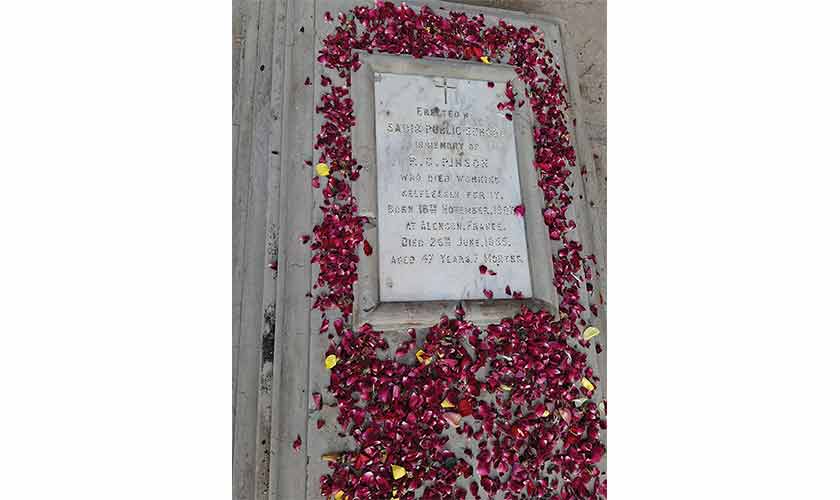
In September 1955, when the boys returned to campus after the summer holidays, they received shocking news: Mr Pinson was no longer with them. He had died on June 26 after a short illness and was buried in a forlorn Christian cemetery.
At school we were taught geography by MA Ansari, a former student of Aligarh University and an exceptional teacher who taught us how to tackle examination papers. In my CSS examinations, I chose geography as one of my optional subjects. It seemed a reckless decision, as I had last studied the subject in years 7 and 8 at Sadiq Public School. Yet, thanks to Mr Ansari, I competed with, and outperformed, candidates who held master’s degrees in geography.
Mr Ansari’s daughter, who joined the school in the spring of 1955, provided me with the final piece of information needed to complete the jigsaw surrounding Mr Pinson.
Ms Rifat Ansari was born in 1956 but learnt of Mr Pinson’s tragic death from her parents. With no medical facilities on the remote campus, the circumstances suggest cholera as the most likely cause. According to Rifat, her mother — a close friend of Mrs Pinson — spent that fateful night with the inconsolable young widow and her three toddlers. The morning after the burial, Mrs Pinson gave her a pram and left Bahawalpur forever. A year later, when Rifat was born, her mother made full use of the baby carriage.
As promised to Myriam, I drove from Islamabad to Bahawalpur to visit her father’s grave. Accompanied by the principal, David Dowdles, and members of the Board of Governors of Sadiq Public School, we crossed the main gate, walked through the narrow lanes of the shanty settlement that had sprung up opposite the campus and entered the Christian cemetery. The school staff had already located the grave. After a few moments of silence, during which we remembered Mr Pinson in our prayers, a bugle was sounded and a wreath laid.
I shared the details, along with photographs of the simple ceremony, with Myriam. A few days later, her reply arrived. “Dear Dr Raheal, it took me a while for the emotions aroused by your message and the sight of the photos of the ceremony at the cemetery to subside. I can’t find words to…”
Unlike the story of Goodbye, Mr Chips, in which all things are ultimately forgotten, Mr Pinson’s legacy resurfaced because a devoted daughter refused to let her father be consigned to oblivion. Seventy years after his death, a letter written in French and a black-and-white photograph of a young woman holding a toddler rekindled the search for a dedicated teacher who had almost been forgotten at the campus he helped build.
Sadiq “will never forget his lovableness,” though, of course, it is always difficult to say goodbye. Yet I must, adieu, Monsieur Pinson.
The writer (Tamgha-i-Imtiaz) is a retired civil servant, conservationist and animal rights activist who writes on cultural and heritage issues. He can be reached at [email protected].