Print Story
X




At Chhatwari Darbar, an 18th-Century Udasi sanctuary survives urban decay
| S |
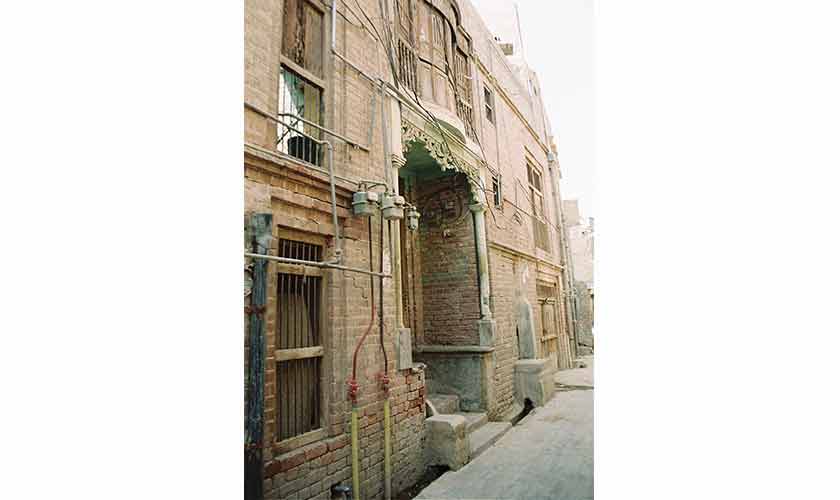
hikarpur is not merely a town in upper Sindh; it is a living archive of the region’s cultural heritage. Its streets, neighbourhoods and institutions carry the accumulated memories of centuries of trade, learning and social reform. Over the last three decades, the city has lost many of its historic buildings. Whatever has survived despite this destruction reflects its glorious past. I have been walking in the streets of Shikapur documenting mansions, temples, dharamshalas, historic educational institutions, hospitals, tombs, mosques and other cultural heritage sites in the city.
Since 1998, I have returned to the city again and again to see those monuments to confirm that they still stand and have not succumbed to the vandals plundering the city’s heritage. Every visit has been a disappointment, with a few buildings lost and others looking precarious. However, a few religious places have survived against odds. One such place is Chhatwari Dharmashala. It is one of the oldest dharmshalas associated with Chhatwari Darbar in Chhat town, Balochistan. It is likely to have been built in the third quarter of the 18th Century and later renovated and expanded by the succeeding Gadisars (custodians of Chhatwari Darbar in Balochistan). It was last renovated between 2011 and 2012, with Rs 1.5 million provided by the provincial government.

I learned from the locals that Chhatwari Dharamshala was built by Udasi ascetics of Chhat in Balochistan. Traders from Chhat and beyond stayed and prayed at this dharamshala whenever they visited Shikapur for business or other reasons. Even students who used to study in Shikarpur lived in this dharamshala. This was a large dharamshala in colonial Shikapur. However, it has now been reduced to a single building. It is a two-story building. A well in the dharamshala has survived.
As one enters Chhatwari Darbar, as it is now called, one notices, on the left, a room where an image of Baba Sri Chand is displayed. Baba Shri Chand was the founder of Udasipanth.
Udasipanth is one of the Sikh ascetic orders. Harjot Oberoi writes in his book The Construction of Religious Boundaries: Culture, Identity, and Diversity in the Sikh Tradition that there are eight Sikh ascetic orders, namely Udasis, Nirmalas, Granthis, Gianis, Pujaris, Dhadis, Rababis and Ardasias. Udasi panth or order was further divided into ten sub-orders, each named after its founder. They were Almast, Balu Hasne, Phul, Goinde, Suthre Sahie, Bhagat Bhagaw, Sangat Sahibie, Mihan Sahie, Bakhat Malie and Jit Malie.
Baba Sri Chand travelled in Sindh in the second half of the 16th Century during the Tarkhan dynasty (1555-1592). He was believed to have established two dhunis (campfires), one at Rohri and the other at Faqir Jo Goth, which lies 5 kilometres east of Thatta town. Like Nath Yogis, dhuni also played an important role in Udasipanth. Dhuni, the renouncer’s hearth, established the identity of an ascetic. Udasis did not marry and practiced celibacy. They still adhere to this tradition. The earliest dhunis of Baba Sri Chand in Sindh are located in Rohri and Thatta, cities that also boast numerous shrines of Sufi mentors, Hindu sadhus and Sikh ascetics.

After the death of Baba Sri Chand, guru-ship went to Baba Gurditta and later to his four disciples, Almast, Balu Hasne, Phul and Goinde, who preached the thought and ideology of their mentors in the Punjab and Sindh. In Sindh, Almast converted many Hindus to Udasipanth. He was believed to have spent considerable time at the Dhuni of Baba Sri Chand in Rohri. The converts’ new names always ended in either Ram or Das. Some of them came from other regions and established their darbars in Sindh. Some of the popular Udasi darbars in Sindh include Baba Bankhandi Darbar at Sadh Belo, Sukkur; Halani Darbar in Naushero Feroze; Khushi Ram Darbar at Rohri; Samadha Udasin at Shikarpur; Wadi Darbar at Pir Jo Goth; Jumnadas Darbar and Chhatwari Darbar at Shikarpur; and Kalyandas and Sevadas darbars in Jacoababad. I have visited all these shrines.
The earliest Udasi darbar among these is located in Faqir Jo Goth, Thatta. It is also known as Baba Sri Chand Darbar and Raj Ghaat. The second-earliest darbar in Sindh is located at Rohri.
The earliest Udasi darbar among these is located in Faqir Jo Goth, Thatta.
Udasi saints used to wear a cap and kept a rosary of flowers, a cotton bag, a vessel made of dried pumpkin, ash for smearing on the body, a chain to tie around the waist and a deer-skin/ lion skin upon which to perform Hatha Yoga.
Chhatwari Darbar in Shikarur is spiritually associated with Baba Giyandas Darbar in Chhat town, Nasirabad district, Balochistan. This darbar was founded by Baba Giyandas, who came from the Punjab in the 18th Century, established the Darbar and preached Udasipanth in Chhat and beyond. Baba Gurmukhdas, who founded Chhatwari Darbar in Shikarpur, was a Gaddisar (custodian) of Baba Giyandas’ Darbar in Chhat town. Baba Giyandas was a celebrated Udasi ascetic who converted many to the Udasipanth. His samadhi is located in Lehri town in Nasirabad. Baba Sevadas Darbar in Lehri is another famous Udasi shrine in Balochistan, from which many Udasi ascetics travelled to Sindh and the Punjab to spread Udasipanth. In Jacobabad, there is also the Sevadas Darbar, spiritually connected to the Seva Das Darbar of Lehri.

On the outer wall of the hall of Chhatwari Darbar in Shikarpur, where the image of Baba Shri Chand is placed, there is an inscription in Hindi that names Baba Gurmukhdas Udasin as the founder of Ashram Purandas. This shows that Chhatwari dharamshala or darbar was also known as Purandas Ashaern in colonial Shikarpur. This ashram of Purandas or Chhatwari Darbar was inaugurated by Mahant Baba Gurmukhdas Udasin in 1946. He was the disciple of Sarandas Baba Udasi. According to Sachanand of Jacoababd (follower of Chhatwari Darbar), Baba Gurmukhdas Udasi had two prominent disciples, Baba Kalyandas and Baba Paryag Muni. His disciple founded the Kalyandas Darbar in Jacobabad. It is one of the most impressive darbars in the town. At the centre of the darbar hall there is an image of Baba Sri Chand. In a corner of the hall are found the images of Baba Kalyandas and Baba Kirpa Ram. On the walls of the darbar hall there are some pictures of Udasi ascetics associated with Chhat and Lehri darbars. Prominent ascetics associated with Giyandas Darbar of Chhat include Baba Giyandas, Baba Gurmukhas, Baba Purandas, Baba Sarandas and Baba Jugat Ram. There are a few pictures of Udasi ascetics associated with Lehri Darbar, including Satguru Sevadas and Satguru Premdas.
Chhatwari Darbar in Shikarpur is the most important Udasi shrine in the town. Pilgrims, traders and students used to stay in Chhatwari Darbar, a dharamshala. After the Partition, the Chhatwari Darbar was abandoned. Refugees from India occupied it for some time. With the efforts of the Hindu Punchayat of Shikarpur, it was eventually vacated. In 1958, it began operating again as Kalyandas Udasi. The Gadisar of Baba Giyandas Darbar from Chhat used to come and stay for a few days at Chhatwari Darbar in Shikarpur.
The Chhatwari Darbar in Shikapur remains a vibrant hub of worship, where followers of Udasi ascetics can freely express their devotion without hindrance. This enduring practice showcases not only the remarkable tolerance that has flourished in the Shikapur community over the years but also serves as a testament to the town’s rich cultural and religious heritage.
The writer is an associate professor and anthropologist at the Pakistan Institute of Development Economics, Islamabad. He has authored 18 books on Pakistan’s cultural heritage and anthropology. He tweets @kalhorozulfiqar. He may be contacted at [email protected]