Print Story
X




Iqbal Hussain took lived experience and turned it into defiant art
| T |
he parking lot of the National College of Arts in the mid-1980s was small, containing a few cars, some motorbikes and a number of bicycles. None attracted much attention from students except a black motorbike which, unlike others of its kind, carried an added feature: a phrase painted in white across its dark fuel tank, Not a day without a line. Whether a quote, a manifesto or a personal resolution, it stirred curiosity about its owner.
Students soon discovered that the motorcycle belonged to Iqbal Hussain, a member of the Fine Art Department faculty and a painter of considerable fame and repute.
We would cross paths with the young professor in the college corridors and offer our salaam. But it was only once he began teaching us that we came to understand the artist, his opinions, his aesthetics, deeply rooted in European art history, particularly the Impressionist movement, and his connection to the maestro Khalid Iqbal. In his office at NCA hung his painting of Khalid sahib seated at his desk in the same institution. The room, in that moment, felt like a mirror within a mirror, a reflection across generations.
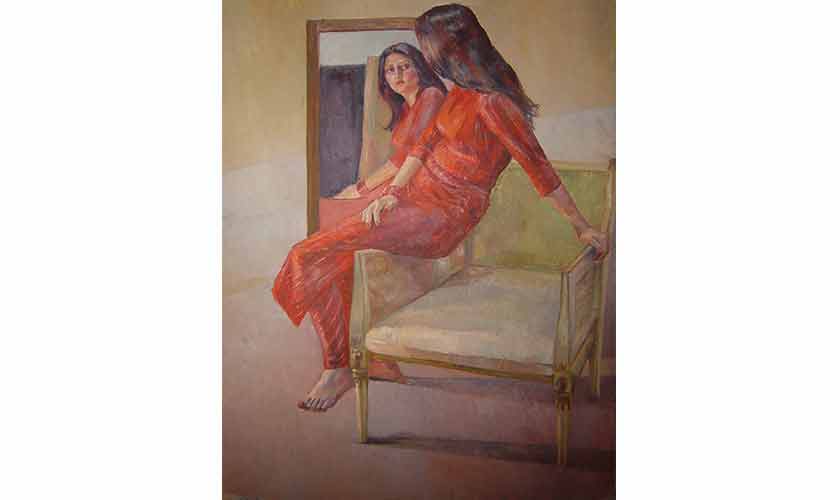
In fact, if one were to surmise, Iqbal Hussain remained a mirror throughout his life, a mirror that, some years ago, became tarnished by illness, isolation and age, until it finally vanished from the physical realm on January 22. The life and art of Iqbal Hussain were so deeply intermingled that it was impossible to detach one from the other, even as many creative personalities struggle to separate their Jekyll selves from their Hyde sides. In Hussain’s case, the opposite was true: it was unthinkable to draw a line between the person and the painter, the private and the public, the family background and the art world.
Rather than being secretive, embarrassed or apologetic about his origins, a temptation for many professionals, Hussain was assured of his lineage. Born into a traditional matriarchal household in Lahore’s red-light district, he traced his ancestors instead to an artistic lineage: Edouard Manet, Edgar Degas, Pierre-Auguste Renoir, Claude Monet and Henri de Toulouse-Lautrec. From each, he absorbed what he chose, ultimately transforming those influences into a distinct visual diction that came to be known simply as Hussain.
Many times, I entered my teacher’s room to find him leafing through publications on Impressionist artists. I remember Iqbal Hussain looking at a reproduction of Edgar Degas and applauding: “What a composition.” It was like someone watching a cricket match and exclaiming, “What a stroke,” because for him what was unfolding on his desk was not a work produced nearly a century ago, but an image still in the making.
Like young and opinionated art novices, we used to think of him as someone still breathing the stale Parisian air of the early Twentieth Century, until, years later, we realised that a work of art is not an object of the past. If it is substantial, it belongs firmly to the present.
Iqbal Hussain learned from his favourite painters and incorporated them into his poetics, which, if simplified, can be broken down as follows: the deft brushstrokes of Edouard Manet; the extraordinary and unexpected compositions of Degas; the fascination with depicting the lustrous female flesh found in Pierre-Auguste Renoir; the presence of light and brilliance of colour in Claude Monet; and the alienation and pathos of the prostitutes portrayed by Henri de Toulouse-Lautrec.
In his paintings, he brought Paris’s Montmartre to Lahore’s Old City, and Moulin Rouge and Pigalle to Shahi Mohalla. He was undoubtedly successful. Like his heroes, he rendered these charmingly miserable women into icons of beauty and desire. He also transformed his low-income neighbourhood, initially on Shehla Saigol’s advice, by establishing a café as part of his studio-home, into a thriving area. Today, it bustles with tourists seeking food, artefacts and other forms of entertainment.
Just imagine a reverse scenario: had Iqbal Hussain not studied art, the fate of that locality might have been very different, arguably far worse, especially after the area’s primary business was banned during Zia-ul-Haq’s dictatorship.
The story of how Hussain ended up at the National College of Arts, as he recounted to Marjorie Husain for the monograph Iqbal Hussain: The Painter of Imprisoned Souls, is revealing. On a friend’s suggestion, he appeared for the drawing portion of the entrance test but, aware of his limitations, did not attempt the English section. To his surprise, Hussain was called for an interview. There, Khalid Iqbal asked him to read an English newspaper, which he managed to do. Admission was granted. From that day onwards, and even after his graduation in 1974, Khalid Iqbal remained a constant source of inspiration, guidance and support.
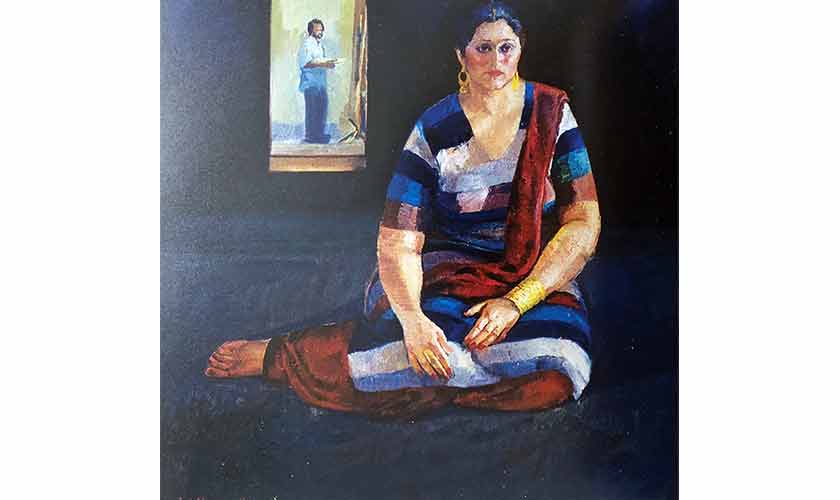
Yet, unlike many other students of Khalid sahib, Iqbal Hussain did not imitate his teacher. Instead, he carved out a parallel style. Although subjects such as landscape and still life overlapped, Hussain’s hand is unmistakable, vigorous, daring and at times flamboyant. This is evident in his depictions of the Ravi River at dawn, views of the Badshahi Masjid at dusk, and his many self-portraits, which together form a pictorial curriculum vitae of a life in flux. They chart his journey from a struggling painter to an established name, culminating in a work where he places himself alongside Rembrandt and Delacroix, the three masters of realism.
That particular work is with Shehla Saigol, the largest collector and most steadfast supporter of Iqbal Hussain. At one point, she also offered him a space at the Lahore Art Gallery to use as his studio. Hussain’s paintings were acquired by several other art lovers as well, yet for many, the work was welcomed more readily than the maker, if he was welcomed at all. This sense of alienation did not affect Hussain. He continued to pursue his subject with conviction, which, borrowing a phrase from Georges Bataille, was “play, play as opposed to work, play whose essence is above all to obey seduction, to respond to passion.”
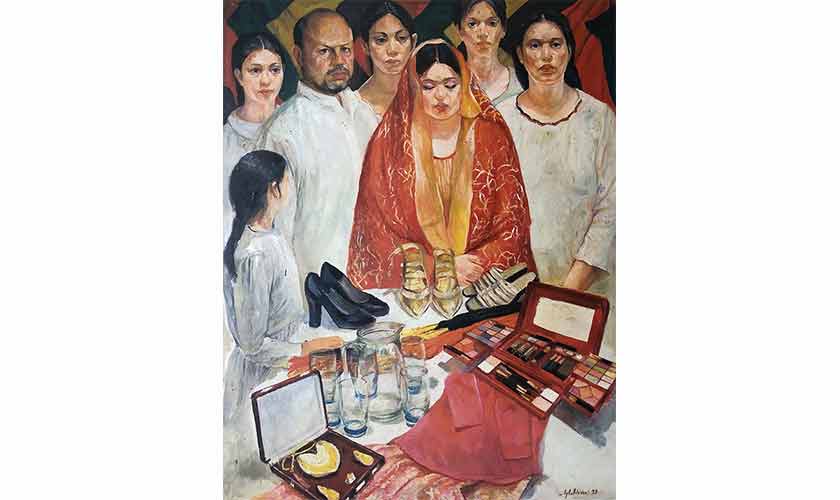
On a superficial level, one might describe his work as depictions of female nudes, figures from the red-light district, or the atmosphere of its narrow alleys. In reality, his canvas was far broader. It was filled with love, fate, family, fear, relationships, cruelty, exploitation, innocence and oppression. Men and women, fully clothed, partially clothed, or completely naked, are often composed in scenes where mirrors play an active role, extending both pictorial and psychological space. It felt as though Hussain had assumed the role of a mirror himself, reflecting the more unsettling truths of our society through both his imagery and his persona.
Usually, this course was pursued in an indirect way. One of his remarkable works, for instance, installed at the Lahore Art Gallery, shows two women facing one another as they lie beside a fluffy, light-yellow chick. If the image hints at a future for the women not unlike that of the chicken, both destined to be consumed by a hunger for flesh, it also reveals Hussain’s ability to tackle one of the most challenging pictorial problems: capturing the feathery body of an unsteady bird. Instead of a calculated rendering, he simply twisted his brush, loaded with the right tint and amount of paint, and brought the tiny creature into being. This association between the desirable and the edible appears in other works as well, such as two young girls surrounded by cockerels, or a pair of women placed next to a sacrificial goat.
Although he painted friends, patrons and colleagues, Hussain’s primary subject was his family and the people of his immediate surroundings. Much like the fiction of writers such as Charles Dickens, Emily Bronte, William Faulkner, VS Naipaul, Gabriel Garcia Marquez, Maryse Conde, Naguib Mahfouz, Toni Morrison and Orhan Pamuk, to name only a few, the identity, location and the era of his figures eventually become secondary. What endures, after time and distance have done their work, is the human condition, shared across cultures and continents.
A similar code applies when reading the work of Iqbal Hussain. The singular quality of a work of art, however, is that it can be deciphered across varying contexts. One such context is Hussain’s enduring act of defiance. The painter once told his biographer that he had been a “young gangster,” who “learnt to carry daggers like the rest of the boys” in the mohalla. That seed of resilience came fully into bloom when his solo exhibition (1985-86) was cancelled at the Alhamra Arts Council in Lahore because of its representations of fallen women.
Hussain responded by staging his own version of a Salon des Refusés, displaying the rejected paintings along both sides of The Mall, next to the venue.
Today, no one remembers who ordered the removal of those paintings. What remains is the memory of Hussain himself: the artist, the subject of admiration, and now, the figure being mourned.
The writer is a visual artist, an art critic, a curator and a professor at the School of Visual Arts and Design, Beaconhouse National University, Lahore. He can be contacted at [email protected].