Print Story
X




A historic Sikh shrine in Sindh reveals how craftsmanship once sustained a deeply inclusive urban culture
| S |
hikarpur’s pluralistic society attracted traders, scholars, pilgrims, priests and mystics from Central Asia to South Asia, making it one of the most vibrant cities in colonial Sindh. It became an economic node connecting Sindh with Balochistan, the Punjab, Afghanistan and beyond. The cultural and religious diversity of Shikarpur was integral to its identity. People who settled in Shikarpur to expand their businesses later became embedded in the city’s society and culture, contributing to its pluralistic character.
Shikarpur emerged as a pluralistic and inclusive society in Sindh during the 18th and 19th Centuries. Temples, darbars and samadhis were built next to the mosques and Sufi shrines, reflecting the communities’ tolerance toward one another and boosting not only communal life in the city but also local business. They invested in developing the healthcare and education systems together. These investments transcended religious boundaries. In many cases, Muslims and Hindus worked together to build public institutions. Some notable members of the Sikh community also built their places of worship in Shikarpur. One of the important Sikh shrines in Shikarpur was Masand Darbar. Several Sikh shrines emerged in Shikarpur in the 18th and 19th Centuries as the influence of Sikh mystics and Masands grew.
The religious places built by Sikh nobles and mystics included Akal Bungo (Singhanwari Dharamsala), Samadha Ashram, Khatwari Dharamshala, Chhatar Wari Darbar and Masand Darbar. One learns from Munhinjo Watan Munhija Mahnoon by Lok Ram Dodeja that when Guru Gobind Singh Ji was fighting the Mughals, Dhiyal Singh took part in those battles. Later, Guru Gobind Singh instructed him to preach Khalsa Sikhism in Sindh. It is said that he founded Akal Bungo in Nandi Bazaar, Shikarpur, which later became known as Singhanwari Dharamshala.
Among the darbars, the Masand was the most notable Sikh shrine in Shikarpur, believed to have been built by Bhai Dhanraj. Masands and their descendants became quite powerful and influential in the 18th, 19th and 20th Centuries.
Masands were appointed representatives of the Sikh Gurus during the early development of Sikhism, particularly from the time of Guru Ram Das and Guru Arjan Dev. Their primary role was to act as local links between the Guru and Sikh congregations spread across different regions. Masands organised religious gatherings, conveyed the teachings of the Gurus and collected dasvandh—a voluntary contribution traditionally set at one-tenth of a Sikh’s income—to support the Sikh community and its institutions. At a time when communication was limited, the Masand system helped Sikhism grow into a well-organised religious community.

Over time, however, some Masands accumulated unchecked power and misused their authority. Seeing this drift from Sikh ideals of equality and integrity, Guru Gobind Singh decisively abolished the system. Authority was returned to the collective Sikh community, centred on the Guru Granth Sahib.
According to Munhinjo Watan Munhija Mahnoon by Lok Ram Dodeja, the Guru appointed Bhai Dhanraj as Masand of Sindh, Balochistan and Kandahar. Masand Darbar was one of the most important Sikh sacred spaces in Shikarpur, where devotees from distant areas visited. Lok Ram Dodedja believes that Bhai Dhanraj and his descendants played an important role in preaching and spreading the influence of Sikhism. At the beginning, Bhai Dhanraj, or possibly one of his ancestors, had established a darbar in Rohri, which they later handed over to the Gurpotas and established a Masand Darbar in Shikarpur. Moreover, Lok Ram Dodeja states that Bhai Ranjhanmal, the grandson of Bhai Hasanand, travelled to Delhi to obtain a perwana (a letter of authority) from Guru Gobind Singh for the collection of revenue. From the family of Bhai Ranjhanmal, Bhai Molram established a darbar in Khairpur. Later, on the insistence of Gurpotas, Gurpat Prasad was handed over the darbar. Bhai Molram, after handing over the darbar to Gurpat Prasad, went to Shikarpur, where he established a darbar near Chabutra. It is not clear from Lok Ram Dodeja’s writings whether Molram and Bhai Dhanraj were related. It is also not clear whether Ranjhanmal and Bhai Dhanraj were contemporaries. Masand Darbar was likely built by Bhai Dhanraj himself and later expanded by his descendants.
Two related developments are central in understanding the growth and expansion of Sikh darbars, particularly those associated with Khalsa Sikhs, in Sindh. The first was the abolition of the Masand system by Guru Gobind Singh, a reform intended to end the role of religious intermediaries and restore moral accountability within the Sikh community. The institutional reform did not instantly erase social realities. Many Masands had already established deep local influence and their authority proved resilient even after the system was formally dismantled.

Seen through an anthropological lens, the presence of posters of Sikh Gurus alongside images of Hindu deities and local saints in Shikarpur points to a long-standing culture of lived pluralism rather than formal religious mixing.
The second factor was historical circumstance. At the time the Masand system ended, several Masands and their families had become powerful religious figures. As Mughal persecution of the Sikhs intensified, waves of Sikhs—especially those linked to former Masand lineages—migrated from the Punjab to Sindh. In their new settlements, they founded darbars that evolved into enduring centres of worship, community leadership and collective memory. Any serious discussion of Sikh darbar culture in Sindh, particularly during the 17th and 18th Centuries, must account for this convergence of reform, migration and the reconfiguration of inherited authority.
Masand Darbar, established by Bhai Dhanraj, is located in Shikarpur’s Boot Bazaar. It was a simple building when it was first built. Later in the first quarter of the 19th century, during the Talpur reign, Masand Sunderdas rebuilt it.
Through interviews with the local community, I learned that the older Masand Darbar was very impressive. Later, Masand Sunderdas rebuilt the darbar, noted for its wooden doors and ceilings, reflecting the builder’s affluence. Later, during its renovation, much of its original work was lost. Today, one notices a beautiful main wooden door carved with floral, geometric and figural designs. This door was engraved during the time of Masand Sunderdas when he was Gadisar of the darbar. The noticeable part of the door features carvings of Baba Guru Nanak with his two companions, Bhai Bala and Bhai Mardana. This trio appeared at most of the darbars in Shikarpur. Some of the darbars, dharamshalas and temples that feature wooden doors with carvings of Baba Guru Nanak with Bhai Bala and Bhai Mardana include Samadha Ashram, Khatwari Dharamshala, Swami Shankaranand Bharti, Balakram Ji Marhi and others. The most impressive wooden doors representing the trio are found in Samadha Ashram and Khatwari Dharamshala.
It is interesting to note that, while renovations, even re-buildings, of darbars were carried out in Shikarpur, the original doors depicting Baba Guru Nanak with his companion were preserved and re-used in all those buildings.

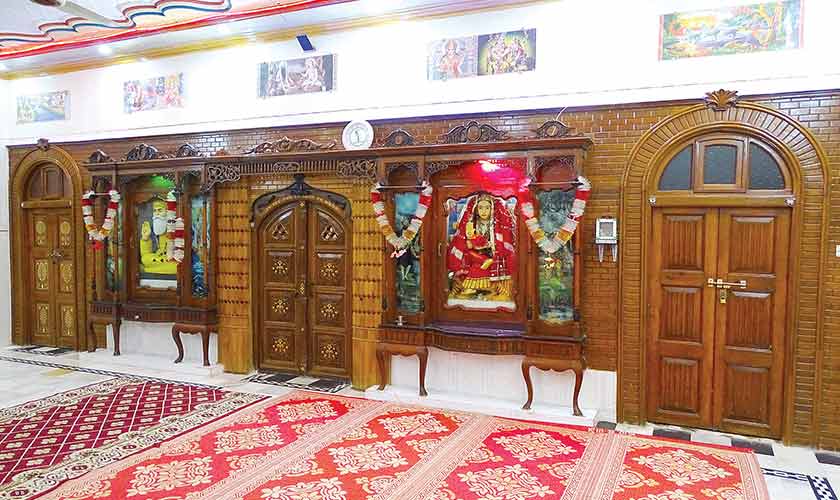
After the main wooden portico, the wooden doors of the Masand Darbar hall capture the attention of visitors and pilgrims. Three doors in the Darbar hall lead to three rooms. Two of the doors are noted for inlay work. The first door has six panels showcasing inlaid stylised trees and floral vases. The second door also represents six panels, each depicting stylised floral designs. The inlaid wooden doors of Shikarpur’s darbars occupy a unique place in Sindh’s material culture. Decorated with stylised tree motifs, the inlay work reflects both symbolic meaning and exceptional craftsmanship. Doors similar to those found in Masand Darbar are also present in the Swami Shankaranand Bharti temple, indicating a common artisanal style across religious institutions. These doors serve as symbols of cultural identity for the darbars and temples of Shikarpur. Their refined execution points to the city’s historical prosperity and the close relationship between merchants, mystics, and artisans—an artistic synthesis rarely seen elsewhere in Sindh.
In the hall of Masand Darbar, Guru Granth Sahib is placed on Takhat Sahib. This highly engraved wooden Takhat Sahib reflects the craftsmanship of the local woodcarvers. Behind the Takhat Sahib, on the wall, is an image of Guru Gobind Singh, mounted on a horse and holding a falcon. In the darbar hall, posters and ceramic tiles depicting Hindu deities, saints and Sikh Gurus adorn the walls. A few also show pictures of the family who took care of the Masand Darbar.
There is also an image of Baba Guru Nanak encased in a glass and flanked by the posters of Ram and Lord Vishnu. Another image on the same wall, encased in glass, is that of Durga Mata. Seen through an anthropological lens, the presence of posters of Sikh Gurus alongside images of Hindu deities and local saints in Shikarpur points to a long-standing culture of lived pluralism rather than formal religious mixing. These visual arrangements reflect how religion was practiced in everyday life within a mercantile city shaped by trade, mobility and sustained inter-communal contact. For Shikarpur’s merchants and residents, religious symbols functioned less as markers of exclusive identity and more as shared moral and protective references within domestic and commercial spaces. Such visual co-existence reveals a social world in which boundaries between communities remained porous and negotiable. This syncretic and inclusive ethos, grounded in daily economic and social interactions, has been a defining hallmark of Shikarpur’s historical identity.
The writer is an associate professor and anthropologist at the Pakistan Institute of Development Economics, Islamabad. He has authored 18 books on Pakistan’s cultural heritage and anthropology. He tweets @kalhorozulfiqar. He may be contacted at [email protected]