Print Story
X




Addressing Pakistan’s educational challenges in developing capable and purpose driven people to implement reform
| E |
very few years, Pakistan rediscovers its education crisis. An emergency is declared, new programmes are announced and policy language is updated. Those of us involved with education development debate whether to start with better assessments, better teachers, better data or better technologies. Then, quietly, the system swallows the innovations and provocations and continues onwards, largely unchanged.
These technical inputs matter. But they are not sufficient to interrupt the system’s patterns. Despite decades of investment by governments, non-profits and the private sector, learning outcomes remain poor and inequity deeply entrenched. This isn’t because we lack ideas about what to change but because a complex, human system has been treated as if it could be fixed one input at a time. The deeper question that Pakistan must answer, if we are serious about achieving educational equity, is this: how do we develop a critical mass of capable and purpose-driven people who work long-term across the education system—and across society—to implement reform?
Visionary and equity-minded leadership is a naturally occurring phenomenon. Pakistan’s past and present bear witness to the outsized impact of individual efforts by educationists, social entrepreneurs, activists, civil servants and politicians. But to drive change at scale, to shift how an entire system responds to the most vulnerable children in its care, we need leaders at every level of education delivery within institutions that make decisions about human development and across society that shapes those decisions.
Without this distributed leadership, good ideas can neither be executed nor anchored. The collective power required to consistently prioritise the child most likely to be left behind is never fully mobilised.
Developing the human capacity to steward change within human systems cannot be left to chance. It needs careful, deliberate engineering and uninterrupted investment.
Such leadership development can take many forms but some principles are tested and true. Our most capable people need to be solving our hardest problems. This means that the best and brightest of Pakistan’s talent must be engaged in the effort to change our education system. This includes those who come from privilege as well as those who have lived experience of educational inequity.
This investment—the irreversible inspiration to strive for change over the long haul—will not come from books or rhetoric alone. Especially for rising generations who think critically about the world and their place in it. It must come, instead, from being placed inside the problem we are asking them to solve.
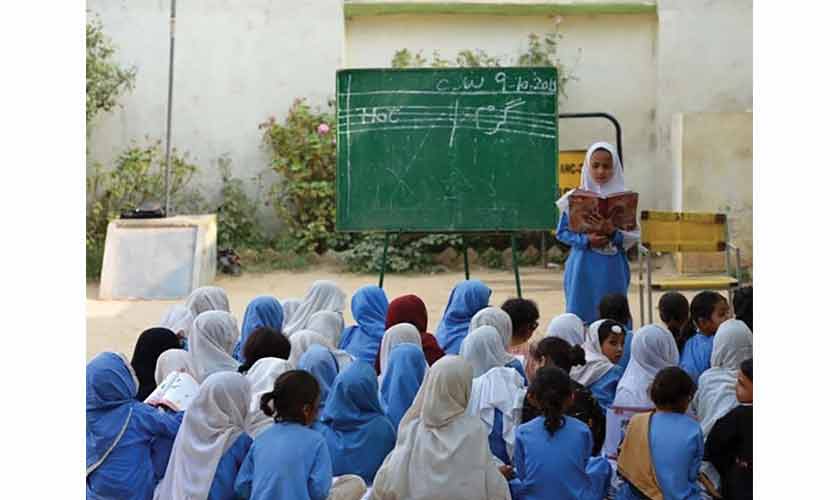
One such space is the classroom that perpetuates inequity. In public schools, low-cost private schools and non-formal institutions serving low-income populations across the country, children battle hunger, uncertain healthcare, low expectations, insecure housing and sanitation as they struggle to learn. They sit in overcrowded classrooms led by ill-equipped and unsupported teachers, overseen by principals waging their own battles over basic resources and authorities. They face cultures of violence, unchecked and normalised across every domain of their lives.
When future leaders have the opportunity to wrestle with such inequity, for instance, as teachers in under-resourced classrooms working to alter their students’ learning and life trajectories, a lifelong commitment is forged. When they go on to assume positions of influence in schools, education systems or the wider society, their decisions are rooted in their bonds with their children, a deep commitment to justice and an audacious sense of possibility. Their ability to read and align interests across groups of stakeholders is shaped by the experience of mobilising entire school-communities to contribute to their students’ learning.
Developing such leadership capacity is not a 3-5 year project. It is patient, generational work. Its effects are difficult to attribute and rarely immediate. But studying the evolution of other systems that have made significant progress on educational equity, with similarly low starting points, can be instructive and heartening. As one generation of leaders committed to shared purpose work together to improve the system’s outcomes, the system produces more capable leaders to drive the next cycle of improvement. As leadership accumulates, change compounds.
On this International Day of Education, the challenge is not to search for another solution but to ask ourselves how we will get at the barriers that prevent our solutions from taking root. Our lack of intentionality in nurturing the leadership that allows our education system to learn, adapt and improve is one such barrier. But as the proverb goes, “The best time to plant a tree was twenty years ago. The second-best time is now.”
The writer is the CEO and founder of Teach For Pakistan.