Print Story
X




Does everyone have equal opportunities to acquire quality education in Pakistan?
| E |
ducation is regarded across the world as a metaphor for change. Through education, change occurs in the personal lives of students. When these individual changes come together, they hold the potential to transform the society. Unfortunately, over the past few years a fundamental change has occurred in education in Pakistan. Now, the acquisition of quality education has become contingent upon the availability of substantial financial resources. Children of affluent parents can obtain education from good educational institutions, after which doors to the best employment opportunities automatically open for them. This facility is not available to the children whose parents lack adequate financial resources.
One of the key objectives of education is to reduce economic and social disparities in society. This is possible only if everyone has equal opportunities to acquire quality education. The bitter reality is that children belonging to powerful sections of society have access to better educational institutions whose expenses are beyond the imagination of middle-class parents. Consequently, children from deprived sections of society are unable to reach school; even if they manage to cross the threshold of schooling, their schools are ordinary in every respect.
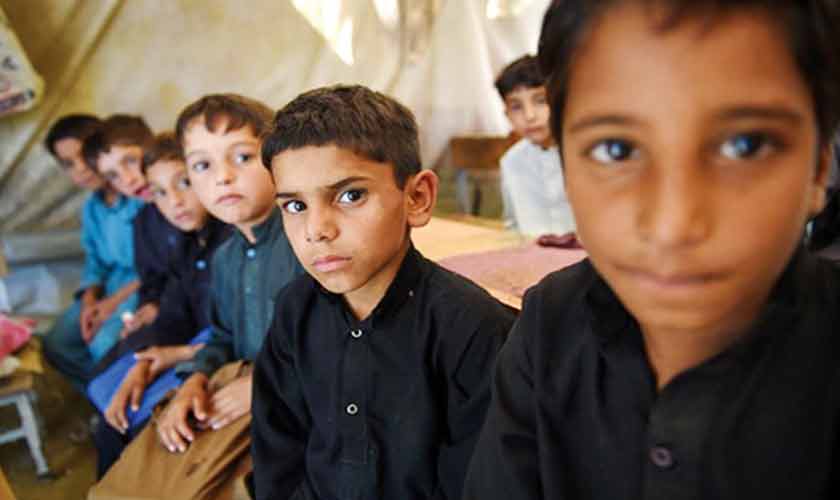
According to a report by the Ministry of Education, more than twenty-five million children in Pakistan are currently out of school. These are children who have been deprived of their basic constitutional right of “free and compulsory education.” Even among the children who have access to school, 42 percent are forced to drop out by the time they reach Grade 8. A major reason for dropping out is the lack of financial resources. Household poverty compels parents to include their children in labour instead of sending them to school. In some cases, children become the sole source of income for their families.
The millions of children that either remain out of school or are forced to drop out are left at the mercy of harsh circumstances. Many of these children can be seen begging on busy city roads. Some of them are seen selling newspapers, flowers or similar small items in freezing mornings and scorching afternoons. A large number of children work in workshops where they are not only subjected to physical abuse but are also constantly humiliated and rebuked. This inhuman treatment turns them into resentful individuals who become involved in negative activities; theft becomes their habit, and some of these children eventually become fuel for terrorist organisations.
On the other hand, children of parents with financial resources receive education from good institutions and secure good jobs. In this way, they establish their identity in society and eventually reach positions from where they influence society. In contrast, children from deprived classes move within a vicious circle: lack of access to schooling due to poverty; lack of access to employment due to lack of schooling; and poverty as a consequence of lack of employment. This educational apartheid has never received due attention.
The French sociologist Pierre Bourdieu explains the concept of power in society through different forms of capital. These include economic capital, social capital and cultural capital. According to Bourdieu, these three forms of capital influence one another. For instance, children of individuals possessing economic capital acquire education from elite institutions and subsequently gain numerous economic, social and cultural advantages, thereby giving children of the elite class a clear superiority over others. While numerous public education policies have been introduced in Pakistan, none has meaningfully addressed educational inequality nor has a practical action plan been proposed for the purpose.
A glance at Pakistan’s educational landscape reveals educational disparities everywhere. On one side are expensive English-medium schools for the elite; on the other are so-called English-medium schools operating in narrow streets and neighbourhoods, along with Urdu-medium schools, cadet colleges, madrassas, government schools, schools run by the armed forces and Danish Schools. These disparities are not limited to names alone; they are clearly reflected in buildings, curricula, textbooks, teachers, students and facilities as well.
A World Bank report published in 2006 stated that “individuals should have equal opportunities to pursue the life they choose and should not be deprived of achieving outcomes.” The most important step in this direction is to provide access to schooling for out-of-school children. Under Article 25-A of the constitution, it is the responsibility of the government to provide free and compulsory education to children aged five to sixteen. In this regard, the construction of new schools, recruitment of teachers and provision of scholarships to deserving children are fundamental tasks. All these measures require additional funding. The education policy of 2009 promised that by 2015 educational funding would reach 7 percent of GDP, but like many other promises, this too remained unfulfilled. Instead of increasing, education funding declined to 1.77 percent in 2021, according to the Economic Survey of Pakistan.
There is an urgent need to immediately increase public funding for education in order to ensure the implementation of Article 25-A. At present, Pakistan lags behind India, Sri Lanka, Nepal, Bhutan and the Maldives in literacy rate. Given the seriousness of the issue, an educational emergency should be imposed across the country. An independent monitoring commission comprising experts should be established to oversee progress toward educational targets and submit its report every six months to the president, prime minister and the chief justice of Pakistan. This is an extremely sensitive and serious issue that concerns 25 million children. The time has come for us, as a nation, to accelerate our efforts on a war footing to implement Article 25-A and to transform the 25 million flickering lamps into bright and shining beacons.
The writer is an educationist and author of Reimagining Education in Pakistan.
Website: https://drshahidsiddiqui.com/