Print Story
X




In Turkwal, migration and rebuilding are quietly undoing pre-Partition architectural memory
Against this intellectual backdrop, I have been travelling across the Pothohar region to conduct ethnographic research in Pothohari villages, exploring them from multiple perspectives. My enduring interest lies in understanding how these villages are being transformed, socially, economically and culturally, and how processes of modernity are reshaping everyday life. In particular, I am concerned with how such transformations affect cultural heritage: what is preserved, what is adapted and what risks being lost.
To grasp these dynamics more fully, my fieldwork has extended beyond villages to nearby towns. I have closely observed the lives of those who have migrated to urban centres yet remain deeply connected to their home villages through kinship, memory and social obligations. These movements between village and town reveal a continuous dialogue between tradition and change, offering valuable insights into the evolving character of Pothohar’s rural society in an era of rapid transformation.

The cultural heritage of villages is most acutely affected during this transformation. A telling example is Turkwal village, located in the Gujar Khan tehsil of Rawalpindi district. I first visited Turkwal in 2015 and returned in 2019, 2021, 2022, 2024 and most recently in December, 2025. During these visits, I saw the gradual yet profound erosion of the village’s material heritage.
Over the years, I observed how historic, pre-Partition structures, once central to the village’s architectural and cultural identity, were either altered beyond recognition through insensitive renovations or completely demolished to make way for new construction. Each visit revealed further losses, as older buildings were replaced by modern structures that prioritised utility and status over historical continuity.
This process is not merely an architectural change; it represents a more profound rupture with the past. As these structures disappear, so too do the stories, memories and social meanings embedded in these cultural heritage spaces. Turkwal is thus a powerful illustration of how modernisation, left unexamined, can quietly but decisively erase rural cultural heritage, transforming not only the physical landscape but also the cultural memory of village life.
During various visits, I met local community members and interviewed them about the village’s lost cultural landscape. On my most recent visit in December, 2025, I met several people, including Dr Ashraf, Khan Nawaz, Riaz Hussain and Dr Fazl Hussain. During conversations with them and earlier interviews with other oral historians and village intellectuals from the local community, I learned that there was a bazaar in pre-Partition Turkwal. Muslims, Sikhs and Hindus had lived in the village before independence. After Partition, however, Sikhs and Hindus left for India, leaving behind some historical choubaras and their religious places.

According to Dr Fazl Hussain, a notable of the village, Turkwal is named after Baba Turk/ Turku, who was the ancestor of the Mughal Kassar. Baba Turk came from Lakhwal in Chakwal and founded this village. The first settlers were the descendants of Baba Turk, the Mughal Kassars. Later, Hindus and Sikhs also migrated from various villages and settled in Turkwal. Turkwal, being close to the Dhan area of Chakwal, has a great affinity with the Dhani culture and society.
According to Dr Fazl Hussain, there were shops owned by Hindus and Sikhs in the old bazaar of Turkwal village. Both these communities were affluent. There was also a dak-khana (post office) of Mahraj Babu Mohan Lal, one of the wealthiest persons in Turkwal village. Other notables included Hari Ram, Partab Singh and Sita Ram. Turkwal once had a Sikh dharamshala situated near the Jamia Masjid, reflecting the village’s plural religious past. Today, the structure has disappeared, leaving behind only memories of a space that once embodied inter-communal presence and cultural coexistence.
This process is not merely an architectural change; it represents a more profound rupture with the past.This process is not merely an architectural change; it represents a more profound rupture with the past.
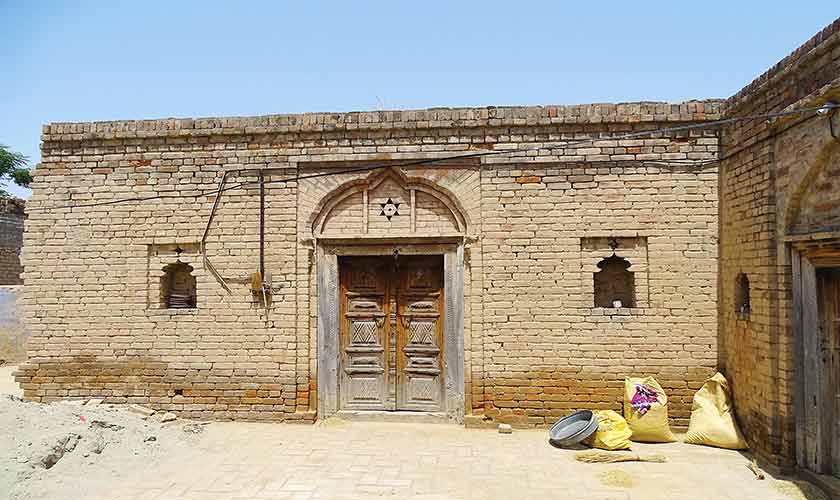
The choubaras of its Sikh and Hindu residents once dominated the landscape of Turkwal. The remains of a few old buildings still exist, but much of their original glory has been lost during renovations. Most of the other structures have been demolished. Some of the old buildings I saw in 2015 no longer exist. These structures were noted for intricate wood carvings. The carved wooden doors and ceilings were the distinctive features of those choubaras. There were also beautiful houses of the Mughal Kassar Muslim community in the village. A majority of the houses built by Muslims in pre-Partition days too have been either demolished or renovated. After the Partition, several Muslim Rajput families came from Kashmir and settled in Turkwal village.

Later Mughal Kassar and Rajput families began leaving Turkwal village for nearby towns and, increasingly, for overseas destinations, especially the Middle East. Through the steady flow of remittances, migration became embedded in everyday village life and emerged as a central force of social change. The Pakistani Diaspora, though physically distant, remained socially present, reshaping Pothohar’s culture and social relations. Investments in larger houses, expanding businesses and real estate were not merely economic decisions; they were expressions of status, aspiration and belonging, gradually redefining the village’s built environment and social hierarchy.
While building a new house or expanding an older one, the precious wooden-carved doors and ceilings were replaced with concrete ones. A majority of the houses in Turkwal once had wooden doors, which once served as identity markers of the village. Over the last few decades, several carved wooden doors have been removed from houses.
Carved wooden doors were found in almost every pre-Partition building in the village. A majority of the intricately carved wooden doors were used in mosques and mansions. The nearby villages of Turkwal, including Fim Kassar and Siral, are noted for stone-built mosques whose wooden doors are skilfully carved. Notably, the wooden doors of Siral and Fim Kassar mosques are ornately carved. One does not find such highly crafted doors in the Chakwal and Rawalpindi districts.

Apart from these mosques, one also finds an ornately carved door at the Jamia Masjid in Chawli, Chakwal district. The Chawli mosque is noted for its carved wooden door and wooden-pillared hall. I have also seen some of the fabulously carved wooden doors in the Muslim mansions of Siral, Neela and Gulyana villages. The house of Sultan Khan in Siral village has some splendidly carved doors. Similarly, the house of Mahar Khan and Kabas Khan in Neela village is noted for brilliantly carved wooden doors and a wooden ceiling. Likewise, the Qasr-i-Amir mansion in Gulyana has some of those richly engraved doors that one does not find elsewhere in the Gujar Khan tehsil. The houses of Ghulam Abbas, the father of Dr Fazl Hussain, whom I interviewed; Jahangir Khan; Khudadad Khan; and Mir Zaman were also noted for highly carved wooden doors. Unfortunately, all the doors were removed from these houses during renovation and rebuilding.

There are still a few houses in Turkwal with intricately carved wooden doors. These include the house of Khan Nawaz, built by his grandfather, Baz Hussain. There are four carved wooden doors, of which two are exquisitely carved, reflecting the rich craftsmanship of village wood carvers. I learned during a conversation with village oral historians that the mistri community of Turkwal engraved wooden doors. They were not only skilled wood carvers but also adept at stone carvings. The masons of Turkwal and neighbouring Fim Kassar villages were noted in Chakwal and Rawalpindi districts for their skilled mastery over woodwork and stone-craft. Some of the eminent masons of Turkwal who built houses and engraved wooden doors and ceilings included Mistri Noor Muhammad, Mistri Ghulam Hussain and Mistri Abdullah. They also constructed stone-built mosques in Turkwal village. Jamia Masjid Hanfia, Gulzar-i-Madina, is one of the earliest stone mosques in Turkwal village. This mosque was built using dressed stone slabs quarried from nearby. The mosque has also been renovated and expanded. Only the western wall of the mosque remains in its original state.
Socio-economic conditions in Turkwal have visibly reshaped residents’ lives, bringing comfort and new opportunities. Yet, this progress has silently altered the village’s architectural soul. The old choubaras stand in fragments. Only through memory can one glimpse the rich cultural heritage the village once held.
The writer is an associate professor and anthropologist at the Pakistan Institute of Development Economics, Islamabad. He has authored 18 books on Pakistan’s cultural heritage and anthropology. He tweets @kalhorozulfiqar.He may be contacted at [email protected]