Print Story
X




Tombs in Gadap’s ancient necropolis offer a rare record of Karachi’s forgotten past
| G |
adap in Karachi’s Malir district hosts many ancient graveyards. A prominent necropolis is located at the foothill of Narathar. It is situated about 4 kilometres west of Konkar in the Gadap taluka. Around Narathar, there are several stone-carved graves, including those of Mataras, the characters in the famous Sindhi folktale of Mokhi and Mataras. The tombs of Mataras are located in a stone enclosure at the foothill of Narathar. Some believe that they are located on top of the hill. I have written several articles on the folktale of Mokhi and Matara. I first visited the Narathar graveyard in 2007 and returned in 2009 and 2018.
Mokhi and Matara is a famous Sindh folktale that features a public liquor house and a woman who sells wine to eke out a living. Some Sindhi scholars believe that the events occurred during the reign of the last Soomra dynasty ruler, Hamir Soomro (1328-1349 AD). Hamir Soomro ruled the Tharparkar area. As legend has it, Natar, the mother of Mohki, served as a barmaid at Kak Mahal (the palace of Moomal), later moving to present-day Karachi, where she established a bar and a distillery.
Natar was a distiller at Kak Mahal in Moomal. She also taught her daughter Mohki to make liquor. Mokhi established a distillery and an inn on the main choraho or chowk from which four roads led to Karachi, Gadap, Mol and Hub. Traders travelling on these routes used to stay at Mokhi’s inn and enjoy the liquor served there.
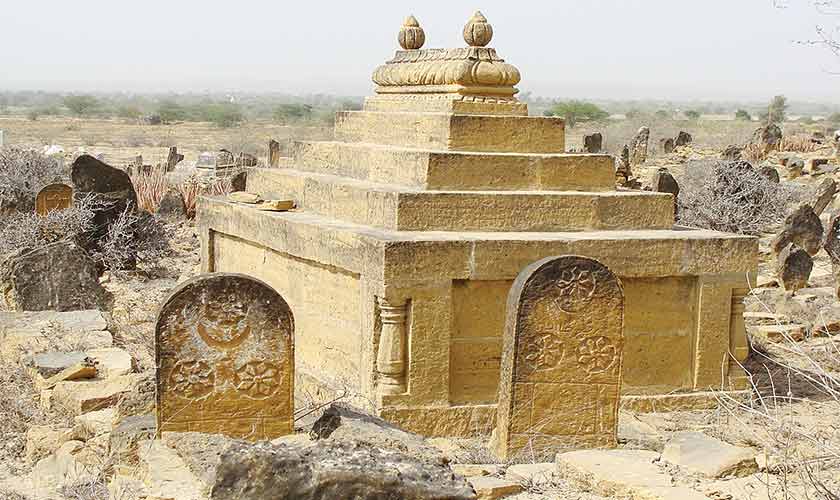
Legend has it that the fame of the tavern and the name of Mokhi travelled far and wide, and many drinkers and revellers began to frequent her bar. The madh attracted many a traveller and connoisseur.
One day, on their way back to their villages, some mataras (stout men) stopped at Mokhi’s tavern and demanded wine. At that time, Mokhi had little to offer them. Since they were regular customers, Mokhi did not want to disappoint them. She looked through the pots and eventually found some wine in one of them. However, she also found a dead snake in that pot. Mokhi took the liquor from the pot and poured it into cups for the mataras.
The mataras enjoyed the wine and demanded more of it. Mokhi told them that the pots were now empty. Later, she also told them that the liquor they drank may have been poisonous because of the dead snake. Hearing this, the mataras died on the spot. In another version of the story, they died a year later. In the latter version, when they visited the bar six months later, they asked Mokhi to serve them the liquor they had drunk the previous year. She told them that the liquor that they drank then may have been poisoned. Hearing this, they died on the spot.
Mokhi’s taven was probably located near Narathar. The remains of the bar, locally called Kafiran Ja Kot (dwellings of the unbelievers), are situated one kilometre south of Matara tombs near the village of Sohrab Faqir Jokhio. These remains are likely the bar and inn of Mokhi.
According to Dr NA Baloch, the story of Mokhi and the Mataras appears to have originated in pre-Islamic times, when the socio-political influence of Iran extended to Sindh during the Sassanid period (4th to 7th century AD). Mokhi is a Sindhi-ised form of moghi. Moghan, the Zoroastrian priests, used to serve the ceremonial wine at feasts and festivals.
A necropolis northeast of the Matara tombs contains the graves of the Jokhia tribe. According to Muhammad Ashraf Jokhio, a primary school teacher at the Government Primary Boys School Sohrab Faqir Jokhio, the battle between Burfats and Jakhras took place near Narathar. It was called the Battle of Narathar. Dr NA Baloch has mentioned this battle in his book Jangnama. This battle occurred during the Kalhora period (1700-1783). One learns from Dr Nabi Bakhsh Khan Baloch that this battle followed some skirmishes between Burfats and Jakhras. He states in Jangnama that in a certain encounter, Burfats killed Aari Jakhro, a notable of the Jakhro tribe. It is believed that Jam Bijar, then the chief of the Jokhia tribe, supported and encouraged Jakhras to take revenge for the killing of Aari Jakhro. After frequent cattle rustling between them, the conflict escalated to a tribal scale, and they finally faced off at Narathar Hill. Both tribes fought like hell. Jakhras lost the battle and Burfats emerged victorious, becoming more powerful and challenging the authority of many other tribes. We know from Sindh’s tribal history that the Burfats fought several battles with other tribes.
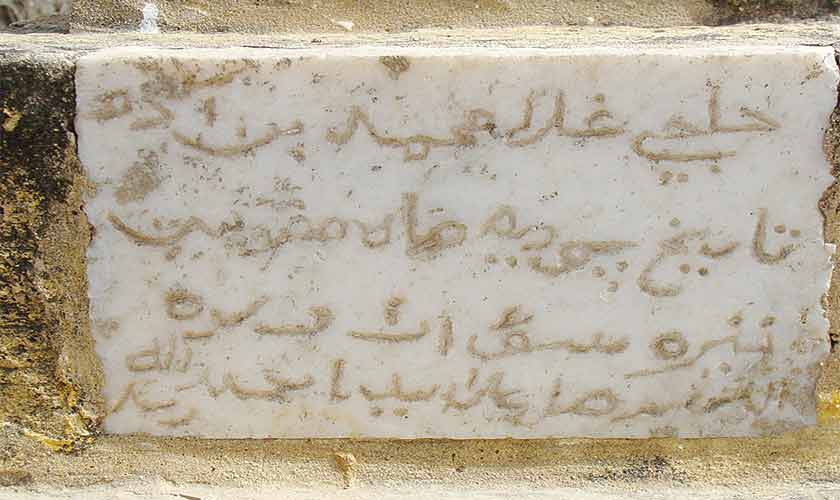
The Narathar necropolis of the Jokhias is far more than a burial ground of finely carved stone graves; it is a living archive of memory.
It remains uncertain whether those who were killed in the battle were laid to rest at Narathar. Nothing is known about this.
However, Narathar graveyard contains the graves of the Jokhia tribe. It is known as Narathar graveyard and Jokhia graveyard. It is one of the most ancient graveyards of various lineages of the Jokhia tribe in Gadap. According to Muhammad Ashraf Jokhio, this graveyard served as a collective burial ground for all people of Jokhia villages in Gadap. People after whom many of the villages are named are buried in this graveyard, including Haji Jokhio, Mureed Jokhio, Mangio Jokhio, Radho Jokhio, Sohrab Faqir Jokhio, Ghulam Muhammad Jokhio, Qadu Jokhio, Ghanwar Jokhio, Bakhar Jokhio, Ghulam Ali Jokhio and Soomar Jokhio.
This graveyard dates back to the 17th Century. The first category of graves, mostly without ornamentation, is from that period. Graves in the second category, lime-plastered, date back to the Eighteenth Century. The third category of graves is stone-carved graves. These emerged in the last quarter of the Eighteenth Century and continued through the 20th Century. There are also some modern graves, mainly concrete and partially marble-covered. People stopped burying their dead in the graveyard after 1998. They now bury their dead in their respective villages. People of Haji Jokhio, Mureed Jokhio, Magio Jokhio, Pab Mali, Radho Jokhio, Sohrab Faqir Jokhio, Ghulam Muhammad Jokhio, Qadu Jokhio, Ghanwar Jokhio, Bakhar Jokhio, Ghulam Ali Jokhio and Soomar Jokhio used to bury their dead in the Narathar graveyard.
Most of the stone-carved graves are from the 19th and 20th Centuries. A few tombs are noted for their decorative schemes. One of the most impressive is the stone-carved grave of Qaisar Khan Jokhio, a subedar in the Thatta police department during the colonial period. As per the inscription on his grave, he died on 30 Jumada al-Thani, 1323 AH/ August 31, 1905 CE. Interestingly, the inscription on the grave of Qaisar Khan records the cost of its construction: Rs 200. The detail offers insight into local practices of remembrance. Similar notations are found on several graves across Malir, Thatta and Jamshoro, suggesting that recording funerary expenditure is not incidental but part of a shared cultural practice.
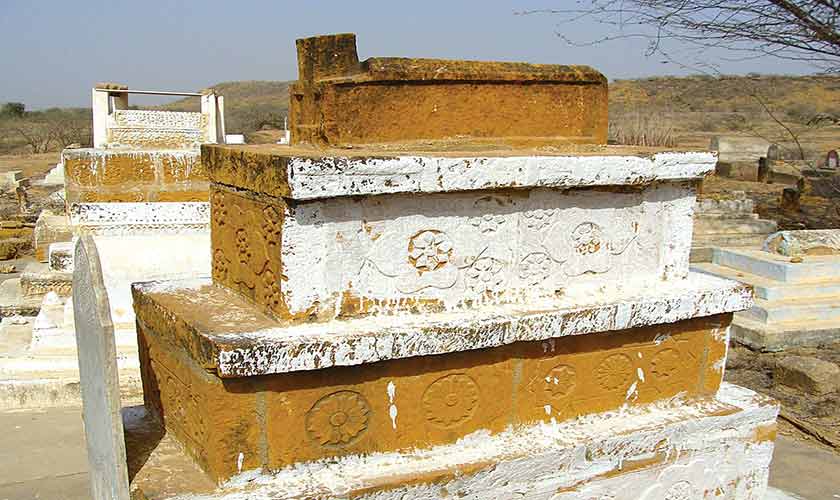
These figures are not merely economic markers; they carry social meaning. They acknowledge the effort and resources invested by the family, reflect notions of honour and obligation. At times, they signal social standing within the community. The inscription of cost thus transforms the grave into more than a site of burial; it becomes a narrative surface where memory is materialised. In this way, the grave records not only the presence of the deceased but also the relationships, values and moral economy through which the dead are remembered in the landscape.
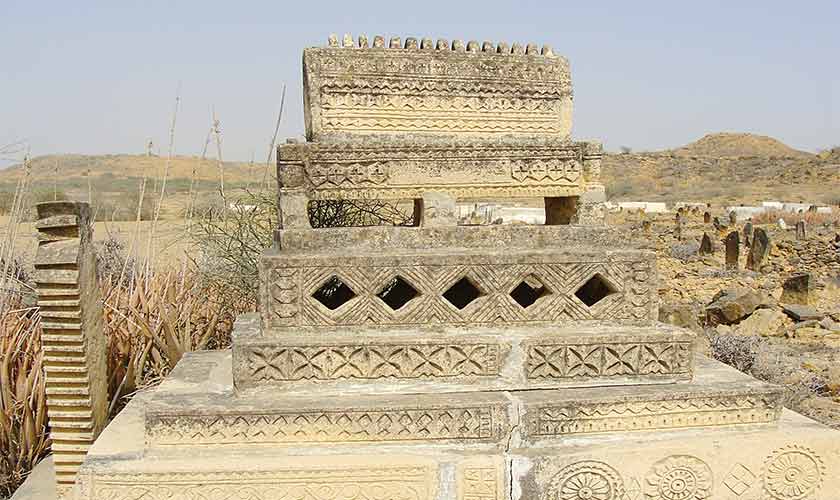
The grave of Qaisar Khan is a fine example of Sindhi funerary architecture, combining structural solidity with rich ornamental detail. It consists of a single casket with a balustrade. Decoration on the balustrade is remarkable, depicting a series of stylised ewers alternating with floral scrolls, symbolising water, purification and the continuity of life in a funerary context.
The headstone of the grave rests on two receding tiers. The casket or chamber of the grave is decorated with floral patterns. Nook shafts add beauty to the structure. Nook shafts are also found on one or two other graves in Narathar graveyard of the Jokhia tribe. The headstone of Qaisar Khan Jokio’s grave is carved with a sword on one side and a gun on the other. Swords and guns are also found on other grave stones in the necropolis.
Generally, one finds one- to three-casket graves in the Narathar graveyard. A three-casket or three-chambered grave belongs to Abdul Karim Jokhio, son of Ibrahim Jokhio. The inscription on his grave lists his date of death as 11 Muharram, 1364, corresponding to December 26, 1944. The grave is decorated with floral patterns. There are two other stone-carved graves, one belonging to Sohrab Faqir Jokhio, the founder of the village of the same name in Gadap.
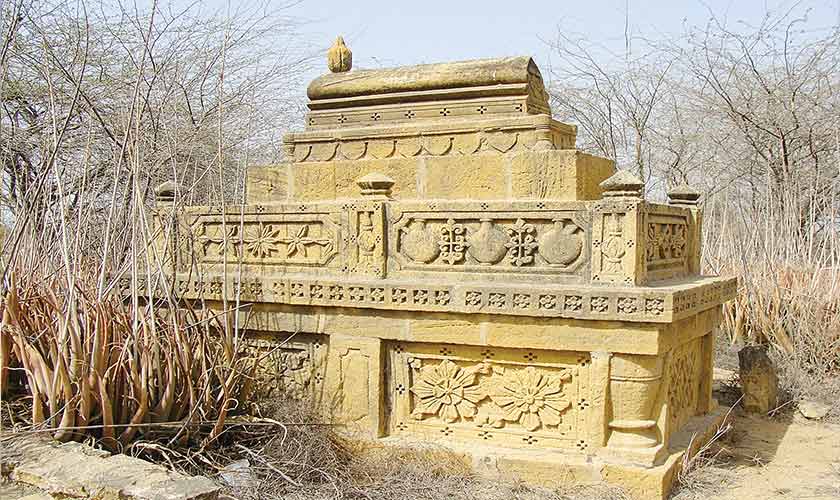
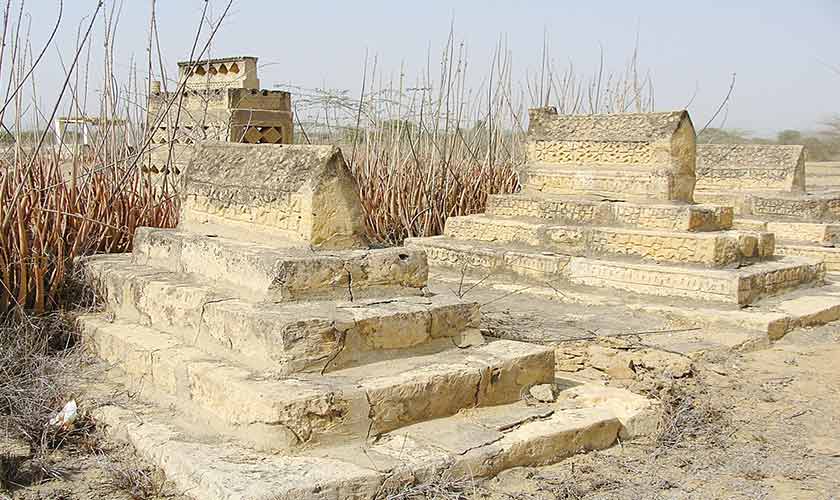
Walking through the graveyard, one comes across another remarkable grave. It is a multi-tiered grave with perforations on the lower and upper parts, noted for its diamond-like perforations on the lower and rectangular cuts on the upper. The rectangular perforation slab is superimposed with another, finally carrying the headstone of the grave. This grave also has a magnificent gravestone on the northern side depicting a stylised plant and rossette. This grave also records the name of the deceased and, more importantly, the name of the mason who constructed this grave. The mason was from the Bura community. Artisans of the Bura community were skilled stone carvers and masons who constructed graves not only in this graveyard but also in several others in Gadap and Thano Bula Khan.
Another magnificent stone grave, noted for its nook shafts on the casket and an impressive headstone with lotus buds, rendered with two finials or turbans on either side, in the necropolis commemorates Haji Ghulam Muhammad Jokhio, the founder of the village with the same name in Gadap taluka. As per the inscription on his grave, he was the son of Adam. According to the inscription, he died on 13 Safer, 1308, corresponding to September 28, 1890 CE. To the south of the grave of Haji Ghulam Muhammad are two gravestones bearing the names Rahim Khan and Wadero (landlord) Baloch Khan. Apart from stone-carved graves, one also comes across exquisitely carved gravestones in the cemetery. Some of the gravestones depict mosque motifs along floral patterns.
Also Buried in this necropolis is Jakhro Jokhio, who died fighting dacoits in 1925 in Gadap. Locally known as Gadap jo Dharro, this event refers to a robbery that occurred in 1925, when an armed group of bandits looted the jewellery shops owned by Hindus. No one dared to confront them except for Jakhro Jokhio and his friend Chhato Jokhio, who died fighting the bandits. It is said that Jakhro Jokhio had entrusted his jewellery to a Hindu jeweller, which is why he refused to let the dacoits take it. His courageous fight against the bandits is celebrated in local poetry.
The tombs of Narathar are constructed from locally quarried buff sandstone, characterised by its pale yellow-brown hue and suitability for fine carving. The Narathar necropolis of the Jokhias is far more than a burial ground of finely carved stone graves; it is a living archive of memory. Here, history lingers in the inscriptions etched into tombstones; unfolds through the symbolic motifs carved across their surfaces; and breathes through the rich folklore that continues to surround and animate these monuments.
The writer is an associate professor and anthropologist at the Pakistan Institute of Development Economics, Islamabad. He has authored 18 books on Pakistan’s cultural heritage and anthropology. He tweets @kalhorozulfiqar. He may be contacted at [email protected]