Print Story
X




As awards season reaches its climax, cinema once again finds itself entangled in questions of power and politics
| A |
s Hollywood moves into the final stretch of the awards season, the mood is markedly different. In the run-up to the Oscars, echoes of the Golden Globes linger, not because of red-carpet glamour or box-office triumphs, but because of what many actors, directors and writers chose to say about the cultural health of the contemporary world. The speeches, carefully worded yet unmistakably charged, reminded audiences that cinema does not exist in a vacuum. Films are made by people who live in the world, and inevitably reflect the moral, emotional and political pressures of their times.
There is, of course, a long-standing insistence that film should be kept separate from political heat. Cinema, according to this view, ought to offer escape rather than confrontation. Yet this argument has always been fragile. Films are located in the same world where human beings make their emotional and intellectual choices; where conflicts shape lives; and where power determines whose stories are heard. To pretend otherwise is to ignore the very conditions under which art is produced.
Over the past three years, the conditions have grown increasingly unstable. Norms and protocols once taken for granted have been openly challenged; and in many cases discarded altogether. Individual freedom, the right to self-determination and the sovereignty of nation states have been undermined by a renewed faith in military force as the ultimate arbiter of global affairs. Against this backdrop, cinema’s engagement with political realities has become not only inevitable but urgent.
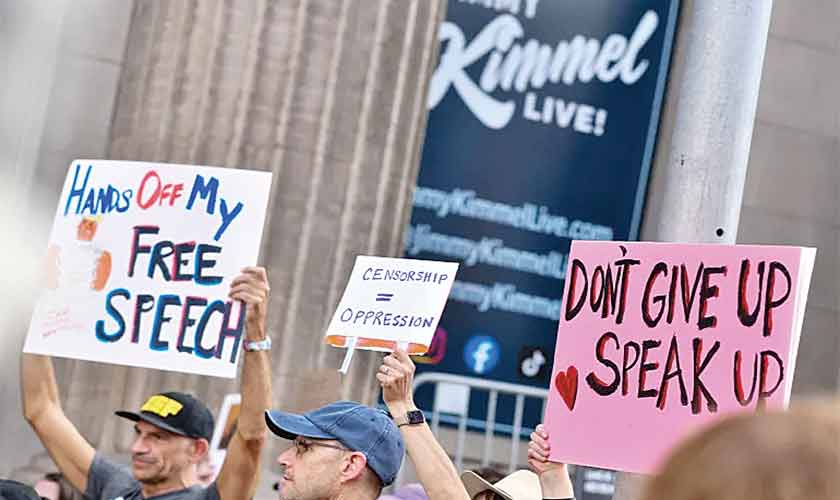
Few issues illustrate this tension more starkly than Palestine. Numerous films have explored Palestinian history, identity and dispossession. Several have been recognised at major international festivals. Alongside awards and acclaim has come a disturbing pattern of backlash. Filmmakers, actors and activists associated with these projects have faced intimidation, professional consequences and, in some cases, threats of violence. In this climate, freedom of expression no longer feels secure. It is conditional, vulnerable and increasingly subject to retaliation.
Hollywood has faced ideological persecution before. During the McCarthy era, the industry endured one of its darkest chapters as writers, directors and actors were accused of communist sympathies, blacklisted and forced to recant. Some informed on colleagues to save their careers; others left the United States altogether, seeking refuge in Europe. The period left deep scars but it also produced a lasting consensus within American cinema: an instinctive rejection of authoritarianism, whether fascist or communist, and a belief, however imperfectly realised, in artistic freedom.
For decades, those freedoms shaped how stories were told and received. Audiences learned to recognise cinema as a space where social anxieties could be explored indirectly, through metaphor, genre and character. Today, however, the challenge feels different. It is not simply a matter of ideology, but of shifting parameters altogether. The very idea of what can be said, shown or questioned is under renewed scrutiny.
Now freedom of expression is not secure; it is exposed to retaliation and violence.
A similar transformation is visible in Indian cinema. Once celebrated for its secular ethos and its commitment to pluralism, mainstream Hindi film has increasingly aligned itself with religious majoritarianism and narrow nationalism. Films that reinforce dominant narratives now enjoy state patronage and commercial success, while dissenting voices struggle for visibility. In this context, a return to earlier values does not appear imminent. The trajectory seems firmly set, with cinema enlisted in the service of a redefined national identity.
Hollywood’s future, by contrast, remains less predictable. While commercial pressures remain intense, the global nature of contemporary filmmaking has opened space for resistance. International co-productions, streaming platforms and festival circuits offer alternative routes for films that might otherwise be marginalised. The assumption that art imitates life still holds, but there is also the unsettling possibility that life may begin to imitate art, absorbing its myths, fears and justifications.
For filmmakers willing to challenge dominant narratives, the task can feel almost punitive. To speak honestly is to risk professional isolation or public condemnation. History is filled with examples of artists who paid a heavy price for defying moral orthodoxies, whether imposed by the state, the market or social consensus. Today, as societies grow more conservative and religious and cultural groups more sensitive to representation, the boundaries of acceptable discourse continue to shrink.
Film festivals were once imagined as a corrective to this pressure. By freeing films from the tyranny of the box office, festivals created a space where critics, rather than ticket sales, shaped reputations. Awards such as the Oscars emerged from this balance: a recognition of popular appeal tempered by critical judgment. In theory, this equilibrium allowed cinema to remain both commercially viable and intellectually engaged.
This year’s awards will test whether that balance still holds. If critical acclaim carries genuine weight, if films that question power, expose injustice or complicate easy narratives are recognised, then there remains hope for cinema’s moral function. If, however, safety and spectacle prevail, the message will be unmistakable.
The stakes are no longer merely artistic. They are cultural and ethical. In a world increasingly defined by polarisation and fear, cinema’s capacity to reflect complexity matters more than ever before. The question hovering over this awards season is not simply which films will win, but whether film itself can still afford to tell uncomfortable truths and whether audiences are prepared to listen.
The writer is a culture critic based in Lahore.