Print Story
X




A journey into Kazakhstan reveals a country shaped by chance
| W |
e had spent 10 days in Uzbekistan, a country that had quietly won our hearts. Its cities felt like pearls set into Central Asia’s crown, luminous, layered and steeped in history. Leaving was not easy. Yet travel, by its nature, demands forward motion; ours was about to take us into almost entirely unfamiliar territory. Our next stop was Kazakhstan, a country about which we knew very little.
The limitation was offset by a single, persuasive voice. A close friend of mine had been living in Kazakhstan for three years on an official assignment. He was based in the capital. One evening, as a casual conversation drew to a close, he said, “Yasir, you must visit Kazakhstan. You won’t regret it.” The certainty in his tone was disarming. By July 2025, we had decided to follow his advice.
“If he says so, then we’re going,” I told my wife as we began sketching out our plans. She has known my friend well; his recommendations are never casual. So, she agreed without hesitation. Armed with little more than trust and a promise from my friend that “everything will be taken care of,” we set off for Kazakhstan knowing almost nothing about its geography, climate or highlights. As we prepared to cross the border from the familiar into the unknown, a flicker of apprehension remained.
Kazakhstan is the world’s ninth-largest country by land area and the largest landlocked nation on earth. It has a population of just 20 million — fewer than the city of Lahore alone. Lying primarily in Central Asia, with a small portion extending into Eastern Europe, it borders Russia to the north and west, China to the east, Kyrgyzstan to the south-east, Uzbekistan to the south and Turkmenistan to the south-west. It has a long shoreline along the Caspian Sea. Its capital is Astana. Almaty, capital until 1997, is the country’s largest city and its cultural and commercial heart. We were determined to experience both.
On July 2, after watching the light and sound show at Registan Square, the thought of leaving Uzbekistan stirred an unexpected heaviness. Tourists and locals drifted through the streets as they always did, while my wife and I sat on a bench by the roadside, sharing slices of honey cake. “We should have stayed longer,” she said, voicing exactly the way I felt.
“What if Kazakhstan has just as much to offer?” I replied. “After all, it’s the largest country in Central Asia.”
She smiled, unconvinced but curious. “Let’s see.”
Over the next few days, we would encounter a country that far exceeded our expectations. The journey began before dawn, with an early-morning train from Samarkand to Tashkent. The Afrasiyab arrived precisely on schedule and departed at 5.05am sharp, so punctual, one could set a watch by it. As the train pulled away, Samarkand slipped quietly out of view.
We reached Tashkent in just under three hours and took a taxi towards the Kazakhstan border. The plan was to cross by road. “It will be an experience of a lifetime,” my friend had assured me while we were finalising the itinerary in April. He was right.
At the border, we had to leave the taxi on the Uzbek side and continue on foot through the checkpoint. The scene was crowded and chaotic, thick with movement and noise. A boy accompanied us to help navigate the crossing. He was known to the taxi driver and had joined him during a college break. He was eager to be helpful; equally eager apparently, to experience a border crossing. As an Uzbek citizen, entering Kazakhstan was routine for him, but his excitement was unmistakable.
As we walked together, he offered a running commentary, describing how Kazakhs differed from Uzbeks in appearance, mannerism and temperament. “They have emotionless faces and are rude,” he said casually as we approached immigration. I found myself half-expecting it, and then half-believing it, when I saw a row of officials seated behind their desks.
The hall was loud and disorienting. Voices overlapped in Russian, Uzbek and Kazakh. We could not understand a word of the conversation.
A sniffer dog, unleashed, moved calmly through the crowd. My wife, who is apprehensive around dogs, immediately grew tense. “Don’t panic, it’s a trained dog,” I said quietly, trying to reassure her. Almost at once, a sudden roar broke through the hall.
A group of security personnel were restraining a middle-aged woman who was screaming at the top of her voice. During her attempt to cross from Kazakhstan into Uzbekistan, something had apparently been flagged. The officials wanted to conduct a body search. She resisted fiercely, shouting and struggling. The scene quickly descended into chaos. All immigration counters were brought to a halt as staff focused their attention on the unfolding confrontation.
Our first real encounter with Kazakhstan, even before setting foot in the country, felt unsettling and strange.
Then it was our turn. The immigration officer examined my face, then my green passport, then my face again, repeating the sequence several times. Without explanation, he walked over to a colleague at the neighbouring counter. We had no idea what was happening. Anxiety set in. I glanced at my wife; her smile had vanished.
To make matters worse, my Uzbek SIM had stopped working, leaving us unable to contact my friend in Astana. Later, he told me that during this period of silence, he had been thoroughly reprimanded by his wife for insisting on a road crossing instead of flying. He, too, had begun to worry. “Kazakhs can be stern and unpredictable,” he said afterwards, “sometimes for no apparent reason.”
The poker-faced official returned to the counter and asked why I was travelling to Kazakhstan. I attempted to explain our purpose using a mix of languages, drawing on whatever words I could muster. After a brief pause and a final glance at my passport, he waved us through. Nothing dramatic followed. We stepped out of the border post with stamped passports and into the land of the steppes.
A security officer handed us two SIM cards. I immediately slotted one into my phone. My friend had already arranged a taxi to pick us and drive us to Turkistan, an ancient city now being redeveloped as a major tourism hub. After a moment of confusion, we spotted the driver, or rather, he spotted us. Soon we were on the move in his black Hyundai Sonata.
As we left the border behind, the landscape opened up in every direction. Just a few kilometres down the road, we caught sight of what looked like the wreckage of a large ship. The absurdity of it stopped us short, a ship marooned in a landlocked country. The driver tried to explain its story, but little of what he said was intelligible.
Beyond it stretched endless plains and open fields, the horizon so distant that it felt as though the earth was melting into the sky. “This is the beauty of Central Asia,” I said, barely containing my excitement. “This is the vastness of the steppe.” My wife, equally transfixed, said nothing.
We stepped out of the border post with stamped passports and into the land of the steppes.
At around 11am, we arrived in Shymkent, Kazakhstan’s second-largest city by population.
It was the first time since entering Kazakhstan that we saw tall buildings and a modern skyline. We skirted the city centre and took the road towards Turkistan. Along the way, the landscape shifted to low-rise neighbourhoods: single-storey houses built in a practical, hut-like style suited to harsh winters and heavy snowfall.
After about three hours on the road, we reached Turkistan. Large national flags fluttered across the city, an unmistakable display of patriotic pride. Kazakhstan was part of the Soviet Union until 1991. It became independent in December that year. As we drove, we reflected on the vast scale of the USSR at its height, Kazakhstan being one of the 15 republics that emerged as independent states.
July is among the hottest months in the country, with temperatures climbing to around 40 C. The sky was cloudless and the sun unforgiving. Hungry and tired, we asked the driver to help us exchange some dollars for local currency. He took us to a bank, where we exchanged $100 for Kazakh tenge without difficulty. Despite it being a working day, the roads were unusually quiet.
After the stop, the driver asked about our plans. In turn, we asked for suggestions on how to spend a day in Turkistan. “You must go to the old city,” he said. “There is much to see in and around it.” We agreed at once.
That left us with one problem: our luggage. We had a late-night flight to Almaty and had not booked accommodation in Turkistan. The travel bags were quite heavy. Dragging those through the old city was not an option. Then an idea occurred to me. Since we intended to offer prayers at a mosque, perhaps we could ask the imam to hold our bags until the evening.
The driver approved of the plan and offered to help explain. The mosque, built in traditional Central Asian style, was quiet after prayers. The imam was speaking to another man when we approached. Our driver explained our situation and made the request. To our dismay, the imam declined. Citing security concerns and past incidents in the country, he said he did not want to risk any trouble.
We were at a loss momentarily. My wife and I looked at each other. Now what? However, we could understand the hesitation. Security concerns were not unfamiliar to us Pakistanis.
The driver suggested checking local hotels to see if any would store our luggage for a fee. We tried three or four, but none were willing. Finally, seeing our growing frustration, he made an unexpected offer: he would keep the bag with him until nightfall and drop us at the airport in time for our flight. That way, the handover would be straightforward. We agreed on the charges and accepted. At last, unburdened, we were free to spend the day walking.
We asked the driver to drop us back at the mosque, the one where the imam had declined our request, so that we could offer our prayers.
By then, the sun was directly overhead and the heat oppressive. After the prayers, we turned to Google Maps to look for nearby places to visit. My wife, glancing at the blazing streets, suggested that we find an indoor activity to escape the heat until evening. This made sense.
The map showed a nearby market and entertainment complex called Caravan Sarai, and we began walking towards it. Just outside stood a striking, golden, egg-shaped structure named Altyn Samruk. Gleaming in the sunlight, its form and surrounding wooden framework evoked the nest of the mythical bird Samruk. Inside there was a cinema with VR and AR attractions. We decided to pass it by and head straight into the complex.
Caravan Sarai blended Islamic and European architectural elements, with a narrow water channel running through it, reminiscent of Venice. By now, hunger had caught up with us. We chose a restaurant with a shaded outdoor seating area cooled by water sprinklers. After studying the menu for several minutes, we ordered nuggets and chips. Most of the dishes were beef-based and we wanted something light.
After lunch, we decided to stay indoors to escape the relentless sun. A large superstore called Magnum Super became our refuge, its powerful air conditioning offering immediate relief. Sitting on a bench, we lingered over ice cream and cold juices.
Turkistan felt unexpectedly modern. Many people bore Persian features, with fair complexions and a keen sense of style. For a moment, it felt as though we were sitting in a European city. As we cooled down, we took the chance to observe daily life around us: girls practicing dance routines, children happily clutching ice cream sticks, middle-aged shoppers pushing trolleys through the aisles. The scene was calm and unhurried. We were in the land of the Kazakhs, ready to see more.
By around 5.30pm, as the heat began to ease, we stepped back outside and walked towards the old city. After a 15-minute stroll along a pedestrian walkway, we emerged into a space framed by fountains and sculptural metal trees. Drawn out by the softer evening light, tourists had started arriving.
Passing the Yasawi Museum, a striking structure with sweeping, curved lines, we paused to take photographs. Nearby stood the International University of Tourism and Hospitality, an elegant building with domes, arches and pillars shaped in contemporary Islamic style. Trees had been carefully planted around the complex, softening its scale. I was keen to go inside, but it was a holiday and the building was closed.
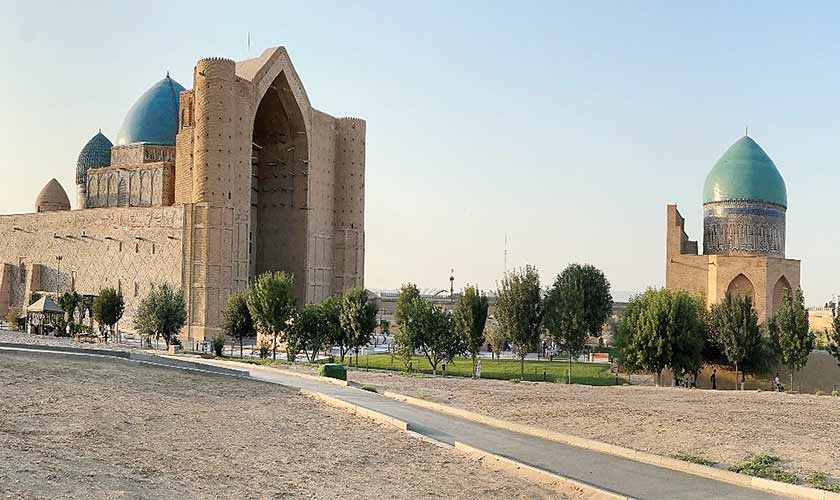
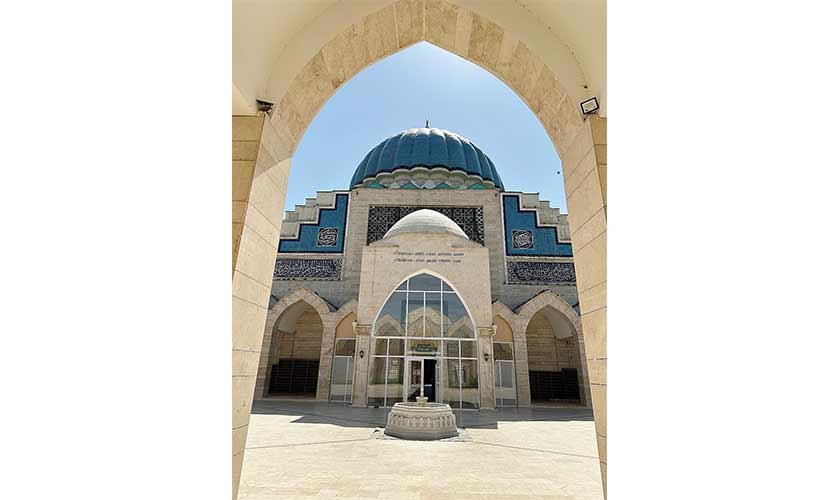
We were now approaching Turkistan’s most celebrated landmark: the mausoleum of Khodja Ahmed Yasawi. Just across from it stood another graceful structure, crowned with a turquoise dome and a pointed arched entrance, the mausoleum of Rabiya Sultan Begim, daughter of the Timurid ruler Ulugh Beg. Neatly manicured lawns surrounded the building. There were some foreign visitors, but most of the crowd appeared local.
The Yasawi mausoleum itself was imposing. Its vast entrance arch was propped with wooden poles, evidence of ongoing restoration. Much of the façade was bare, its decorative glazed tiles long stripped away, leaving the scars of time exposed. “It’s going to take them years to finish this,” I murmured to my wife. Given the sheer scale of the structure, it seemed inevitable.
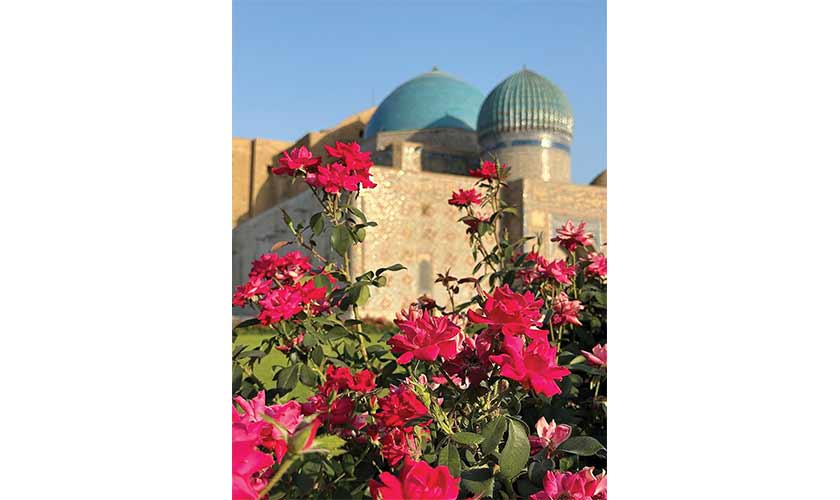
We began circling the building, where the outer walls were still clad in traditional blue tiles. At the rear, the restoration appeared almost complete. The resemblance to Samarkand was unmistakable, the style closely echoed the madrasahs of Registan Square. The ribbed dome gleamed in the sunlight. Despite the heat and our fatigue, the sight was mesmerising. For a moment, we forgot the temperature entirely.
We entered through a smaller doorway and found ourselves in a quiet chamber with a decorated mihrab, a space set aside for prayer.
Right next to the mausoleum there was a vast garden, where sprinklers arced gently over manicured lawns and rows of rose bushes. In the soft, golden light of early evening, everything shimmered.
We moved on to the other marked sites: the Juma mosque and the remnants of the old city. The mosque’s interior was supported by distinctive wooden pillars, lending it a quiet, grounded elegance. Nearby, parts of the site had been cordoned off for excavation. From there, we had a panoramic view of the Yasawi mausoleum and the grand mosque together, their scale fully revealed. A few souvenir stalls dotted the area, though nothing tempted us to stop.
As the sun dipped lower, we began walking back towards the newer part of the city. A school group passed us, children between the ages of 10 and 17, laughing, talking, brimming with energy. There was something infectious about their mood. Childhood, after all, has its own rhythm: few worries, endless momentum. They seemed happy simply to be there, much like we were.
We reached the golden Altyn Samruk building just as dusk settled in. The day was drawing to a close. We had moved between the ancient and the modern. With the heat finally gone, the air was perfect for walking. Still, we were content to stop. We called our driver and asked him to take us to the airport.
We were reunited with our luggage and settled in to wait for our flight. It had been a long, strange day. “You know,” I said to my wife, “that driver really saved us.”
Travel has a way of unfolding through chance encounters. Turkistan reminded us of that, from an imam’s refusal to a stranger’s generosity, all within a few hours. We did not yet know what Almaty would bring, but one thing was already clear: this country was full of surprises.
The writer is a professor at the National University of Sciences and Technology.