Print Story
X




Climate change has erased many of Sindh’s painted tombs and the stories they carried
| T |
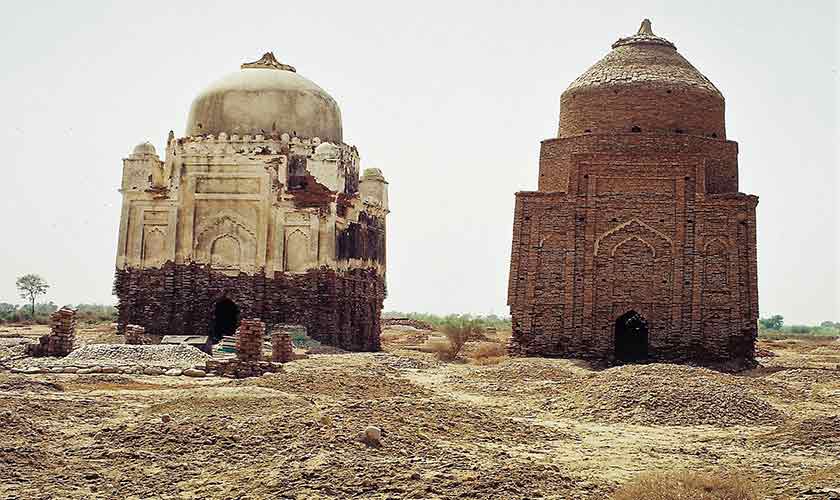
he material culture represented by the tombs in Sindh highlights its unique identity and beauty. Over the course of more than two decades of fieldwork in Sindh, I documented numerous tombs in Kamber-Shahdadkot, Larkana, Dadu, Shaheed Benazirabad and Sanghar districts, renowned for their painted romantic tales. However, over the past two decades, climate change has significantly affected Sindh’s cultural heritage. The devastating floods of 2010 and 2022 caused extensive damage to several domes, resulting in the loss of many tombs and their physical structures. Those that survived were also affected, leading to the collapse of domes and walls that exposed the interiors of the tombs. This exposure has significantly damaged the frescoes depicting romantic tales in the tombs.
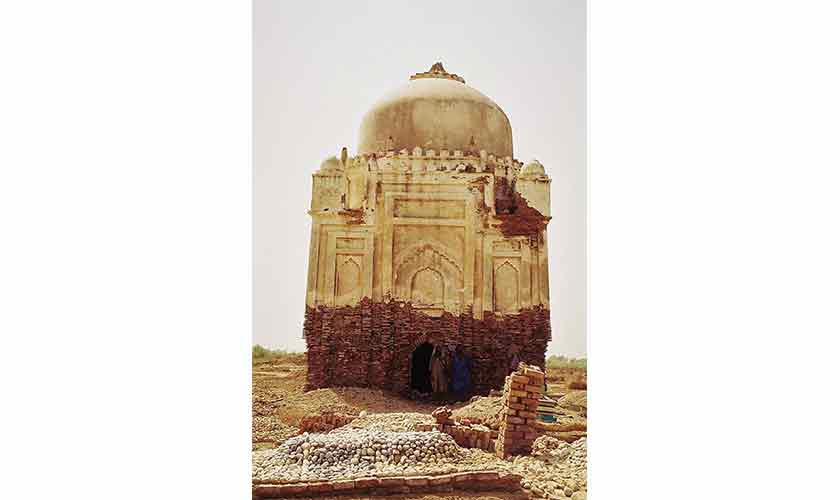
During the 2010 and 2022 floods, some tombs in Kamber-Shahdadkot collapsed. Prominent among these tombs were those of the Jamali tribe that collapsed in the 2010 floods. These had featured the most remarkable paintings of romantic tales. With the collapse of the tombs, we also lost the visual narratives that decorated the walls of the Jamali tombs. Those tombs were located in various villages of Shahdadkot taluka. Two tombs were located in Imam Bakhsh Jamali village, situated about 18 kilometres northwest of Shahdadkot town. Those tombs belonged to Mir Sobdar Khan Jamali and Bhai Khan Jamali, respectively.
Mir Sobdar Khan Jamali was the chief of the Jamali tribe during the Kalhora period (1700-1783). It is believed that the tombs were built by Mir Shaho Khan, who was either a son or a descendant of Mir Sobdar Jamali. The tomb of Mir Sobdar Khan Jamali was adorned with paintings depicting various folktales, including Sasui-Punhun, Leela-Chanesar, Nuri-Jam Tamachi, Laila-Majnun and Suhni-Mehar, as well as Moomal-Rano.
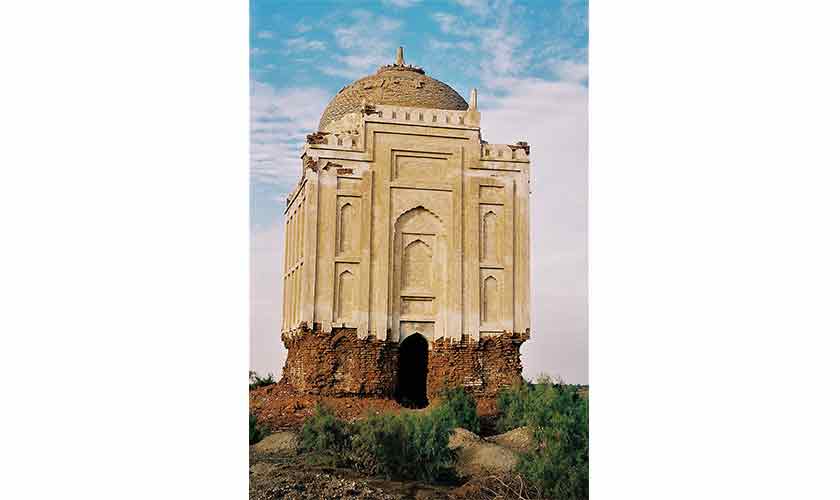
During the 2010 flood, the tomb of Shakal Khan Jamali, too, collapsed. The tomb was located about 12 kilometres northwest of Shahdadkot, along the road to Imam Bakhsh Jamali village. According to local traditions, Shakal Khan Jamali was the head of his village. Some believe that the tomb was built by his descendants. The interior of the tomb was adorned with beautiful paintings.
Paintings of Rai Dyach on the left and Laila and Majnun on right in the tomb of Rehan Khan Jamali
Another historic tomb collapsed during the 2010 floods. This tomb had belonged to Saeed Khan Jamali. It was located about 20 kilometres north of Shahdadkot town in the Qubo Saeed Khan village. The tomb was constructed using baked bricks and was adorned with floral paintings.
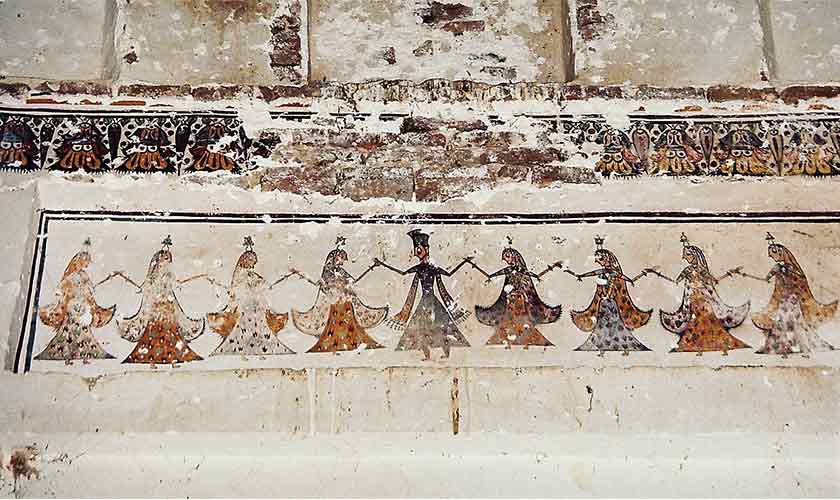
Another historic tomb commemorating Rehan Kahn Jamali collapsed in 2010. This tomb was located about 12 kilometres west of Shahdadkot near Noor Nabi Village on the road leading to Garhi Khairo town. The tomb was one of the most impressive in terms of figural paintings in the entire Kamber-Shahdadkot district. The tomb was built in a square plan with a hemispherical dome. One of the distinctive features of the tombs of the Jamalis was painting. Except for Saeed Khan Jamali’s tomb, all other tombs featured representations of animals and humans. Notably, the Jamali tombs commonly included scenes from romantic tales and dance. The tomb of Mir Sobdar Khan Jamali was adorned with depictions of dance and well-known folktales, particularly those of King Dyach and Bijal, Sasui-Punhoon, Nuri-Jam Tamachi, Moomal-Rano, Laila-Majnun, Leela-Chanesar and Suhni-Mehar. Similar stories were also painted in the tomb of Rehan Khan Jamali and Shakal Khan Jamali.
Several painted panels depicted folk romances and dance scenes in the tomb of Mir Sobdar Khan Jamali. One of the panels illustrated two folktales: Moomal-Rano and King Dyach with Bijal. The romance of Moomal and Rano was portrayed in all three tombs. In Mir Sobdar Khan Jamali’s tomb, there was a painting of Rano with his two friends, all on horseback, heading to Kak Mahal, the palace of Moomal. Moomal was depicted sitting with her sisters in the palace. Similar representations were found in the tombs of Rehan Khan Jamali and Shakal Khan Jamali.
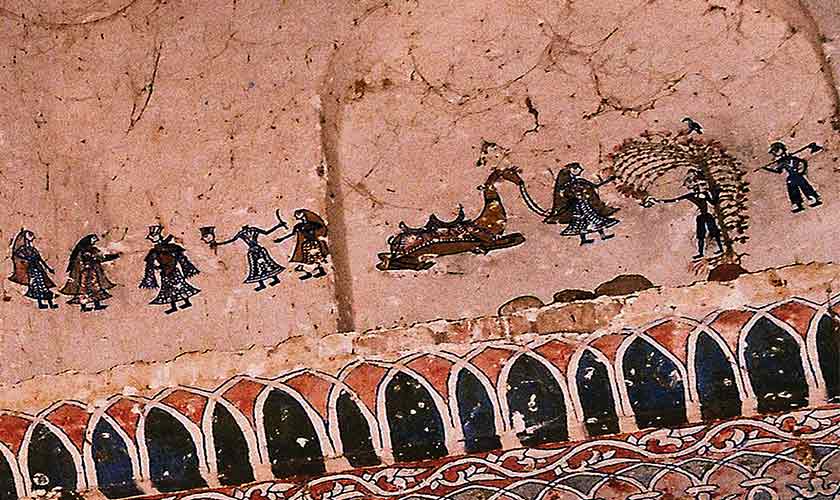
The folk tale of Rai Dyach was also illustrated in several Jamali tombs. It featured the tale’s principal characters, including Rai Dyach, Sorath, her maid and Bijal, thereby highlighting the story’s central figures. Bijal, a renowned bard from Junargah, was portrayed outside the main entrance of the palace, having made a promise to King Ani Rai to deliver the head of Dyach.
In the artwork, Bijal was seen playing his fiddle on the palace stairway. Rai Dyach was depicted presenting his severed head to the bard Bijal Charan. Beneath the image of Rai Dyach, two female figures, Sorath and her maid, were illustrated in mourning over the king’s death.
Another panel depicted several hunting and combat scenes, as well as a folktale of Jam Tamachi. The tombs of Shakal Khan and Rehan Khan also depicted the folk romance of Nuri-Jam Tamachi.
It was intriguing to view the paintings of Laila and Majnun in the Jamali tombs. Although the tale of Laila-Majnun was not local, it has captured the imagination of Sindhi artists, who illustrated it in several tombs in upper Sindh. All three Jamali tombs featured depictions of the tragic romance of Laila and Majnun, including scenes of Majnun sitting beneath a tree and Laila approaching him. Additionally, there was a figure holding an axe depicted on the left side of Majnun’s image.
The tale of Laila and Majnun, derived from the khamsa of the 12th-Century Persian poet Nizami, became a recurring theme in Mughal and Deccani paintings. These miniature paintings depict the love story of Laila and Majnun. Notable poets who have written about Laila and Majnun, or included the story in their work, include Amir Khusraw Dehlavi, Jami, Saadi, Hafiz and Hilali. The two most popular versions of the story in India are those by Nizami (1141-1209) and Amir Khusrau (1253-1325), both of which are part of their respective quintets (khamsa or panj ganj). The story of Laila and Majnun has also been one of the most frequently illustrated texts in Persian and Mughal artistic traditions.
The stories of Yusuf and Zulekha; Khursrau and Shirin; and Laila and Majnun were also depicted in the art of Ottoman and Mughal empires. The love story of Laila and Majnun first captured the attention of Persian poets and later travelled to the Indian subcontinent, becoming a popular theme in the Mughal period and the provincial painting schools. Later on, the theme was copied by Rajasthani and Deccani painters. This Arabic love story travelled through literature and art to distant lands, inspiring many poets and painters, and became a most frequently practiced theme in the literary repertoire.
Although these romantic stories were painted in Sindhi tombs, the Sindhi painters did not paint the Khusrau and Shirin tales. I don’t know the reason for this omission. Other Persian tales were painted on the walls of Sindhi tombs. Even Bahram Gur and Dilaram’s love tale is depicted in some Sindhi tombs. Khusrau and Shirin’s tale was the most popular and recurrent one in Persian painting. I have seen a representation of Khusrau and Shirin’s tale depicted on a wall of a canopy at Fin Garden in Kashan. In the Bagh-i-Erum at Shiraz, mural ceramics decorate the facade of a building depicting Khusrau and Shirin, as well as hunting scenes.
Although the tombs were swept away in the catastrophic floods of 2010, they have not vanished entirely. Through my documentation, these monuments continue to exist—as images, descriptions and memories preserved for posterity.
The writer is an anthropologist at the Pakistan Institute of Development Economics, Islamabad. He has authored 17 books on Pakistan’s cultural heritage and anthropology. He tweets @kalhorozulfiqar. He may be contacted at [email protected]