Print Story
X




The Jamia Masjid of Haral is a testament to communal devotion and local craftsmanship in the Salt Range
| H |
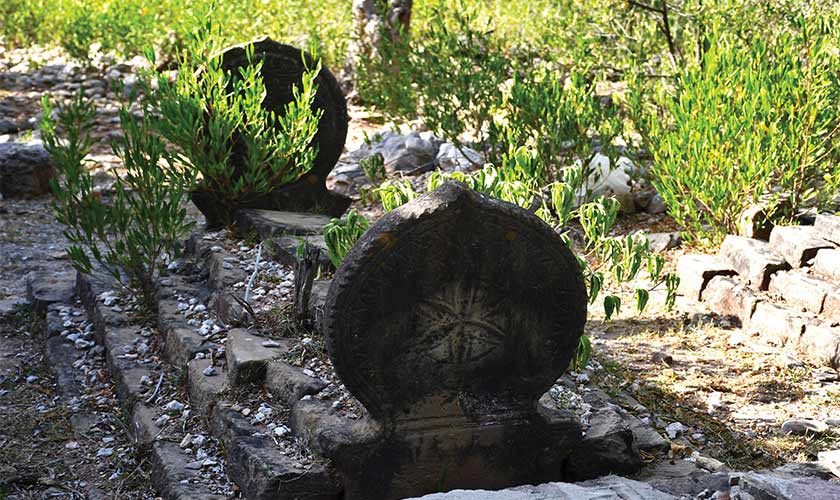
aral is a historic village in Chakwal’s Choa Saidan Shah tehsil. It lies 6 kilometres north of Basharat, a small town and union council in Choa Saidan Shah. The village derives its name from the Haral clan of the Gondal caste. According to Mehr Zafar Ali Faridi, a Haral village notable, his ancestor, Mehr Jalal Khan, first settled in Kot Umer, Pind Dadan Khan, from Mateela in Sargodha district. According to Punjab: Shehr Shehar Gaon Gaon, Sargodha by Abid Gondal, Mateela is located 11 kilometres from Kot Momin in Sargodha district. Mehr Jalal Khan and Jafar Khan first settled in Kot Umer. The great-grandfather of Mehr Zafar Ali Faridi, Mehr Jalal Khan, a subedar in the British army, founded Haral village in the first quarter of the 20th Century. Later, his cousins, Sikander Khan and Adalat Khan, also came from Kot Umer and settled in Haral village. The graves of those who first settled in Haral are located northwest of the village’s famed Jamia Masjid. All three graves are located adjacent to the shrine of Bahram Khan, about whom nothing is known. According to the inscription on Jalal Khan’s tombstone, he died in 1348 AH/ 1929 AD.
In this graveyard, there are several stone-carved tombstones, including those of Chauhans who also came with Harals from Kot Umer. They were friends of Jalal Khan. The most notable person among them was Kifayat Ali Chauhan. A majority of the tombstones in the Pir Bharam graveyard have floral designs. One of the tombstones commemorating Chan Bibi bears a prayer rug with her date of death, 1931. A majority of the graves belong to the Haral caste. The tombstones are found across the Salt Range and the Pothohar Plateau. There are several villages in Choa Saidan Shah where one can see tombstones depicting a variety of motifs. The most magnificent of these show prayer rugs and ewers.
Apart from tombstones, the Salt Range and Pothohar are also famous for stone-built mosques. Stone-built mosques have always fascinated me. Their intricate carvings reflect local craftsmanship. My extensive field visits to various villages and towns in the Pothohar region and the Salt Range for research on stonemasons and stonemasonry have opened up a largely unexplored avenue of study in these areas. In this regard, the Jamia Masjid of Haral village stands out. The Haral mosque is believed to have been constructed by Mistri Sher Muhammad, the renowned architect of Pothohar and Salt Range. Mistri Sher Muhammad was a celebrated stone mason who built several mosques in the Jhelum district, of which Chakwal was once a tehsil.
The Jamia Masjid in Haral was built with contributions from all the villagers. Everyone contributed, including women. Some of them gave their jewellery. The older mosque was demolished to make way for the new which was inaugurated in the early 1950s. Captain Hidayat Ali (retired) supervised the construction. His name is inscribed on one of the panels on the mosque’s façade. It took several years to complete the mosque. Sandstone was brought from a nearby quarry and engraved on the site. It was transported on camels to the village. Mistri Sher Muhammad carved the slabs for the mosque.
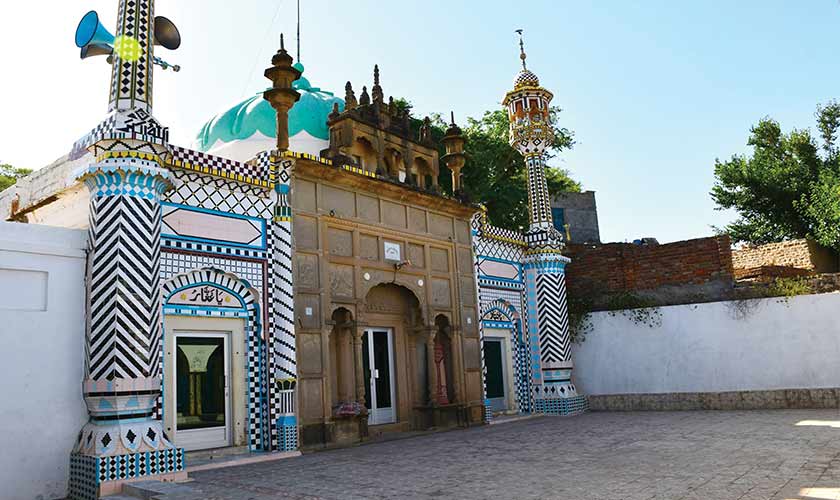
As one enters the mosque, a beautifully stone-built façade draws the visitor’s attention. Apart from Quranic verses, the mosque’s façade features an engraved flag of Pakistan with the slogan, Hukumat Pakistan Zindabad. Another decorative panel features the Pakistani flag with the word Hukumat engraved. Below the word Hukumat are engraved two other words: Islam Zindabad.
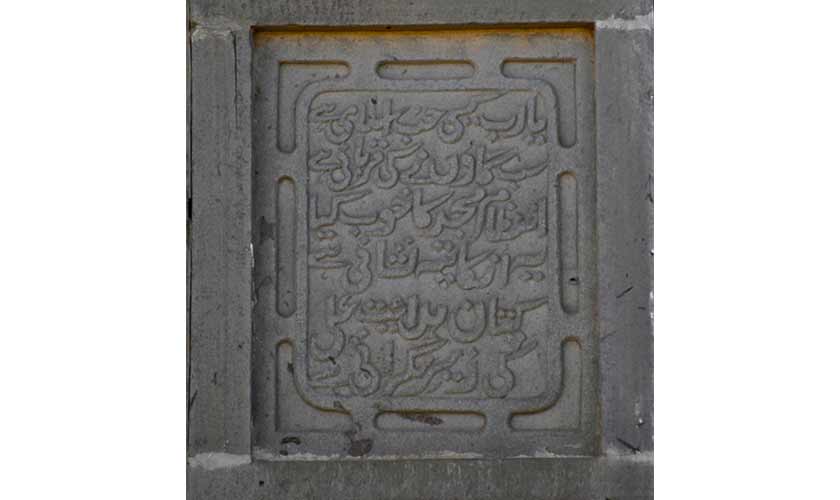
The main doorway to the prayer hall is skillfully engraved. The recessed panel above the doorway features the most magnificent carvings, depicting a series of bells set against a floral pattern. The spandrels of the recessed panel are decorated with a floral scroll, a design mostly seen in the mosques built by Mistri Sher Muhammad. Marble rosettes are also embedded in the spandrels as decorative elements. The dividers of panels have stylised fruits and floral vases with knives and scissors. On the façade of the mosque, there are two vertical panels bearing the mason’s name and the date of construction. The first panel bears the name of Mistri Sher Muhammad of Takiya Shah Murad. The second panel bears the date of construction of the mosque, 1377/ 1957.
For local stonemasons and residents alike, these features are a visual signature, easily identifiable within the traditions of stonemasonry in the Pothohar plateau and the Salt Range.
The main prayer hall is crowned by a dome constructed entirely of sandstone. This mosque is especially significant, as it is the only known example of a building by Mistri Sher Muhammad to feature a domed roof. All his other mosques were built without domes. Instead, they were covered by flat roofs supported by wooden beams. This distinction sets the mosque apart within his architectural corpus.
The stone carvings on the Jamia Masjid in Haral are exceptional. They showcase intricate designs and speak of the remarkable skill of Mistri Sher Muhammad, a master craftsman whose contributions have left a lasting legacy in Pothohar and the Salt Range.
I was amazed to see the beauty and precision of the Haral mosque. After visiting this mosque and learning about the skilful work of Mistri Sher Muhammad, I decided to visit all the stone-built mosques that he had constructed. As I moved from village to village, I began to recognise his craftsmanship in stone; carvings marked by recurring decorative motifs, disciplined symmetry and refined floral and geometric designs. For local stonemasons and residents alike, these features are a visual signature, easily identifiable within the larger traditions of stonemasonry in the Pothohar plateau and the Salt Range.
I also went to Takiya Shah Murad, a village near Khanpur in Chakwal district. There I met some descendants of Mistri Sher Muhammad. These encounters were marked not only by genealogical recollections but also by a palpable sense of pride in his craft. I also came to know in Takiya Shah Murad village that Mistri Sher Muhammad had constructed the stone-built portico of the shrine of Shah Murad in 1933. This portico is also exquisitely carved, reflecting Mistri Sher Muhammad’s mastery of stone carving. The floral and geometric motifs make it one of the most magnificent porticoes in the Chakwal district. I have visited almost all the villages in Chakwal, but not found such a refined and remarkable portal. Although one can see beautiful stone-crafted portals in some of the mosques and mansions in Pothohar and Salt range, the portal to the shrine of Shah Murad has unique elegance and grace.

Chakwal district, in particular, is home to such craftsmanship. Villages including Mona, Siral, Fim Kassar, Minwal, Vahali, Tamay, Jandial Faizullah and Kot Iqbal are dotted with stone mosques whose façades bear witness to the skill of local artisans. Many of these structures reveal stylistic affinity with the work of Mistri Sher Muhammad, suggesting either direct involvement or the diffusion of his aesthetic idiom among contemporaneous stonemasons. When viewed ethnographically, these mosques are not isolated monuments; they are deeply rooted in social memory, artisanal traditions and a regional context where stone serves as a medium for both devotion and identity.
Among the mosques built by Mistri Sher Muhammad, I also visited the Jamia Masjid in Vahali village, which stands out for its beautiful wood and stone carvings. Mistri Sher Muhammad’s name is displayed on one of the painted ceiling beams, cementing his legacy. His motifs, seen on façades, pillars and panels, exhibit unparalleled brilliance and have inspired other stonemasons to adopt and imitate his technique.
The Jamia Masjid in Haral was the last mosque he built. The villagers told me that after the mosque was completed, he went up to give a final inspection. Unfortunately, his foot slipped and he fell from the mosque roof and died. Later, some of the undecorated slabs on the façade were added by his students after his death.
The Jamia Masjid in Haral was renovated in 2014-2015 under the supervision of Captain Muhammad Yaqoob. The villagers contributed financially to the renovation of the mosque; however, most of the funds were provided by Captain Muhammad Yaqoob. During the renovation, the stone-built façade of the mosque was neither removed nor renovated. The originality of the façade was maintained.
The stone-built mosques constructed by Mistri Sher Muhammad and his students in various villages and towns across the Pothohar region and the Salt Range reflect a distinctive style of decoration, recognisable by his scheme, adopted later by his students. His architectural style and craftsmanship will continue to influence generations of stonemasons in the Pothohar and Salt Range regions.
The writer is an anthropologist at the Pakistan Institute of Development Economics, Islamabad. He has authored 17 books on Pakistan’s cultural heritage and anthropology. He tweets @kalhorozulfiqar. He may be contacted at [email protected]