Print Story
X

As the curtain falls on 2025, we ask artists and critics to reflect on how they returned to art and creative practice as a way of finding meaning in an increasingly fragmented world. Their responses, compiled here and presented in alphabetical order, do not offer solutions. Instead, they show how meaning is seldom found on the surface and more often emerges through a deeper engagement with what lies beneath.
Our writers speak of the year as it was lived – delicately held together by the belief that creative work still matters, even when the world feels adrift.
Aasim Akhtar
Art critic
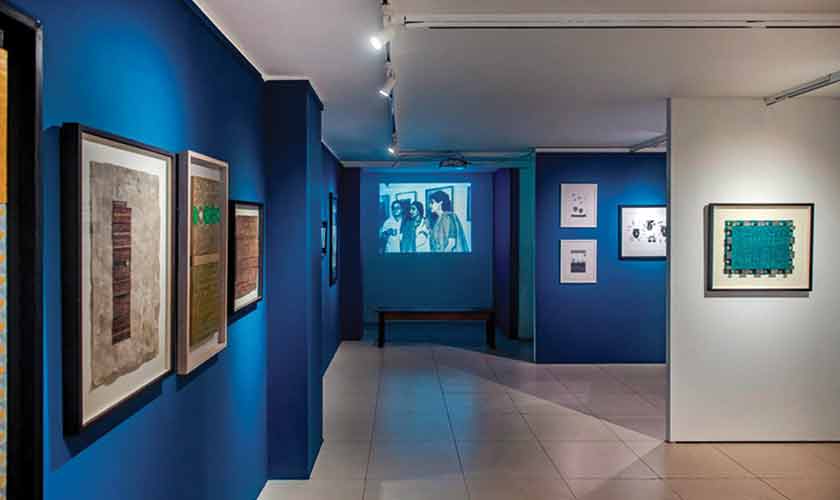
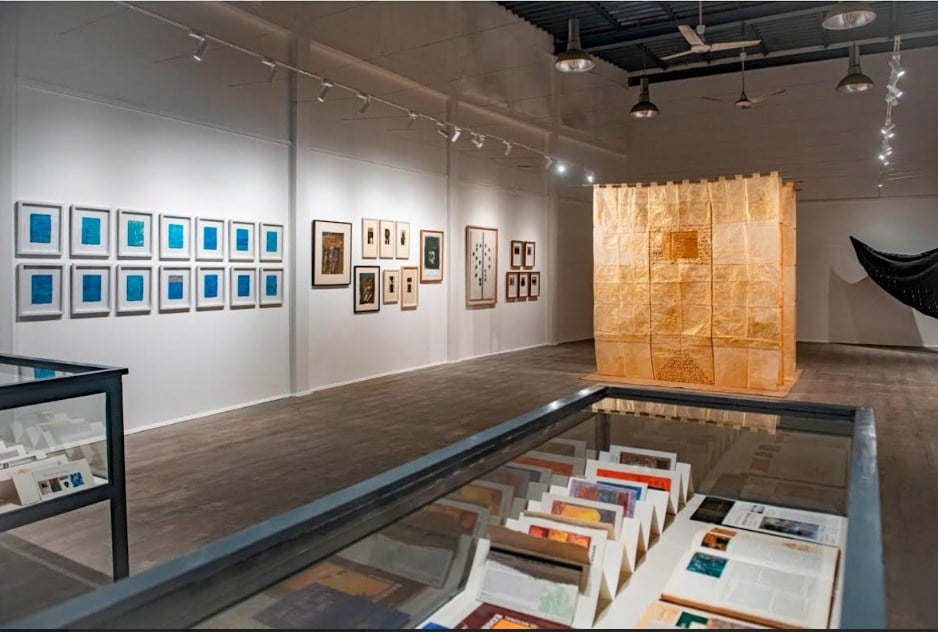
What made this year’s retrospective of Meher Afroz’s works from 1974-2025, curated by Nilofur Farrukh and held at the Alliance Française and Chawkandi Art in Karachi, all the more extraordinary, beyond its almost complete compilation of the artist’s work, were the curator’s tutorial asides linking the oeuvre to the various influences and circumstances in the artist’s career. When reading the curator’s attempt to construct a fertile ground of aesthetic influence and dialogue, these encounters intensified the recognition of Afroz’s utter singularity and incomparability.
Almost inadvertently, then, this exhibition titled, ‘...connecting internal and external time...’ seemed to suggest that one could look back at the Twentieth Century and divide its greatest artists into two types: those whose discoveries engender a potentially infinite production, and those whose definitions of aesthetic practice have radically diminished the options that would allow for an expansive artistic production.
If these paintings coalesced into nameable images, we might call them, collectively, a travelogue. Many of the works that employed text (mainly singular words and verses selected from Mir Anis’s marsiya) cobbled together a map of triangular scraps of paper painstakingly folded and embedded to articulate a pattern. The artist is not word-building, but rather way-finding. For her, the repetition of forms is a way of getting something into focus, mimicking physical phenomena. Mimicking, but not reproducing. For me, it allowed the sensation of movement in time and place, like passing through a sunset.
The skin of these works seemed an accretion of layers of paper, a shadowed quasi-alphabet, the silhouettes of plants and flowers and heads in profile. Inside the elegant lines couched in thread and wire was a palimpsest of bulbous marks that pushed in multiple directions.
Divided categorically into four distinct sections – Seenah ba Seenah, Azad Shehr ki Ghutan, Sakoon o Saraab and Dastavaiz – this first retrospective comprising more than a hundred works drawn from six decades of artistic production spoke for Meher Afroz’s playful narrative style, which offered up quixotic juxtapositions of flora with a cast of human characters.
With its wealth of detail, the exhibits’ densely wrought and constructed surfaces recalled the artist’s stint at the Government College in Lucknow, where she trained as a printmaker, before the family’s migration to Karachi in the early ’70s. It was here that the artist honed her appreciation of pattern, gleaning lessons on composition and the strategic deployment of repeating motifs. Her paintings often sport the kind of ornate borders drawing upon the tradition of chikankari in native Lucknow; their embellished edges function as footnotes to the central narrative depicted in oil and acrylic. While her use of textiles and ornamentation could be considered feminist, Afroz has never overtly characterised her practice in this way. She is, however, deeply aware of the power of women as transmitters of genetic material and, with it, collective memory. The artist draws many of her female protagonists from her own life and, in the case of Begum Hazrat Mahal, from history.
The rush to a conclusion makes me telegraphic, or maybe it is just the fact that comes from realising that with Afroz, no conclusion is ever possible. In the end, what moved me is what the show offered: a beautiful structure, simple and consistent at heart, manifold and evolving in practice, with no commercial strings attached to it.
Sarwat Ali
Culture critic
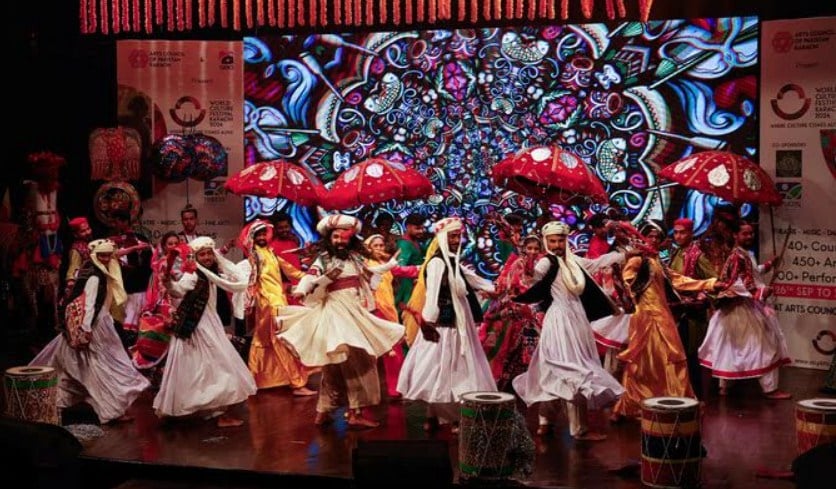
The most significant cultural moment of the year was the international festival hosted by the Arts Council Karachi, which brought together performance groups from across the world. In a country whose cultural image abroad remains weighed down by negative stereotypes, the festival offered a timely and necessary counter-narrative.
Cultural expression in Pakistan has long persisted despite ideological resistance that casts the arts as suspect or un-Islamic. Theatre, music, literature and visual art have continued regardless, though festivals have remained few. After the pioneering efforts of Rafi Peer Theatre in the 1990s, the Arts Council Karachi has, in recent years, emerged as a sustained and ambitious platform. Hosting an international festival was a significant step, allowing Pakistan to present itself not as a cultural outlier but as an active participant in global artistic exchange.
Equally striking has been the growth of literary festivals across the country. What began with the Faiz Festival, Lahore Literary Festival and Karachi Literature Festival has spread to cities such as Hyderabad, Faisalabad, Gujranwala and Multan. Large, engaged audiences signal a deep public appetite for literature, discussion and critical thought. Music, theatre and dance have increasingly been folded into these gatherings, reclaiming space for forms at risk of being marginalised.
Cinema, by contrast, struggled this year, while television continued to dominate viewing habits. Institutions like the National College of Arts, which marked its 150th year with exhibitions and performances, reminded us that preserving cultural practice remains both a responsibility and an act of resistance.
Nashmia Haroon
Artist, creative director
As we reflect on the challenges of 2025, my team and I are humbled by the resilience that has defined our journey. Global and homegrown political instability, uncertainty and chaos have tested our resolve, but we've continued to push forward – powered by our determination and the unwavering support of our community.
In times like these, art can feel like a luxury we can't afford. Yet, for us, it's a necessity. We've directed our efforts toward urgent causes, raising funds for flood relief and humanitarian support for Gaza through exhibitions, music and cultural programming. Our goal has been simple: to bring people together, foster learning and leave them feeling fulfilled.
Earlier this year, we launched our sister company, The Art Edit Advisory, to promote, guide and curate art, ensuring our nonprofit initiatives with Tagh’eer Lahore remain distinct from our commercial work. It's a model that allows us to stay focused on what matters most – impact over profit.
A significant milestone for us was participating in the Asia Now contemporary art fair in Paris, which was entirely dedicated to contemporary Asian art. Held from October 22 to 26 at the Monnaie de Paris, the fair highlighted West and South Asia. Tagh'eer Lahore presented four Pakistani artists: Amra Khan, Ayaz Jokhio, Bibi Hajra and Mizna Zulfiqar. As the fair's curator noted, Asia Now aims "to no longer be just a geography but a methodology, a movement," exploring less-covered areas and raising awareness of artistic communities in Lahore, Kathmandu, Colombo, and promoting cultural ecosystems in the Middle East or West Asia.
I'm grateful for the well-wishers and artists who've stood with us, and I'm proud of the community we've built. We're far from done; we are looking forward to a fulfilling 2026!
Rumana Husain
Author and illustrator
2025 often felt like a year lived in fragments - political unease, environmental anxiety and a persistent sense that familiar structures were quietly eroding. In such a climate, meaning did not arrive through grand statements but through small, attentive encounters. It was a year that asked for patience rather than certainty. Much of it unfolded through my engagement with art and culture - both others’ work and my own.
That sense of instability found an echo in the Pakistan Pavilion at Expo 2025 Osaka, The Universe in a Grain of Salt curated by Noorjehan Bilgrami. I did not experience it in person, yet engaging deeply with its conception, images and intent stayed with me as I wrote about it for two publications. Its emphasis on compression and fragility, rather than excess, felt attuned to the moment, suggesting that clarity does not always come from expansion; sometimes it emerges from restraint. Artist Meher Afroz’s retrospective felt less like an exhibition than a conversation across time. As her student - eons ago - I recognised the discipline in her lines, the moral seriousness of her practice and the quiet insistence that art must hold its ground even when the world feels unstable. Revisiting her work reminded me how deeply those early lessons had shaped my ways of looking and making.
A similar sense of continuity emerged in the Sindhi textiles and, more recently, in textiles from Khyber Pakhtunkhwa at the Haveli Museum in Karachi, founded and curated by Nasreen Askari, who recently retired as director and curator of the Mohatta Palace Museum after nearly three decades. Their stitches carried memory, labour and endurance. In a year of rupture, these works reminded me that meaning often resides in what has survived patiently, without spectacle.
Perhaps the most intimate search for meaning took place in my own making. Writing and illustrating bilingual children’s books: Chichori and A Jawsome Meeting of an Alligator and a Crocodile became a way to insist on empathy, play and connection. Working in two languages, and for young readers, required hope without sentimentality. Towards the end of the year, receiving the published copies of my Urdu textbook series for kindergarten and primary levels lifted my spirits. In a difficult year, meaning revealed itself in fragments: in textiles and teaching, and in stories that choose wonder despite uncertainty.
Quddus Mirza
Visual artist, art critic, curator
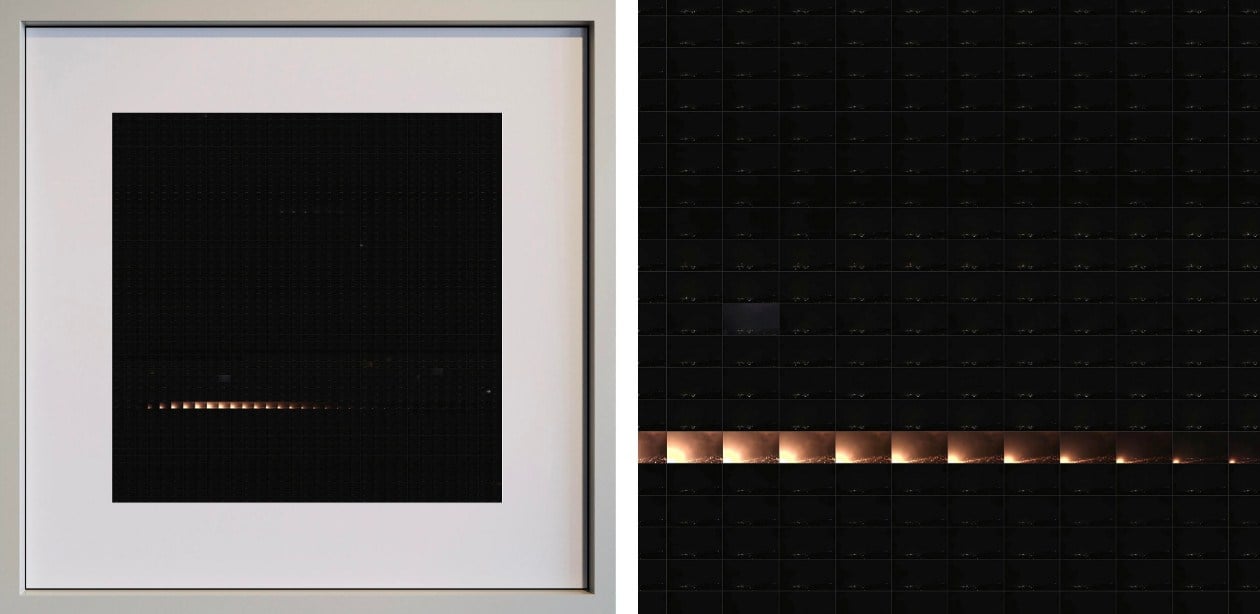
Works of art tend to have a life of their own, independent of their maker’s ideas, intentions and the understanding, perception and classification prevalent in their periods or regions. Art, which survives time surprises an audience due to its unfolding content, contexts and connotations. Rashid Rana’s Beneath the Black Square represents the essence of the year. To me, it is an encounter, sudden, often not pleasant, but it encompasses an un-ignorable reality. For his exhibition at Frieze London with Chemould Prescott Road, Rana embarked on a set of concepts, strategies and pictorial resources in March 2025. The work, in reference to or response to the iconic abstract painting Black Square (1915) by Kazimir Malevich, consists of a series of footage of Gaza at night during air strikes by the Israel Defence Forces.
Calm, silence, peace of a strip of land were shattered through the sequence of flashes, of bombs dropped on a helpless population. Rana, in this digital print, fractured the minimal supremacy of abstraction (or the calm of the Western world) by comparing it to the chaos and turmoil that ripped apart a number of countries on the other side of the political divide. Continuing with the language of abstraction, Rana systematically archived the aftermath of a shooting jet, leaving sparks from explosions in its trail.
Not only the location was not specified, but the context was unpacked too; bringing more surprises to the maker and viewers. Before the opening of his solo exhibition in July, another war broke out in May; between India and Pakistan, mainly fought in the air. This brief battle lit up the skies with fear of death and destruction. It was not dissimilar to the war in which Israel used its planes to annihilate the territory of Gaza; turning it into rubble, debris, corpses, blood stains, shrieks and wails.
Looking at Beneath the Black Square on display in London in July 2025, I realised that a work of this nature shapes history instead of being stuck in its waiting room, often through multiple accounts and unpredictable narratives.
Aarish Sardar
Art/ design critic
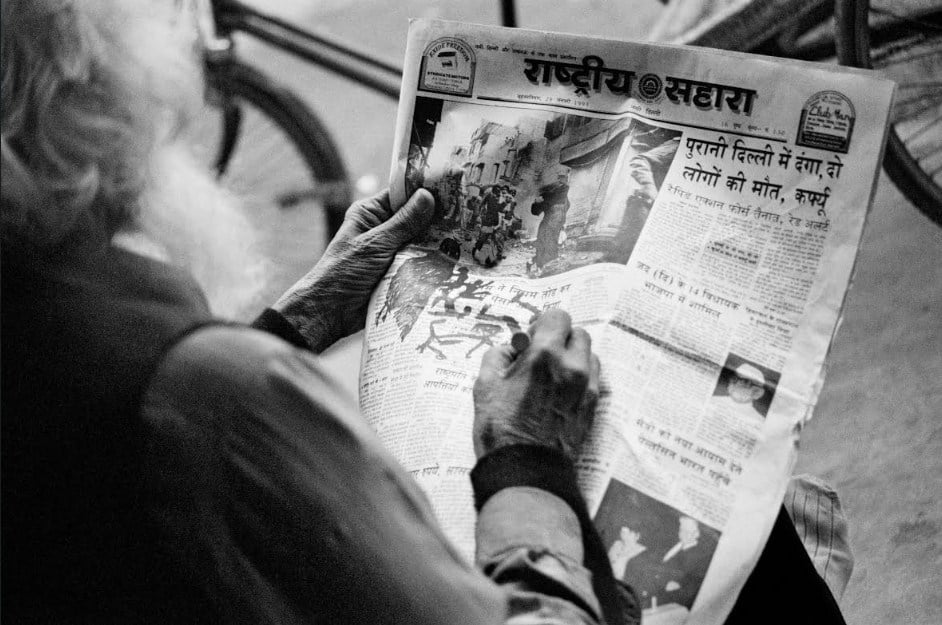
As a Pakistani art critic, writer and educator, my engagement with Maqbool Fida Husain has long been shaped by teaching, research and second-hand encounters rather than direct experience of speaking to him. Like many across South Asia, I often introduced him to students using the familiar and convenient label of the Picasso of India. Engaging with The Rooted Nomad: MF Husain through close research and a conversation with Roobina Karode, director and chief curator of the Kiran Nadar Museum of Art, encouraged me to move beyond this shorthand and reconsider Husain with greater depth and care.
Curated by KNMA and presented in Qatar, the exhibition departs from the traditional retrospective model. Instead of positioning Husain as a fixed modern master, it foregrounds movement as the central force of his practice. The immersive format brings together projected imagery, archival photographs, poetry, cinematic references and reproductions of key works to reflect an artist constantly in transition. This approach aligns closely with Husain’s refusal to be stylistically or ideologically contained.
In my conversation with Roobina Karode, what resonated most was her emphasis on Husain’s nomadic sensibility. From his early years painting cinema hoardings to his role in the Progressive Artists’ Group, Husain absorbed folk traditions, popular culture, mythology and modernist experimentation with remarkable ease. His engagement with religious and historical imagery was never illustrative or reverential. It was exploratory, critical and deeply tied to lived experience. The immersive format, she explained, allows viewers to encounter this plurality as an unfolding journey rather than a linear art historical narrative.
This spirit of experimentation is also evident in the Husain-Doshi Gufa in Ahmedabad, a collaboration with architect Balkrishna Doshi. The underground structure, with its cave-like form, organic geometry and painted surfaces, translates Husain’s visual language into inhabitable space. For me, the Gufa fits squarely within a subject I teach, Fiction and Speculation in Architectural Design, where architecture becomes narrative, experiential and imagined rather than purely functional. It stands as a compelling example of how artistic vision can speculate on alternative ways of occupying space.
Revisiting Husain through research and curatorial dialogue has been intellectually invigorating. The Rooted Nomad presents an artist in constant motion, reminding educators and critics alike that art history remains open, speculative and continually reinterpreted.
Fatma Shah
Writer and curator
When I returned to live in Lahore in 2017, I longed to roam the bazaars of Lahore and Rawalpindi, where I had grown up, searching for familiar objects — cups and saucers, earthenware containers and baskets. Instead, I was often met with the deadpan response of “baji, yeh ab nahin banatay” or the familiar refrain, “woh karkhana band ho gaya hai”. Much like the gleaming nouveau architecture that surrounded me, there was an emphasis on the bright, the glittery and gold-tinted imported objects — dividends of globalisation. This led to my first pop-up exhibition, Revival & Reincarnation, which sought to show that handmade objects may no longer exist in their earlier forms, but could still be reimagined as unique offerings, designed to remain relevant to contemporary living.
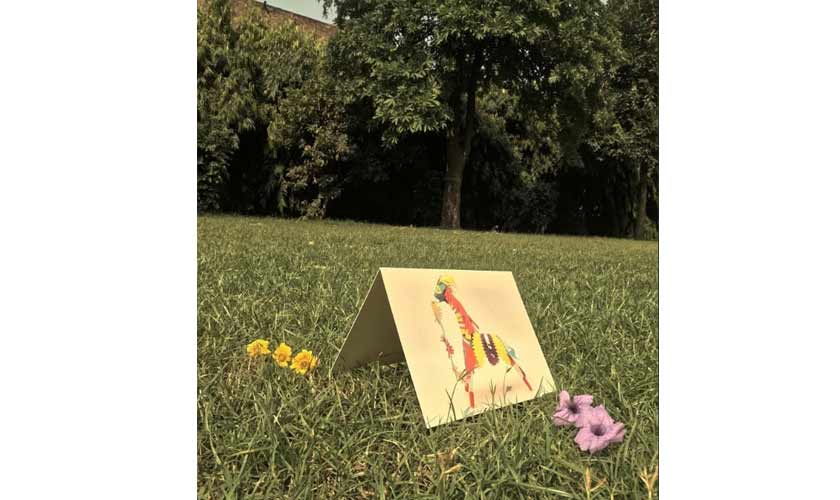
Reflections on this endeavour, and on the journey of a young man, became a cultural moment that revived my faith in the resilience of Pakistan’s handmade artistic traditions. That young man is Waqas Manzoor — a visual and performative storyteller, fluent in both Urdu and Punjabi, and an accomplished photographer documenting people and practices, now in a forthcoming film. Waqas has undertaken an emotional journey with time-honoured indigenous toys made of recycled paper, straw and clay, inviting viewers to accompany him through photographic portraits of these toys and their neglected makers. Once sold in cities and villages on pushcarts, these eco-friendly ghuggoo ghoray, dugdugi, damru rattles and miniature painted vessels are now rarely seen, occasionally sold on weekends by men on bicycles or outside shrines. Sold cheaply, they barely secure a day’s wage for their makers — the true creatives. Through his interventions, Waqas compels us to recognise these simple toys as relevant to children’s lives today, and their makers not merely as craftspeople, but as creative practitioners sustaining a fast-disappearing art and culture.
Suljuk Mustansar Tarar
Art critic
A work of art resonates with different people in different ways. A known work comes with its history and backers, pushing an onlooker to appreciate it, but a new work by a relatively young artist requires one to establish a dialogue with that work. You either pass by or stay on to develop a dialogue. Syed Hussein, a miniature graduate from the NCA, contacted me some time ago to respond to one of his works through writing about it. The work was part of an exhibition curated by RM Naeem in Paris.
Syed Hussein looks like an artist from a karkhana – a workshop patronised by a Mughal ruler, with a number of miniature artists sitting and working together on different commissions. Perhaps I get this feeling because of Hussein’s Hazara features and the delicate work that he produces. There is a sense of realism in his work, but without being too dramatic. His work is mostly figurative and captures ordinary people from his life, social circle and community. They could be his friends, neighbours, relatives and children. In his work, they appear like characters on a stage. These characters are under a spotlight, as one can observe them, for example, standing in subtle tones in the winter sun of Quetta. They stand next to a wall, in a street, at a door, in the neighbourhood, or emerge in different identification documents. Identity is strongly underpinned in Syed Hussein’s work because of his own experiences. The characters in his work unconsciously invoke their identity, be it through expressions or the use of various documents forming the basis of identification. At different points, in our or other parts of the world, identity is legitimised by having a domicile certificate, ration card, national identity card and passport, which allows one to travel outside the country and opens the door to the world beyond. Photographs of standing outside one’s address also come in handy at times to prove identity. Hussein creatively uses all these identity records in his work.
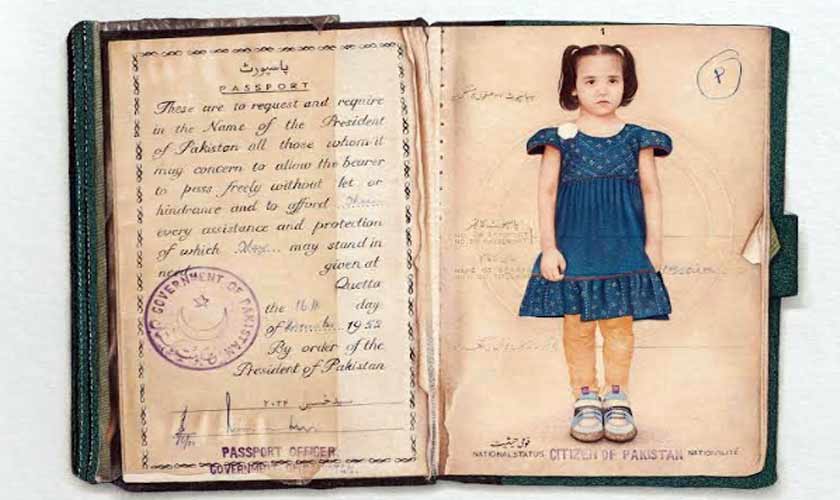
The specific work I responded to is an image of a passport belonging to his grandfather from 1958, but a portrait of his young daughter is painted in place of the passport photograph and becomes the centre stage. As an international identification document, the passport has come a long way. The one in the image is from a time when binding was manual and the stamp and signature of the issuing authority made it authentic – the artist has placed his signature in the same position. Even passport photographs have become more standardised. The young child is painted standing in a typical way, as when a child is asked to pose for a photograph in her Sunday best. At one level, the work shows a generational gap. Many years ago, it was not easy to acquire a travel document and children were documented on their parents’ passports. Now, mostly, even infants have their own separate passports. The work also shows the dilemma of the past, when acquiring a travel document or identification required tedious processes, and of the present day, when everyone is able to carry an identity but must also balance multiple aspects of it – typically national, ethnic, religious, socio-economic and political, and, at times, in the case of the diaspora, dual nationalities. Syed Hussein’s innocent characters peer out from all his works, questioning these multiple identities and wondering where they actually belong in terms of an original identity.
With the world adrift in 2025, I felt that Syed Hussein’s work speaks volumes about how identities are being reinforced yet remain fluid, in a world driven by algorithms and extreme political ideologies, while a new generation looks at us from an uncertain vantage point.