Print Story
X




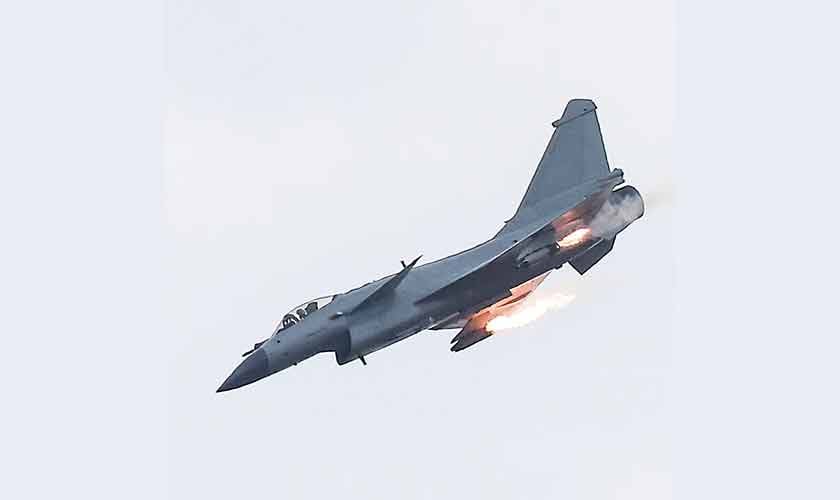
PAF humbled India after New Delhi launched unprovoked strikes against Pakistan.
| T |
he May 7 morning dawned with war drums being beaten. In an overnight operation, India had launched missiles and jet strikes in Azad Jammu and Kashmir and in the Punjab, Pakistan. The missile strikes were carried out in Bahawalpur, Muridke, Gulpur, Bhimber, Chak Amru, Bagh, Kotli, Sialkot and Muzaffarabad. The projectiles hit populated areas, including some mosques. India later said the strikes were meant to avenge the April 22 Pahalgam attack – a terrorist incident in which five militants killed 26 tourists – that it blamed Pakistan for, without sharing any evidence.
According to a report recently released by United Nations special rapporteurs and independent experts, the strikes represented a breach of international law. UN experts point out that international law does not recognise any state’s right to employ military force under the pretext of counterterrorism. India also didn’t formally inform the UN Security Council of the so-called act of self-defence under Article 51 of the UN Charter.
Soon after the Pahalgam attack, India unilaterally ‘suspended’ the Indus Waters Treaty. The report says such unilateral suspension is unlawful as it circumvents established procedures.
Presuming itself to be the judge, jury and executioner, India carried out a misadventurestrikes by the Indian Air Force resulted in global embarrassment for New Delhi when the Pakistan Air Force downed seven Indian military jets, including the glorified Rafale, promoted as pride of military hangars. The best modern European fighter jet faced the defenders of Pakistan’s skies, the Pakistan Air Force, who, despite having the capability of downing more jets, refrained from doing so. Quaid-i-Azam has famously said, “A country without a strong air force is at the mercy of any aggressor. Pakistan must build up her air force as quickly as possible. It must be an efficient air force, second to none.” The PAF proved that it was second to none.
After the initial strikes on May 7 morning, India expanded its military operations to strike eight Pakistani air bases, including the Nur Khan Air Base in Rawalpindi.
In response to Operation Sindoor, and exercising its right to self-defence, Pakistan launched Operation Bunyan-un-Marsoos, carrying out missile and drone strikes on 26 military sites across India and Indian Occupied Kashmir. This was followed by a second phase of attacks targeting areas along India’s western border.
The News on Sunday reached out to Ali K Chishti, a defence and security expert, for an assessment of India-Pakistan ties over the year. “2025 was probably the worst year for Indo-Pak relations because of the short war Indo-Pak fought. Pakistan repulsed the (Indian) attack,” he said.
Chishti said there was a method to the Indian madness. “Both sides carefully chose limited deterrence, hitting sparsely populated areas. Although India did target civilian areas in the first round on pretext of jihadis living there, later, air force bases were selected and drones were used for low-intensity hits. Both sides exhibited an understanding of the social dynamics of the other country.”
Chishti said he didn’t think a cycle of violence will ensue. “I do not think so. Pakistan downed 7 Indian aircraft and (additional) assets on the ground. Pakistan (is) consolidating its hard power by (strengthening) deterrence. It has added the Rocket Force and signed the Pak-Saudia Defence Framework Agreement.” He said India had been forced to delay its plans and recalibrate its strategic designs.
With Kashmir again at the centre of tensions, Chishti said that it would likely remain the principal flashpoint due to the water management issue. “Kashmir remains central due to water management issues, primarily (linked to) the Indus Waters Treaty. This will remain the main conflict over which Pakistan and India will fight wars.”
Chishti said, “The Indian government used its defence forces to influence domestic politics. This has cost it setbacks and losses.” He said the armed forces will push for time and caution. The push from the political leadership will be for a limited strike. Remember that Operation Sindoor was launched for domestic issues, not external ones.”
Chishti said, 2026 would be an interesting year. “Pakistan will want to leverage its foreign policy and hard power into some sort of economic advantage. India will focus on strengthening its defence and offensive capability.”
Chishti said the poliymakers “will have to watch out for non-state actors, not just Al-Qaeda, the TTP and some rogue elements, but also non-state actors emerging from India and inspired by the RSS, who wish to take India and Pakistan closer to war.” That is why Chishti said, “The role of counter terrorism is very important.”
He said, “India and Pakistan might see a cold war. In 2026, they might fight it in Afghanistan or Bangladesh in 2026.”
In Strategic Reckoning: Perspectives on Deterrence and Escalation Post-Pahalgam – May 2025, a landmark edited volume published by the Institute of Regional Studies, Islamabad, in collaboration with the Center for Security Strategy and Policy Research and edited by Dr Rabia Akhtar, the editor writes in the last chapter, “India’s doctrinal drift toward a more aggressive, pre-emptive stance has upset the old balance, introducing dangerous new uncertainties into the India-Pakistan rivalry. The events of May 2025 crystallised this strategic turn: Operation Sindoor, India’s military riposte following the Pahalgam terror attack, starkly demonstrated how far the goalposts have moved.”
Following the May 2025 conflict, the world witnessed Pakistan successfully leveraging diplomacy to its advantage. The global recognition it gained across multiple fronts became the diplomatic highlight of 2025.
Dr Akhtar, the editor of Strategic Reckoning, warns of the dark clouds that envelop South Asia due to the dangerous doctrinal shift in Modi’s India. “The doctrinal drift that India has embarked upon has upset the careful balance of deterrence, pushing the region into uncharted and treacherous waters… It is now up to the region’s leaders and stakeholders to heed them, or else reconcile with a future where equilibrium is only remembered as a lost stability, buried under the debris of doctrinal hubris and strategic misadventure,”
The writer, a communications professional, is currently the manager at the Centre for Excellence in Journalism, IBA Karachi. She can be reached on X: @mariaamkahn