Print Story
X




Kaiser Naseem’s memoir offers an insider’s critique of global development finance and its failures
| T |
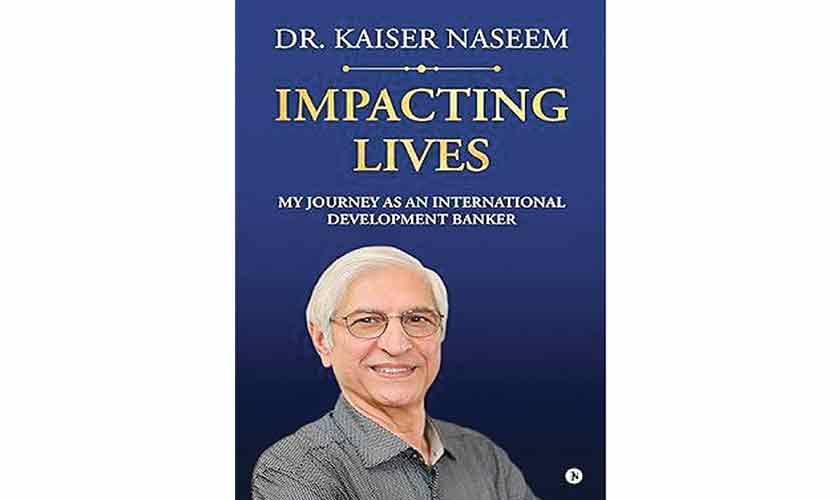
he landscape of international development underwent a major change in 2025. The world’s largest aid agency, the USAID, was dismantled by President Trump. Major donors such as the EU, the United Kingdom and Germany have slashed their development assistance budgets. Apart from bilateral donors, multilateral donors are also being forced to rethink their development strategies due to budget constraints imposed by their funding partners. In such a challenging scenario, Dr Kaiser Naseem’s Impacting Lives: My Journey as an International Development Banker is a timely and poignant book. Part memoir, part analysis, it is a brief and breezy read, blending humour with profound insights.
Dr Naseem’s professional journey, from Pakistan Steel Mills in the 1970s to more than 25 years with the IFC/ World Bank Group across various continents until his retirement in 2020, has been quite remarkable. A dynamic and charismatic leader, he also headed the SME Bank and a leasing company in Pakistan during his impressive career. In retirement, Dr Naseem serves on several boards of directors globally and is widely recognised as a thought leader in the areas of fintech, corporate governance and sustainable development. In 2022, he was awarded an honorary doctorate in development finance and economics.
Kaiser Naseem studied at the PAF School, Sargodha, but due to medical reasons, decided not to pursue a career in the Pakistan Air Force, although he trained as a fighter pilot for a short while. He went to the erstwhile Soviet Union, at the height of the Cold War, to learn Russian and study engineering on a scholarship funded by Pakistan Steel Mills. The chapter in his book about his student days in Russia in the 1970s is laced with interesting anecdotes and observations about the communist society and systems.
On his return to Karachi, Dr Naseem found his job at Pakistan Steel Mills uninspiring. A few years later, he switched his career to development finance and banking after completing his MBA from the Asian Institute of Management in Manila, Philippines. As he had married months before proceeding to Manila, his classmates at AIM often joked that he was on a honeymoon at a business school.
His newlywed wife also joked that he had learned a language, Russian, which hardly anyone spoke, and had studied metallurgical engineering, a subject in which he lost interest after a few years and did not wish to pursue a career. Kaiser, however, was convinced that knowledge acquired and languages learnt never go to waste. This belief was vindicated within a decade when his proficiency in Russian proved to be a game-changer in his life.
An IMF bailout is not an economic strategy. More accurately, it is an economic tragedy.
Kaiser began his development finance career with the National Development Finance Corporation in the 1980s, before going on to head a leasing company in Karachi. In 1991, while leading the leasing company, he met IFC chief John Pott in Islamabad to discuss a financing proposal. Pott offered him a job on the spot with the IFC in the Central Asian region. He had noticed in Kaiser’s profile that he was fluent in Russian and had strong development finance experience. At the time, the IFC/ World Bank Group was seeking Russian-speaking finance professionals for the newly independent Central Asian countries; Kaiser’s profile matched this requirement to a tee.
Joining the IFC/ World Bank Group was a dream come true for Dr Naseem, who went on to serve with the institution for 26 years in Central Asia, Russia, Pakistan and the Middle East and North Africa regions. Development finance has been his passion. He sees it as having the potential, when practised correctly, to create real change in people’s lives. One of the most insightful chapters in his book focuses on Uzbekistan, where he worked for much of his career. He presents it as a success story over recent decades in terms of per capita development and integration into the global economy, despite having started almost from scratch. However, he also admits that in their efforts to promote development finance in developing countries, multilateral institutions such as the World Bank and IFC have not always been successful in striking a balance between economic growth and social justice.
Dr Naseem is openly critical of the role that multilateral institutions have played, or failed to play, while lending to developing countries such as Pakistan. He critiques the poor leadership and economic planning of Pakistan’s leaders for the country’s struggling economy, but also blames the IMF and the World Bank for perpetuating Pakistan’s problems by continuing to lend money even when they knew it was not being used wisely. He points out that every IMF bailout package for Pakistan is celebrated by successive economic planners as a success. The reality, he says, is that an IMF bailout is not an economic strategy. In fact, it is closer to being an economic tragedy.
Dr Naseem makes a persuasive case for reforms in multilateral donor agencies such as the World Bank Group, which, despite six reform efforts over the past few decades, continues to operate as a massive global entity, burdened by a cumbersome organisational structure and suffering from gaps in skills and delivery mechanisms. More importantly, he also points out the disproportionate political influence exercised by the United States of America in the operations of the World Bank Group, by virtue of its position as the largest shareholder and its role in appointing the President of the Group. Dr Naseem bemoans the fact that the World Bank Group sometimes assumes the political role of a soft-power tool for Washington, rather than focusing purely on development goals.
Net-net, this instructive and enlightening book by Dr Naseem is a must-read for development professionals as well as economic planners, students of economics and anyone interested in international development.
Impacting Lives
My Journey As An
International
Development Banker
Author: Dr Kaiser Naseem
Publisher: Notion Press (India, Singapore, Malaysia), 2024
Pages: 153
Price: Rs 1,200
The reviewer is an Islamabad-based development and finance professional. He tweets @AmmarAliQureshi.