Print Story
X




Pakistan-India ties are likely to remain in the spotlight during 2026
| O |
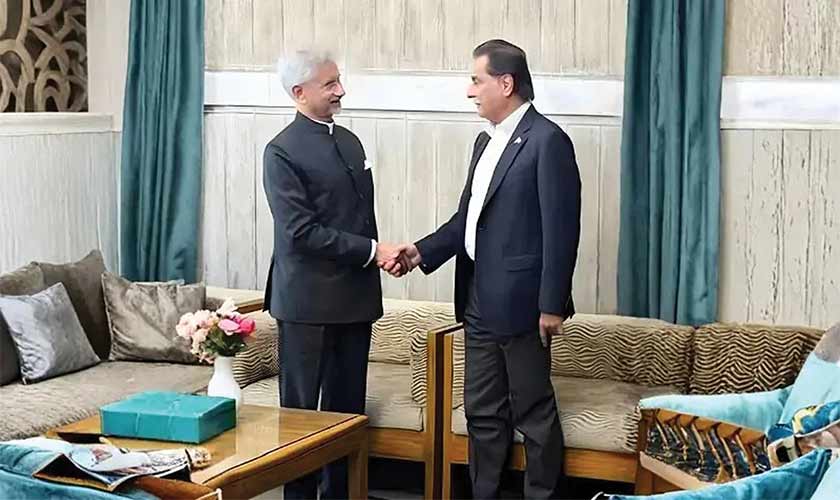
n New Year’s eve, a handshake between Pakistan’s National Assembly Speaker Ayaz Sadiq and Indian External Affairs Minister Subrahmanyam Jaishankar made news.
A handshake is part of basic etiquette. From diplomatic summits to sporting arenas, basic etiquette is expected. This handshake drew attention because it marked the first high-level contact between Pakistani and Indian officials since the military conflict in May 2025. Sadiq and Jaishankar briefly exchanged greetings in Dhaka, on the sidelines of former prime minister Khaleda Zia’s funeral.
The relations between the two neighbours hit a low after the terrorist attack in Pahalgam in which five militants killed 26 tourists. India blamed Pakistan for the attack, without sharing any evidence.
After Pahalgam, India unilaterally suspended the Indus Waters Treaty, shut down the main border crossing, cancelled visas for Pakistani citizens, expelled military advisers from Pakistan’s high commission in New Delhi and withdrew its own officials from Islamabad.
Beyond formal diplomacy, politics seeped through to sports events. The Indian cricket team refused to shake hands with their Pakistani counterparts during the Asia Cup last year and in recent matches played between the two sides. They also refused to accept the Asia Cup trophy from Mohsin Naqvi, the Asian Cricket Council president and the Pakistan Cricket Board chairman.
So, the handshake in Dhaka matters. However, most analysts caution against reading too much into it. Naqvi had recently told reporters: “If they (Indian cricket team) do not want handshakes, then we have no desire for it either.”
The News on Sunday spoke with experts in international relations on what India-Pakistan relations are likely to look like in 2026.
Muhammad Faisal Awan, assistant professor at the Department of International Relations, University of Karachi, said, “The strategic stability in India-Pakistan relations will remain fragile, but intact. Nuclear deterrence continues to impose strong constraints on full-scale war. The recent fighting has lowered the nuclear threshold.” He said the deterrence frameworks still function at the nuclear level but maybe less effective in managing lower-level escalation risks, “particularly those arising from airpower use, precision strikes and signaling below the nuclear threshold.” He said ambiguity and compressed decision-making timelines “have made deterrence more fluid, rather than predictably stable.”
Drawing on historical precedents, particularly how India-Pakistan relations recalibrated during the earlier conflicts between the two, Awan said that the post-Pahalgam period reflected a similar pattern in terms of crisis learning and adaptation. “Both sides tested new options. They also absorbed lessons about escalation limits. Both have learnt new lessons from these episodes… not for peace but for future conflicts. India learnt that limited conventional action has political value but carries strategic risks; Pakistan reinforced its emphasis on rapid signaling and controlled response.”
Awan said that 2026 was “more likely to witness episodic crises with managed de-escalation, rather than either sustained normalisation or uncontrolled instability.”
After Pahalgam, India unilaterally suspended the Indus Waters Treaty, shut down the main border crossing, cancelled visas for Pakistani citizens, expelled military advisers from Pakistan’s high commission in New Delhi, and withdrew its own officials from Islamabad.
Dr Kenneth Holland, an adjunct professor of political science at the University of Utah, said nuclear deterrence still helped prevent the worst-case outcomes. However, he added, “it no longer offers a reliably ‘manageable’ crisis framework on its own… The region looks deterrence-stable at the nuclear level but escalation-unstable below it, with growing risks from speed, ambiguity and political compulsion. Multi-domain actions—drones, cyber operations, precision strikes, air-defense interactions—raise the chance of ambiguity (what happened, who did it, was it authorised) and rapid tit-for-tat dynamics.”
Regardless of nuclear risks, Dr Holland said, “terror attacks (or the accusation of sponsorship) can push leaders toward public retaliation for domestic political reasons.”
From a US foreign policy perspective, Dr Holland said: “Washington’s closer strategic alignment with India—paired with a narrower, more transactional engagement with Pakistan—has tended to tilt the political-military balance toward India while making crisis management more awkward but still essential for the United States. Pakistan’s perception of an Indo-American alliance against China matters because it reduces the credibility of the US as a balancing actor for Pakistan—and can push Islamabad to seek leverage elsewhere (notably with China), while New Delhi feels greater room to maneuver.”
US constraints as a mediator, Dr Holland said made “crises more political, faster moving and harder to reset afterward.”
On May 10 last year, the world was told that a ceasefire had been agreed upon between the nuclear-armed neighbours, India and Pakistan. President Trump announced on Truth Social: “After a long night of talks mediated by the United States, I am pleased to announce that India and Pakistan have agreed to a full and immediate ceasefire. Congratulations to both countries on using Common Sense and Great Intelligence. Thank you for your attention to this matter!”
TNS asked Dr Holland how that had shaped escalation control in South Asia. “Toward India, US signaling is increasingly structural and long-term. Deepening defence cooperation, interoperability, technology sharing and Indo-Pacific alignment signal that Washington views India as a net security provider and a strategic counterweight to China.” As for Pakistan, Dr Holland said, the signaling was “deliberately restrained and transactional, with engagement focused on counterterrorism, nuclear safety and crisis communication, not broad strategic partnership. The relationship between the US on one side, and India and Pakistan, on the other, is asymmetrical.”
“Washington avoids formal mediation and instead relies on parallel, private diplomacy, including simultaneous calls, messages and nudges tailored to each nation. This has been called “phone call” diplomacy.”
Dr Holland said 2026 could prove a period of continuity or a potential inflection point in India-Pakistan relations. “The Indus Waters Treaty and water security escalation is the clearest barometer of whether the rivalry is hardening. India has continued to advance Chenab hydropower decisions while the treaty remains described as “in abeyance/ suspended” since April 23, 2025. Pakistan is increasingly framing this as strategic coercion,” he said.
He said that “India’s deepening strategic partnerships (especially with the US and Indo-Pacific groupings) and Pakistan’s reliance on China (plus Gulf ties) shape confidence and risk tolerance, even if they don’t decide crises.”
Awan said, “Competitive hostility grounded in deterrence stability is the most likely defining feature in 2026. Structural drivers—such as unresolved territorial disputes, asymmetric threat perceptions, domestic political incentives and regional strategic realignments—continue to favour periodic crises over sustained engagement,” he says.
While deterrence reduces the probability of major war, Awan says, it does not eliminate the likelihood of episodic confrontation, making stability contingent, reversible and heavily reliant on crisis management mechanisms.
The writer, a communications professional, is currently the manager at the Centre for Excellence in Journalism, IBA Karachi. She can be reached on X: @mariaamkahn