Print Story
X




Dr Shahid Siddiqui’s latest book offers a penetrating critique of Pakistan’s education system and the long-standing policy failures
| R |
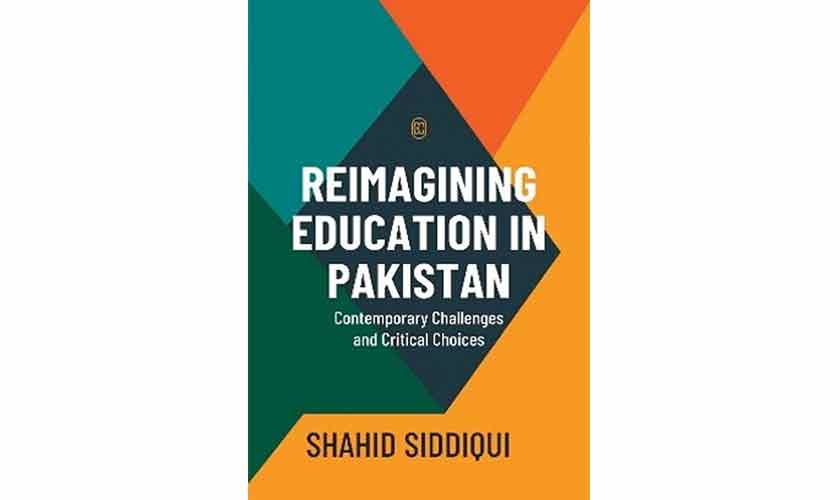
eimagining Education in Pakistan: Contemporary Challenges and Critical Choices is a thought-provoking and timely contribution to the literature on education reform in developing societies. Written by Dr Shahid Siddiqui, a distinguished educationist and academic administrator, the book offers a penetrating critique of Pakistan’s education system and the long-standing policy failures that have hindered equitable and quality learning. Through a careful blend of historical review, policy analysis and conceptual reflection, the author presents a compelling case for radical rethinking of how education is governed, structured and delivered in the country.
Dr Siddiqui brings exceptional academic and administrative experience to this work. He holds a PhD in linguistics from the University of Toronto and has served in prestigious academic institutions, including Aga Khan University, the Ghulam Ishaq Khan Institute of Engineering Sciences and Technology, the Lahore University of Management Sciences, the National University of Modern Languages and Allama Iqbal Open University. During his tenure as Vice Chancellor of Allama Iqbal Open University, he introduced a holistic and inclusive institutional framework that prioritised access, diversity and quality. He is currently the dean of the Faculty of Social Sciences, Media Studies, Art and Design at the Lahore School of Economics. This rich professional background lends both credibility and depth to the arguments advanced in the book.
The book is organised into nine coherent parts, ranging from education and contemporary discourses to education and change. This structure allows the author to move fluidly between theoretical concepts, policy critique and practical recommendations while maintaining intellectual coherence. One of the book’s central strengths lies in its ability to connect classroom practices with broad political, economic and cultural forces that shape education systems. Rather than treating education as an isolated technical domain, Siddiqui situates it firmly within questions of governance, inequality, language politics and national development.
At the heart of Siddiqui’s argument lies the persistent gap between ambitious policy declarations and weak implementation mechanisms. The author offers a critical reading of Pakistan’s education policies from 1947 onwards, beginning with the early policy frameworks introduced under the guidance of Quaid-i-Azam Muhammad Ali Jinnah. He notes that the post-independence vision was upfront: free and compulsory primary education, uniform standards and gradual adoption of Urdu as the official language of governance. These foundational goals remained largely unrealised in the later decades.
A major contribution of the book is its systematic examination of national education policies, from the Sharif Commission Report of 1959 to the National Education Policy of 2009. Siddiqui demonstrates how each policy cycle promised expanded access, improved literacy, enhanced teacher training, greater attention to women and vocational education and the moral development of students. However, he shows that these pledges were rarely matched by sustained political support, institutional capacity and financial investment. The result has been a cycle of rhetorical reform without structural transformation.
The quantitative realities presented in the book are sobering and reinforce the author’s central thesis. Pakistan’s literacy rate remains low at 60.6 per cent in 2024-25, reflecting the system’s limited reach and effectiveness. The scale of educational deprivation is equally alarming, with more than 25 million children out of school. Pakistan’s international comparative standing is also troubling. The country ranks 168th on the global Human Development Index and 148th on the Global Disparity Index, underscoring the deep link between educational failure and broader patterns of social and economic inequality.
Perhaps most striking is the author’s discussion of state investment in education. Despite repeated policy pledges, public spending has steadily declined. In the 2024-25 budget, education was allocated only 0.8 per cent of GDP, one of the lowest proportions in the country’s history. This budgetary contraction is particularly paradoxical given the government’s declaration of an “education emergency” in 2024. The author notes that despite this official announcement, literacy rates have not improved and overall education expenditure has continued to fall.
The book offers a nuanced exploration of why educational reforms have repeatedly failed in the country. In this respect, Dr Siddiqui identifies a complex web of constraints: lack of political will, weak bureaucratic ownership, chronic capacity shortages, inconsistent and unreliable data, excessive dependence on externally designed reform packages and the near absence of rigorous monitoring and accountability frameworks. These factors, he argues, have created a system more adept at producing policy documents than delivering meaningful learning outcomes.
Importantly, the book’s conceptual core lies in its advocacy for a shift from rote learning and mechanical assessment towards critical, creative and participatory forms of education. Siddiqui argues that meaningful reform requires more than new and/ or universal curricula. Rather, it demands a transformation in how teachers, students and communities understand the purpose of education. The author makes a persuasive case for embedding critical thinking, effective communication, institutional collaboration and ethical citizenship at the heart of educational choices and practices.
Another notable strength of the book is its balanced tone. While sharply critical of systemic failures, Siddiqui avoids pessimism. Instead, he frames Pakistan’s educational crisis as a challenge that can be addressed through sustained political commitment, professional capacity building and public engagement. He views education not merely as a sectoral issue but as the foundation of democratic culture, social cohesion and national resilience.
Dr Siddiqui’s writing style is accessible yet rigorous, making the book valuable for both academic and policy-oriented audiences. Drawing extensively on official documents, policy reports and empirical evidence, the author maintains a careful balance between scholarly depth and practical relevance.
Reimagining Education in Pakistan is a significant work of policy analysis and educational critique. It provides a comprehensive account of the structural and institutional weaknesses of Pakistan’s education system while charting a credible path towards reform grounded in critical learning, equity and institutional accountability. The book is especially recommended for policymakers, educators, researchers and students seeking to understand the political economy of education in Pakistan and the possibilities for sustainable transformation.
The writer has a PhD in political science from Heidelberg University and post-doc experience at University of California-Berkeley. He is a DAAD and Fulbright fellow and an associate professor. He can be reached at [email protected]