Print Story
X




Muhammad Hameed Shahid’s inter-textual novella shows how conflict turns private suffering into a battlefield
| L |
Literary texts form a complex ecology where every piece is linked to others. While we, as humans, easily succumb to alienation and even animosity, the texts produced by us don’t have any inclination for alienation. They interact with each other; they borrow from one another; they turn the absence of one into the presence of another; they echo within the territories of other texts. They shatter all sorts of barriers. Interestingly, it is not just their words, phrases or sentences that engage, but also their characters, themes and semantic frameworks that converse with each other. In post-modern discourse, this phenomenon is known as intertextuality, a concept developed by French scholars Roland Barthes, Julia Kristeva, Gerard Genette and others.
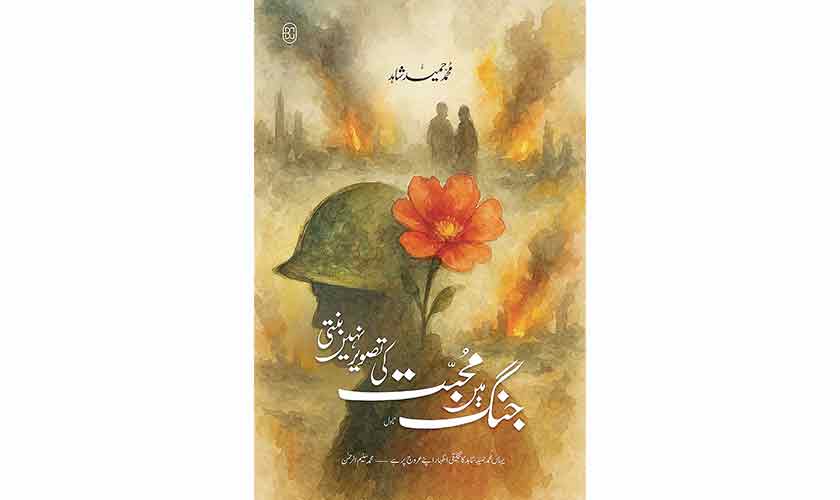
Amazingly, in Urdu literature, there are numerous examples where authors resort to ancient, classical, modern and contemporary texts to craft new writings. For instance, Intezar Hussain’s short stories are embedded in and interact with the Panchatantra, Alif Laila wa Laila, the Bible and the Quran. In Surendra Parkash’s short story Bijoka (Scarecrow), Hori, the protagonist, is taken from Prem Chand’s novel Gao Dan (Cow Donation). Muhammad Hameed Shahid’s Jang mein Muhabbat ki Tasweer Nahi Banti (There Is No Painting Love In Times of War) is a prime example of intertextual fiction in contemporary Urdu literature.
Shahid is a prominent Urdu fiction writer and critic residing in Islamabad. Besides books on appraisal of Urdu and global fiction, he has produced six short story collections, a novel and a novella. His novel Matti Adam Khati hae (Earth Eats Away Adam), which deals with the tragedy of the Fall of Dhaka, also incorporates elements of intertextuality. Although it is based on a manuscript discovered after the 2005 earthquake, the captivating tale of finding the manuscript, its editing, publication and the narrator’s own journey are intricately interwoven into the narrative of the novel.
Jang mein Muhabbat ki Tasweer Nahi Banti first appeared in Asif Farrukhi’s journal, Dunyazaad. It was later included in his fifth collection, titled Sans Lainay mein Dard Hota Hae (I Feel Pain While Breathing, 2019). Although the author initially categorised the work as a novella, it has since been expanded with new additions and republished (as of 2025) under the classification of a novel. However, in my opinion, this work is a novella. Currently, many critics tend to use a singular term for fiction. Considering its apparent length, they categorise it as short or long fiction. However, to truly appreciate fiction in its entirety, considering content, form, style, theme and its evolution through narrative techniques and characterisation, we should not obscure the distinctions between the genres of fiction, namely short story, novella and novel.
It is not merely the length, which is typically longer than a short story and shorter than a novel—that defines a story as a novella, but rather the way the story is treated and which part of the story has been made the point of focalisation.
Employing Julia Kristeva’s terminology, we can say that Shahid’s novella is a “mosaic of texts.” Since the advent of structuralism, not only written words but anything that signifies meaning is being regarded as a text. In Shahid’s novella, there exists a multitude of texts, from the narrator’s memories to Raymond Carver’s short story Cathedral, to the epitaph on his grave, as well as a film adapted from this story and another movie titled Cathedral based on Jacek Dukaj’s short story. The unifying element among these texts is not merely the similarity of their themes or the characteristics of their characters, but also the contrasts and comparisons that arise. Shahid possesses a keen understanding of the nuances of intertextuality. He appears to recognise that a text communicates with another text in its own distinct voice and that this voice is derived from the overall thematic and stylistic ambience of the text. Text must speak in its own, authentic voice. In simple terms, he does not randomly select a few phrases and sentences from Carver’s story; rather, he captures the essential meaning and significance of the story and intertwines it with the theme of his story.
In Carver’s story, the concept of blindness is problematised in a very subtle way. It poses the intriguing question: Does blindness render a person incapable of seeing, or does it differently enable them to perceive, envision and act? Within the story, Robert, a blind man, visits the home of an old female friend following the death of his wife. However, he faces mockery from the husband of his friend, who also serves as the story’s narrator. Robert maintains his tranquillity. So, at the end of the story, both men collaboratively sketch a cathedral on paper with a pencil. It appears that Robert has started to perceive through his hands, and the narrator experiences this awakening as well. In this context, the cathedral, real and one drawn by them on paper, takes on profound significance, symbolising a shared light that connects the blind and the sighted, capable of uniting both good and evil.
Shahid’s novella centres around the Afghan war, which has inflicted countless miseries on the Afghan populace, including mass displacements, the destruction of established businesses, reliance on the cultivation of bhang or cannabis, suicide bombings, fundamentalism and the resurgence of tribal ghairat and honour killings. Rather than addressing these issues directly, Shahid employs an indirect, implicit, creatively fractured and suggestive narrative style. He aims to tell the story of Gul Jan, an Afghan girl whose father is living as a refugee in Pakistan. The author refrains from detailing the Afghan wars against the Russians and later against the US post-9/11, first as Mujahideen and subsequently as Taliban, which are often well-documented. Instead, he concentrates on the suffering endured by a family and a girl due to these wars. This novella not only depicts the plight of a displaced Afghan family but also employs a form of narrative displacement. The events, incidents and experiences of the characters are narrated in a dissociative yet suggestive manner. The Afghan girl’s story is narrated to be deliberately fluid and dislocated; it seems to simultaneously inhabit and transcend various regions and sub-narratives. This technique creates a sense of untethered reality.
Like Robert from Cathedral, Gul Jan is blind. Using intertextuality, Shahid highlights the similarities and draws a comparison between these two narratives from different regions and eras. One significant similarity is the odd combination of emptiness and excitement.
In Carver’s tale, the narrator’s wife and Robert experience excitement, while the narrator endures a sense of emptiness. Gul Jan’s existence is filled with emptiness; she is wed to a Punjabi man who works under his father and she harbours no affection for him. Shahid’s narrator is not merely empathetic towards her; he develops a deep appreciation for her unexpected beauty. In a fleeting, inadvertent moment, he glimpses her breasts and perceives a sweet, inner light emanating from them, a vision that immediately recalls the divine illumination found within Dukaj’s Cathedral.
There is another parallel. Carver’s narrator fails to recognise Robert’s inner beauty. The father of Shahid’s narrator, a businessman whose shop is adjacent to Gul Jan’s father’s, fosters animosity towards Gul Jan’s father, believing he killed his wife. Within him, the pursuit of justice for the murdered woman is inextricably fused with the sharp sting of professional jealousy. The narrator of Shahid’s story incites Ali Mehsood, the father of Gul Jan’s mother. Amidst these events, Gul Jan begins working at an NGO called Roshni. In the end she is ruthlessly slain by her own brother in an act of honour violence, a killing so absolute it was carried out as a suicide attack at the behest of Ali Mehsood. This horrifying event illuminates a central catastrophe of conflict: the way personal, patriarchal ghairat (honour) is fatally annexed by the vocabulary of holy war. The aggressive mindset once targeted at external “infidels” is internalised, making the home a new and volatile battlefield. War is not just fought on the frontlines; it is a chaotic force that dismantles all moral boundaries, allowing the most archaic prejudices to adopt the guise of sacred duty.
In her life, Gul Jan did not yield to her blindness, yet she was unable to find love and respect. The war did not remain limited to Afghanistan; it also spread to Pakistan. The war was indiscriminate. It blindly crossed borders, destructively affecting places, people and the very fabric of society. It remained blind to human suffering.
Carver was an American writer. He was not involved in the war that his country waged against Afghanistan. However, his identity troubles Shahid’s narrator, as it serves as a constant reminder of how Carver’s nation irrevocably altered Afghanistan’s fate, causing Pakistan to suffer as well. Since the advent of modernity, all national-collective identities have dominated individual identities, shifting the burden of decisions made by their ruling elites onto the individuals. How cruelly ironic it is that the very people often crushed by the policies of their own ruling class are simultaneously forced to bear the collective burden and consequence of those leaders’ actions against the world.
Nevertheless, Shahid has astutely woven his narrative with the texts of Carver and Dukaj. Cathedral serves as a common thread in the works of these two Western authors, symbolising light, uniting individuals and facilitating experiences of transcendentalism. This symbol of the cathedral challenges the conventional interpretations of blindness. Shahid employs an intertextual approach to highlight a contrast in this context. In the post-modern West, there exists a symbol that makes them transcend their blindness; however, due to the same Western intrusion, we are condemned to remain blind to our fate and future. The narrator of Shahid’s novella expresses sorrow that his tale lacks such a sacred edifice. The last page of the story reads: “I wish my story could feature the spires or minarets of a cathedral, a temple or a mosque—or another revered edifice. If that were achievable, I could transform that blind woman (Gul Jan) into the magnificence and beauty of such a structure, lying scattered in the middle of the road. I wish the image of a spire, a minaret or an arch could be formed, so that she might gently place her hand in mine.”
The narrative of the novella deliberately shuns chronological order, adopting a convoluted, non-linear plot, a hallmark of post-modern writing. This structural choice is a form of meta-fiction, designed to shatter the illusion of reality by forcing the reader to acknowledge the work as a conscious, invented narrative. The goal is to use this technique to reveal profound yet upsetting truths. The complex plot relies heavily on intertextuality, weaving in references and allusions to literature of other regions and eras. The author seems to believe that truly innovative fiction can only emerge from the interplay and negotiation between narratives of all sorts.
The style of this novella is captivating, engaging readers with each line of the narrative. The author’s desire for it to be read in a single sitting is justified, as its prose maintains a flow that persists until the final sentence. This is a truly remarkable piece of Urdu fiction.
The reviewer is a Lahore-based Urdu critic and short story writer currently associated with the Gurmani Centre, LUMS, as head of publication.
Mera Daghestan-i-Jadeed is his recent publication.