Print Story
X




Raja Faisal Mumtaz becomes the fourth premier in as many years, following the ouster of Anwar-ul Haq through a no-confidence vote
| A |
zad Jammu and Kashmir has once again witnessed a political upheaval. Raja Faisal Mumtaz Rathore of the Pakistan Peoples Party, sworn in as the 16th prime minister of the region on November 18 following the ouster of Chaudhry Anwar-ul Haq through a no-confidence vote, is the fourth premier in four years. The transition signals the PPP’s growing consolidation on one hand and raises critical questions about political stability, institutional continuity and the state’s capacity to convert rhetoric into meaningful public service delivery on the other.
The no-confidence motion against Haq, was carried with 36 votes in favour and only two against, illustrating a profound realignment in the AJK Legislative Assembly. The motion drew support not only from PPP lawmakers but also from PTI’s Forward Bloc, highlighting the fragility of political allegiances in the region. Rathore’s election, thus, was less a contest of ideas than a reflection of shifting political loyalties.
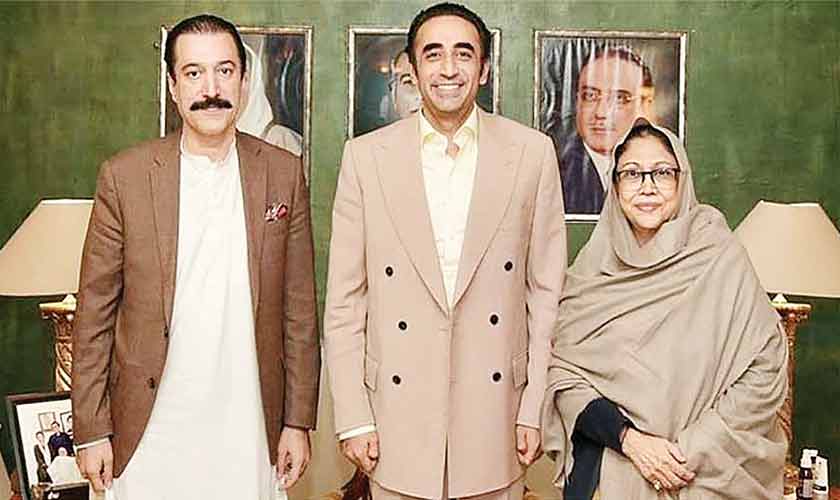
Rathore framed his premiership as both a political responsibility and a moral mandate. He vowed to introduce administrative reforms, enforce financial discipline and engage directly with the citizens. The presence of PPP chairman Bilawal Bhutto-Zardari and senior federal government leaders at the swearing-in ceremony underscored the centrality of Islamabad-aligned party structures in AJK’s political architecture. Bhutto-Zardari’s directive to Rathore to engage citizens “in every nook and corner” reflects the PPP’s attempt to pair political consolidation with grassroots outreach. It reflects a broad recognition that legitimacy in AJK requires more than legislative maneuvering; it demands visible action at the grassroots level.
Rathore’s cabinet, sworn in a day after his own oath, reflects both continuity and strategic inclusion. Of the 18 ministers, eight are long-time PPP loyalists. The rest are recent PTI defectors, individuals who had, until recently, defended the previous government. Their swift pivot raises serious concerns about the credibility and stability of political commitments in the AJK. Such opportunistic alignments suggest that access to power, rather than policy or public interest, remains the primary driver of political choices in the region.
The cabinet also shows AJK’s ingrained gender imbalance. Only one woman, Nabeela Ayoub Khan, has been included, an indictment of the persistent sidelining of women from decision-making spaces. Despite years of discussions on political inclusion and gender equity, representation remains symbolic at best. The exclusion of women not only narrows the policymaking lens but also reinforces structural barriers that limit their participation in governance.
The familiar dominance of entrenched political families also continues. Key positions have gone to close relatives of influential leaders, reinforcing the perception that party loyalty and lineage outweigh competence. Major portfolios have been awarded to the scions and in-laws of senior party figures. Members of the president’s family also hold significant ministries, further blurring the line between public office and private influence. Even advisory positions reflect this dynastic pattern, with posts granted to individuals primarily based on their family ties rather than their professional credentials. Such appointments not only shrink the space for capable, non-connected professionals but also deepen public frustrations with privilege inherited through political lineage.
A particularly notable development is Rathore’s political accommodation with the Joint Awami Action Committee, a powerful citizens’ movement, as no MLA elected from the refugee constituencies was included in the cabinet. Rathore has also admitted the previous government’s mishandling of grievances and acknowledged the JAAC as a legitimate political participant. By centeing the JAAC in his early messaging, he has signalled an important shift: governance in the AJK can no longer ignore organised citizen pressure. The JAAC has emerged as one of the strongest platforms demanding grassroots accountability in the region. Its influence is now unmistakable.
Pakistan Muslim League-Nawaz continues to publicly position itself as an opposition force while maintaining a working relationship with the ruling party. This blurs political accountability and reinforces the transactional nature of AJK politics, where alliances shift according to convenience rather than principle. This also suggests that any future contests are likely to remain confined within the parties and leaders who alternate between rivalry and cooperation.
The cabinet’s inaugural meeting approved several administrative measures, from regularisation of employment to infrastructure and education staffing. Rathore’s declaration that his team will operate like a “T-20 team” signals a governance style centred on speed and optics. His appeal to the prime minister of Pakistan regarding major infrastructure projects, including the Mansehra-Muzaffarabad Motorway (M-4) and the Lohar Gali Tunnel, will be key indicators of whether this urgency can result in long-term development outcomes.
These initiatives also raise questions about the sustainability of rapid-fire governance. Frequent leadership changes, weak institutional memory and resource limitations have historically undermined reform continuity. Rathore’s symbolic gestures, such as visiting the graves and shrines of political figures, may reinforce a narrative of legacy politics, but they do little to address the need for structural, institutionalised governance practices.
After four years marked by rapid leadership changes, shifting party loyalties and citizen-led protests, AJK stands at a crossroads. Rathore’s government carries both the opportunity and burden of breaking away from a reactive, personality-driven politics. Delivering tangible improvements requires more than political balancing. It demands strengthening institutions, merit-based governance and sustaining engagement with the citizens.
Raja Faisal Mumtaz Rathore’s premiership will test not only of his leadership but also PPP’s capacity to convert political dominance into meaningful governance. For the people of AJK, who have witnessed government after government rise and fall with little improvement in their lives, the hope is for a political transition marking the beginning of stable, accountable and citizen-centred governance.
The writer is a freelance contributor from Azad Jammu and Kashmir, currently pursuing an MS in development studies at NUST, Islamabad. She can be reached at hunainmehmud101 @gmail.com and on X: @hunain_mahmood