Print Story
X




Arslan Athar’s debut novel redefines historical fiction
| F |
orty Days of Mourning by Arslan Athar deftly entwines the intimate turbulence of love and desire with the sweeping historical resonance of the annexation of the autonomous Hyderabad state. The writer has, almost seamlessly, crafted an elegant work of fiction that is as much about the pain of human longing as it is about the erasure of cities and identities. Set against the twilight of the Nizam’s Hyderabad and the arrival of Indian sovereignty, the novel presents an everyday woman as the heroine whose personal passions mirror the geopolitical concerns of Hyderabad.
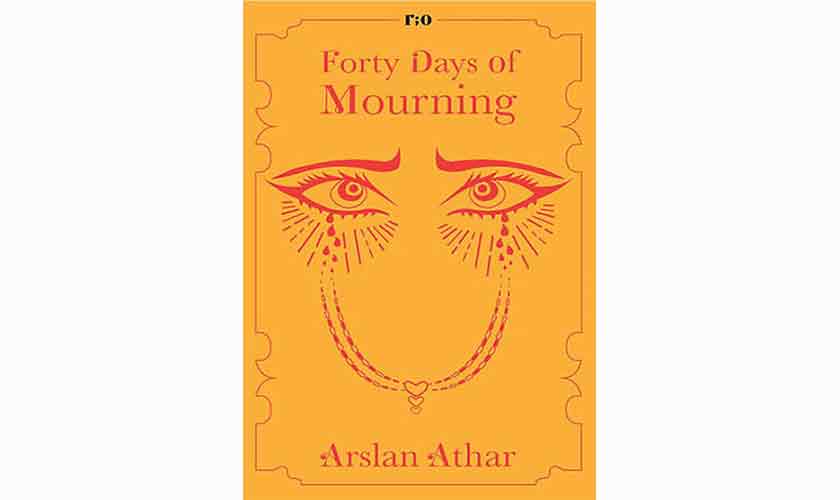
Arslan Athar is based in Lahore, Pakistan. They were a South Asia Speaks Fiction fellow in 2021 and have written both fiction and non-fiction. The catchy cover is an artistic intervention by Mushba Said, who spoke of their inspiration, stating that since the main character was a diva, the cover had to showcase this. “If you look closely, the eyes are inspired by Sri Devi from Bollywood.” At the book launch event broadcast on TV, the author addressed the growing tendency in contemporary times to sensationalise and promote conflict. While some may view the novel’s setting as reference to a bygone era, I found that the historical context deepened its relevance in striking and meaningful ways.
Athar evokes Hyderabad with remarkable intimacy. Its languid heat, lustrous sarees, Dakhani cadences and fading architectural grandeur come alive in their prose. Yet, beyond nostalgic reconstruction, they render the city as a sentient being, one whose culture, language and memory are under siege. Therefore, in their author’s note, Athar makes a deliberate choice to reclaim linguistic agency by stating unequivocally that they will not italicise native vocabulary, thereby asserting the rightful place of local language in the narrative.
Saleema’s struggle, therefore, unfolds not only within her heart but also across the geography she inhabits. Her fight for her dignity mirrors a city’s battle for survival amid the consolidating power of the Indian state. Forty Days of Mourning becomes, in essence, a meditation on identity, on how it fractures under neglect, erasure and the quiet violence of denied agency. At its core, the novel explores the human and political aftermath of Partition, revealing how borders wound both land and self. Through its layered narrative, Athar critiques the futility of divisions sanctified in the name of freedom, foregrounding the enduring tension between belonging and loss.
The novel is divided into three sections. Ignorance shows how innocence can be complicit. The city and its people drift, lulled into thinking that their way of life might persist indefinitely. Then comes Denial, where advancing political change jostles private lives and genders, and Saleema finds her love and her sense of home challenged. Finally, in Mourning, we witness the full weight of loss, of love, of city, of possibility. Mourning here is not only metaphorical but literal. I also felt a more private grief, of losing touch with my own soil and city. Like Saleema’s longing for Hyderabad, I often find myself unsettled by the idea of home slipping into memory. The novel agitated something within me; the ache of belonging to a place that is both present and lost, the anxiety of watching one’s roots fade into abstraction. In that way, Athar’s story felt not just read, but lived. “Each person who had left had left a trail of unfulfilled promises as they headed towards promised lands where who knew if their dreams would be fulfilled.” (p62)
Forty Days of Mourning becomes, in essence,a meditation on identity, on how it fractures under neglect, erasure and the quiet violence of denied agency.
There is a striking interplay between the personal and the political. The book delves into unfulfilled sexual and emotional needs, the concealment of female desire, the double standards of society and the instability of choice. Saleema appears as just another name in contrast to the grandeur of the world she inhabits, yet it is through her very ordinariness that the reader is drawn in, invited to empathise deeply with a woman wronged by both history and society. She craves love, recognition and belonging and her desire somehow becomes tangled with the fate of Hyderabad. The novel shows how desire, whether for a person or a place, can become a kind of betrayal. Saleema betrays her own sense of self while Hyderabad betrays its promise of autonomy. It reminds me of Jigar Muradabadi’s:
Yeh ishq nahi aasan bas itna samajh lejiye
Ik aag ka dariya hai, aur doob kay jaana hai.
Saleema’s path is one of self-discovery but also of survival, resistance and resilience. Athar does not flinch from showing how women in traditional marriages are denied agency. The hypocrisy of the society is exposed. What struck me most while reading Forty Days of Mourning was how profoundly relatable it felt. Especially, its portrayal of how women are bound to notions of honour and made to suffer for choosing to love on their own terms. Saleema’s pain echoed the lived reality of countless women whose emotions are judged through the prism of morality, while men’s transgressions are quietly forgiven.
To me, the writers’ depiction of love as both an act of defiance and a sentence of punishment felt painfully familiar, exposing the deep-seated and insane hypocrisy which continues to define our social understanding of female desire and agency. “Saleema had felt this deathless mourning before.” (p93) In this respect, drawing a connection to Kishwar Naheed’s poem Hum Gunahgar Aurtein feels most relevant. Naheed’s powerful voice in “we, the sinful women, who don’t bow our heads, who don’t sell our lives,” finds an echo in Saleema’s refusal to be quiet, to be complicit, to be erased. Both texts engage with the politics of voice, agency and narrative.
For all its ambition, the novel is not flawless. At times, the layering of metaphor, themes and history can feel heavy-handed. While Hyderabad is convincingly portrayed, some of the minor characters are only sketchily defined, as though existing primarily to reflect the city’s decline rather than to live individual lives. Perhaps that was a deliberate choice.
The strengths of Forty Days of Mourning are abundant. Athar writes with a fluid lyricism, the rhythms of Dakhani speech and the sensuousness of Hyderabad’s culture that permeate the text. Saleema emerges as a vivid, memorable protagonist. Neither saint nor victim, but a woman with incongruities and desires. For readers interested in the intersections of gender, post-colonial identity and historical fiction, Arslan’s novel offers a layered and compelling experience. Enjoy!
Forty Days of Mourning
Author: Arslan Athar
Publisher: Run: On Press, 2025
Pages: 234
Price: Rs 2,250
The reviewer is pursuing post-grad education at the University of Sussex.