Print Story
X




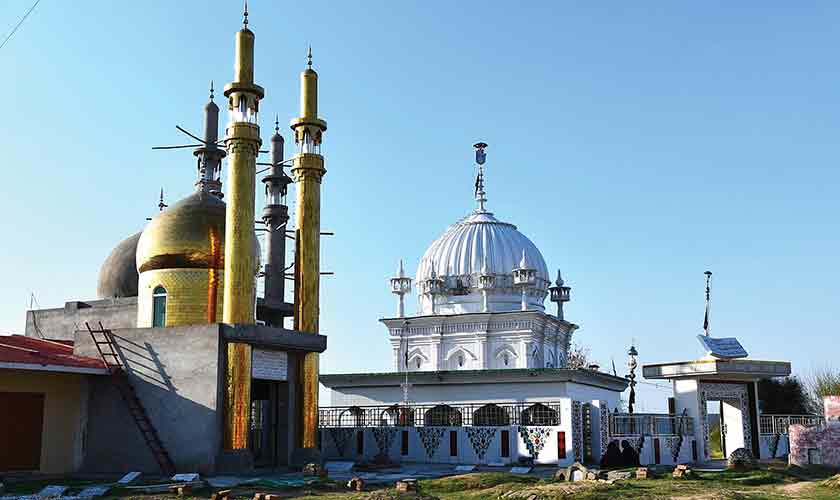
Sayyed, a small settlement in Gujar Khan, preserves a remarkable blend of Sikh-era architecture and Kazmi Sufi shrines
| S |
everal villages in Gujar Khan are renowned for their rich cultural heritage. One such village, known for its historical significance, is Sayyed. It is located about 4 kilometres east of Sayyed Adda on the Mandra-Chakwal Road. Due to its proximity to another historical village, Kasran, it is sometimes referred to as Sayyed-Kasran. However, it is important to note that Sayyed and Kasran are two separate villages. Sayyed village is particularly famous for the shrines of Kazmi Saadat and the monuments built by the Sikh community, who left after the Partition.
I first visited this village in 2019 and then again in 2021. During both visits, I talked to many people about village shrines and colonial-era buildings. To verify the information collected in 2019 and 2021, I returned to the village in November 2025. During this visit, Syed Zaafer Abbas Kazmi, the principal of Government Kazima High School, took time to arrange my meetings with a few oral historians and village intellectuals. One of them was Syed Wasif Hussain, who shared his insights into the village’s history in general and its shrines in particular.
According to Syed Wasif Hussain, there was a considerable Sikh population in the pre-partition Sayyed village. There was a bazaar in the village where most of the shops were owned by members of the Sikh community. He highlighted the fact that Sayyed village was known in the area for interfaith harmony and that no untoward incidents occurred during the Partition.
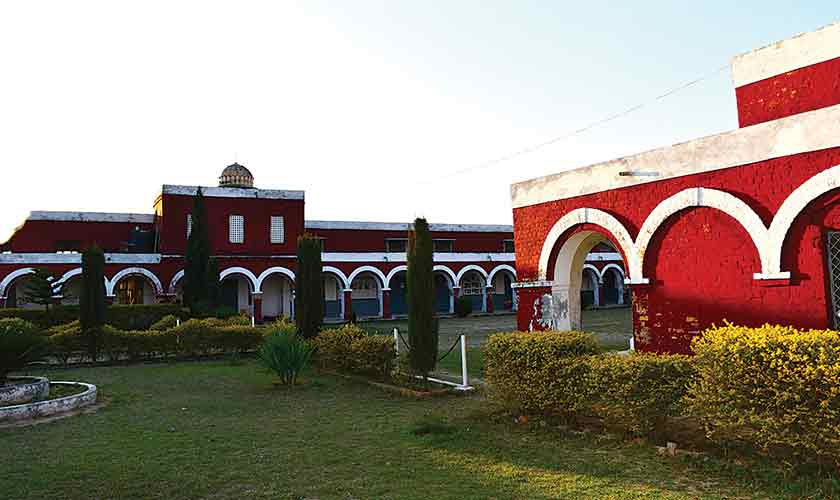
Before discussing the shrines of Kazmi Sadaat, I wish first to discuss the buildings constructed by the Sikh community in the pre-Partition Sayyed village. One of the most prominent landmarks in the village is Government Kazima High School, formerly known as Khalsa High School. The Khalsa High School’s building was one of the most significant buildings in the village. This school was constructed on a 30-kanal area. It had 16 rooms. Four more rooms were added after the Partition. The foundation of the school building was laid in 1898. An inscription in the school corridor says it was constructed by Sardar Bahadur Bishen Singh in memory of his late father, Sardar Bhagwan Singh. The most notable feature of the high school building is its two octagonal towers that enhance the structure’s beauty. The school also housed a printing press, where books were printed on-site. Some of these books have been preserved in the school library.

The Sikhs who left Sayyed for Ludhiana after Partition founded the PothoharSayyadKhalsa school in 1950. According to the school’s website in Ludhiana, it was upgraded to a National Senior Secondary School in 1989.
After Partition, the Kazmi community of Sayyed continued to run the school until it was nationalised in 1972.
Some other monuments built by Sikhs in Sayyed village, including mansions, wells and tanks have also survived. Several merchants among the Sikhs were also known for their philanthropic and welfare work in the village. During conversations with oral historians of Sayyed village, I learnt that Dhani Singh and Tara Singh were famous jewellers. They built wells in the village. Some of the prominent water storages in Sayyed village, built by Sikhs, included Lakhi Ka Talab and Banwara.
Apart from wells, water tanks and the High School, the village still retains remnants of Sikh mansions, locally called maris and choubaras. One of the most impressive maris is located in the heart of the village. It is noted for its beautiful facade and portal, which were once adorned with paintings; traces of which can still be seen.
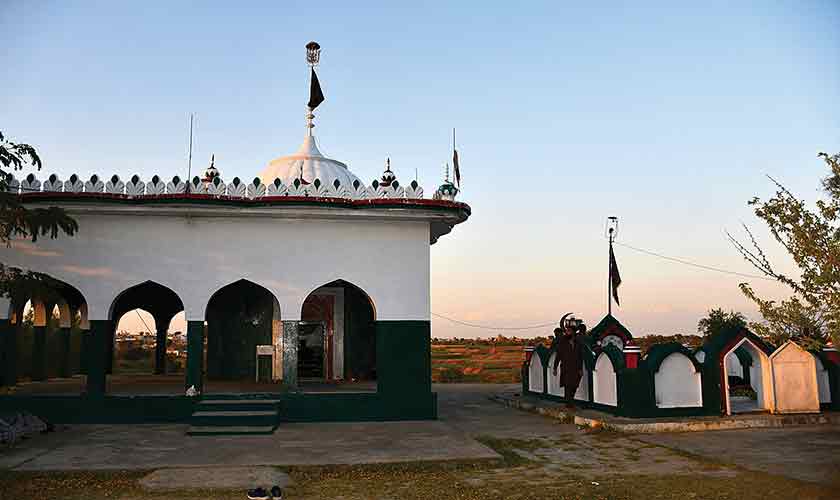
Apart from Sikh monuments, the village is recognised for the shrines of several Kazmi mystics. One of the most significant shrines in the village is dedicated to Shah Nazar Diwan. The name is often written and spoken as a single entity. This shrine comprises four graves, including those of Shah Nazar and Shah Diwan, who were among the earliest mystics in Sayyed village. According to Syed Wasif Hussain, Sayyed village has had many eminent mystics who migrated to various towns and villages in the Punjab and Kashmir to spread their teachings. For him, Sayyed is the most important centre of Kazmi Syeds in the Punjab. The list of those who left Sayyed for preaching is extensive. The notable names he shared include Sakhi Shah Muzzammil, Syed Moazzam Shah Qalandar, Shah Chan Charagh, Shah Piyara Mashhadi, Shah Muhammad Derwesh Mashhadi, Syed Bodla Shah, also known as Baba Boldley Shah Bahar Mashhadi and Syed Hyder Shah. In addition to the Kazmi Syeds, a few non-Kazmi Syeds also migrated from Sayyed village to other areas in the Punjab to preach their ways.
Sakhi Shah Muzzammil, whose shrine is located in Bheka Syedan near F/11 Markaz in Islamabad, was the son of Syed Muhammad Shah Diwan. It is one of the popular shrines in Islamabad. I have visited the tomb of Sakhi Shah Muzzammil several times. Inside the tomb are two graves: one belongs to Sakhi Shah Muzzammil, and the other to his son, Syed Gara Shah, who was also known for his piety. A great-grandson of Syed Gara Shah was Syed Moazzam Shah Qalandar, also known as Mauj Darya, whose shrine is located in Jalhari Moazzam Shah in the Gujar Khan tehsil. Additionally, the genealogy of the Kazmi family of Sayyed village is recorded in the Nisab Nama Sharif, written by Syed Muhammad Shah Mashhadi in 1298 AH/1881 AD.
The ancestors of Bari Imam too came from Sayyed village.They later migrated to Karsal village in Chakwal. Shah Abdul Latif, more commonly known as Bari Imam, was born in Karsal. Another notable mystic from Sayyed village, Syed Shah Chan Charagh, later moved to Rawalpindi. His shrine is located in the Shah Chan Charagh Mohalla of Rawalpindi.
Shah Diwan and Shah Nazar were two of the earliest mystics from the Kazmi family of Sayyed village. They were brothers and the sons of Syed Isam Ali Shah. According to Takira Sadaat Mashhadia-Kazmia by Syed Fazal Abbas Kazmi (2016:25), Syed Muhammad Shah Nazar, alias Shah Nazar Diwan, was born in 986AH/ 1578 AD in Sayyed village. It is not known when he passed away. Shah Nazar became known as Shah Nazar Diwan after his brother, Syed Muhammad Shah Diwan. The shrine of Syed Muhammad Shah Nazar Diwanand Syed Shah Muhammad Diwan is the most frequently visited one by his followers.
The shrine complex of Shah Nazar Diwan includes Imambargah Zarih Mubarak and the shrine of the mother of Shah Chan Charagh. Adjacent to Shah Diwan’s shrine is the Zarih Mubarak of Bibi Fatima al-Zahra (peace be upon her). In Sayyed, there are two zarihs. One of those is dedicated to Bibi Fatima al-Zahra and the other to Bibi Zainab (peace be upon them).
To the left of the Zarih Mubarak of Bibi Fatima al-Zahra (peace be upon her) is the shrine of Pak Mai, who was the mother of Shah Chan Charagh. This shrine is also quite popular in Sayyed village. Moreover, the shrine of Shah Chan Charagh‘s father, Sakhi Shah Malook, is located in Sayyed village, near the road leading to Kasran village. At this site, there are four shrines: the first belongs to Syed Isam Ali Shah and his father, Syed Hussain Ali Shah. Syed Isam Ali Shah was the father of Syed Muhammad Shah Diwan and Syed Muhammad Shah Nazar Diwan. The second shrine is dedicated to Syed Shah Malook. A beautiful tomb was constructed over Shah Malook’s grave by his follower, Sain Iqbal, also known as Sain Bala. Sain Iqbal also built the tomb of Mai Khatoon, the wife of Shah Malook and mother of Shah Chan Charagh. After his death, Sain Iqbal was buried near the entrance of Shah Malook’s tomb.
One can also see other monuments associated with Shah Chan Charagh in Sayyed village, including his house, hujra, chillagah and mosque. Apart from Shah Chan Charagh’s mosque, hujra and chillagah, one can also see a pond in Sayyed Adda that is also named after Shah Chan Charagh.
The third shrine in the Shah Malook complex belongs to Shah AbulKhair, an uncle of Syed Muhammad Shah NazarDiwan. There are three graves in the wall enclosure: those of Shah Abul Khair, his father, Syed Rehamtullah and his mother. Syed Rehamtullah was the brother of Syed Isam Ali Shah. The fourth shrine belongs to Pak Maiyan, a female shrine that contains two graves. Nothing is known about these women. A domed structure is built over the graves of Pak Maiyan.
The entire village is dotted with spaces associated with Kazmi mystics. In Sayyed village, there is another domed structure dedicated to Syed Sattar Ali Shah, the father of Syed Moazam Shah Qalandar. The shrine of Syed Moazam Shah is located in Moazzam Shah Jalhari village, in Gujar Khan tehsil. The tomb of Syed Sattar Ali Shah also holds the grave of his wife.
Among all these tombs, the tomb of Shah Nazar Diwan stands out as the most impressive. According to Syed Wasif Hussain Shah, it was built in 1912. The tomb features a square plan with a square burial chamber surrounded by a verandah, a style commonseen in the Punjab. This type of tomb architecture is often favoured for Sufi adepts in various towns and villages across the Punjab. Some masons in Azad Kashmir have also adopted it.
The shrines of the Kazmi mystics and the Sikh monuments together symbolise the rich, diverse heritage of Sayyed village, where Sikhs and Syeds once lived peacefully side by side. For the followers, and especially for the people of Sayyed village, the Kazmi Syed shrines stand as symbols of identity, memory and belonging.
The writer is an anthropologist at the Pakistan Institute of Development Economics, Islamabad. He has authored 17 books on Pakistan’s cultural heritage and anthropology. He tweets @kalhorozulfiqar. He may be contacted at [email protected]