Print Story
X




In her new show, Aisha Khalid turns the language of miniature painting into a subtle act of defiance
| I |
t was uncanny to spot two women completely concealed in black burqas and hijabs, except for the narrow strips of fabric through which two pairs of eyes were scrutinising a small painting of an Afghan burqa, which replaced and/ or covered a female figure in its flowing folds. The work (part of Aisha Khalid’s exhibition Scattering Stars Like Dust, being held from October 31 to November 30 at the Barracks Art Museum, Lahore) also included a lotus at the back of the head on that pale blue burqa, trying to find firm ground on a shifting plane of geometric floor and patterned wall.
One wonders how this and a number of other pantings in which the human body disappeared in similar types of burqas were received by the occasional visitors who may have emerged from these silent and static pictures. It is an assumption, but in reality a connection that is forgotten once art becomes detached – and elevated – from life. The Barracks Art Museum, being located in a public garden, reminds us of this by inviting all kinds of onlookers, leading to some odd and unexpected encounters between life and art.
The exhibition, a sort of micro-retrospective (in 2022, there was a major retrospective of Aisha Khalid installed at three venues in Karachi), showcases work representing different periods of her career, from small gouache on wasli paper from 2000 to large mixed media on paper board from 2025 and others belonging to her 25 years of practice. The five spaces of the museum, due to their contained dimensions, encapsulate her aesthetics and ideas concisely.
There seems to be a continuation of imagery, along with shifts in technique and changes in material and scale, but essentially the artist has been engaged with a single motive or content: subversion, yet not an act as strong as confrontation.
Since her formative years as an artist, Khalid has created images of women blended into their backgrounds, blurred in the folds of their burqas, invisible except for the outlines of their outer mass. A number of miniature paintings from that period (2000) share the title Captive. A few are named differently, such as Form X Pattern and Silence With Pattern (part of the present exhibition). The former comprises the back of a burqa against a wall, while the latter consists of burqa-clad females perched on open lotuses amid an interior made of flattened motifs. The human body and flower, in their repetition, are turned into a pattern too, thus submerging into the backdrop.
Using the traditional vocabulary of miniature painting but not being constrained by it, the art of Aisha Khalid has been a delicate yet deliberate act of subversion.
Khalid returns to a somewhat corresponding composition in three paintings, Thousands of Rose Gardens (2025), but now the female figure, though still in an identical burqa, does not diffuse into her background. Instead of the lotus (a sign of innocence and enclosure – especially at night), a rose is placed at the back of the head, with its thorny stem that extends (or substitutes) the woman’s body. Thus, she debunks patriarchal society’s expectations of a female by portraying her as an assemblage of beauty and delicacy, as well as of roughness and strength.
The idea of resilience emerges again in When I Am Silent (2013), a rather minimalist surface built with subtle shades of white and grey, depicting the body of a plant in detail, with its seed pod, stem and sprouting leaves submerged in water, except for the uppermost part of the budding flower that appears and thus attains colour. Interestingly, if the symbol of vegetation with its reproductive body conveys femininity, its journey to cut through the netherworld of water, while being at the border marked by the twirling edges of a curtain, alludes to the hardship a woman endures in her surroundings.
Aisha Khalid explores the theme of duality in multiple ways, from the emotional and personal to the cultural and colonial. She creates narratives of beauty and burden, love and trauma, power and resistance, invasion and identity. In You Appear In Me, I In You, two acrylic cuboids are covered with gouache on paper and gold leaf, with their glowing sides placed in close proximity to each other, as if oblivious to the presence, existence or intrusion of an outsider. The work may have spiritual nuances, suggesting that in love with the divine, mortals forget their body and replicate it in another being.
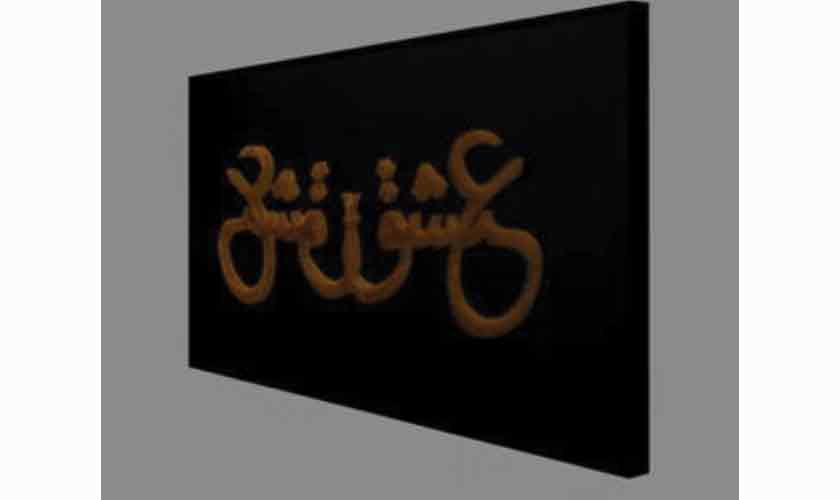
The idea of selflessness is elaborated in her Ishq (2024); the term for love in Urdu, Persian and Arabic is written along with its inverse version, both intertwined by their tails. The word is inscribed by inserting gold-plated steel pins into acrylic on canvas. In its construction, it resonates with another artwork by Aisha Khalid from 2001, titled Infinite Justice, which invokes the illusion of a rose by sticking needles with red threads hanging from their eyes on a camouflage fabric.
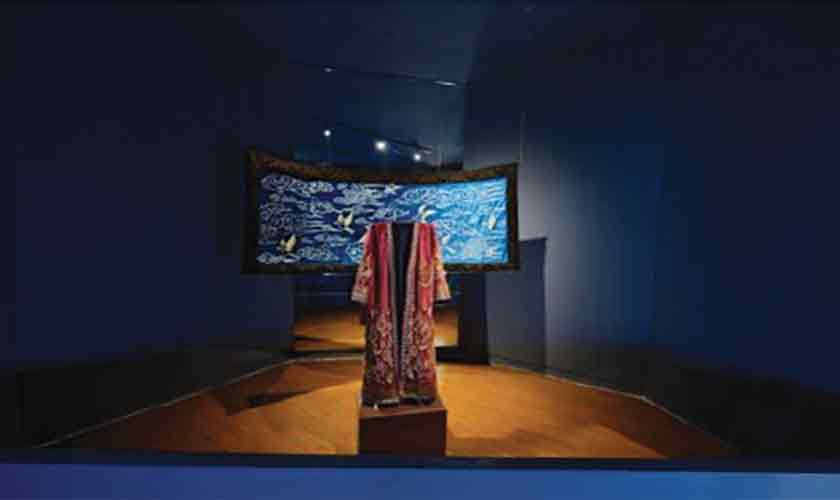
The application of hard materials reappears in the diptych I Am and I Am Not (2021), in which fabric and gold-plated steel pins are used in the making of a choga, a traditional long coat, which, though incredibly intricate and attractive, is impossible to wear due to sharp pins lining both hems.
Drifting from personal and gender-related concerns, Khalid addresses broader, more inclusive issues, especially those evident in a post-colonial society: the unequal balance between English and Urdu; the disparity in learning both languages during early schooling; and the struggle to orient writing from right to left and the other way around.
A series of her works is titled Name, Class, Subject, including a book of gouache on wasli paper from 2009 that comprises a total of 280 pages bound together. In these works, the artist seemingly reproduces common school exercise books for both English and Urdu, often comparing the two, but highlighting the conditions of a bilingual and stratified society. The difference of tongues is not merely the difference between a language imposed by colonial rulers and a language born of the soil; it represents a division rooted in economic imbalance. Command of one determines the power and resources of a child’s family, whereas its lack is treated as a disadvantage, if not a disability.
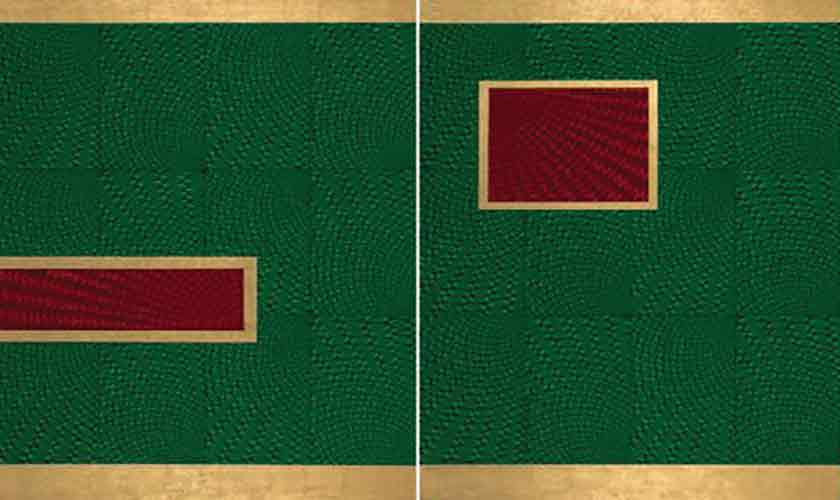
Pages of the similar-looking exercise books, with identical titles, are displayed side by side in the current show. Created in 2025, in one of these, arrows occupying the space of the English page are shooting diagonally at the closely placed Urdu page. The second artwork offers a different scenario: now the arrows on the English side are aligned with its sets of four lines, whereas the Urdu page has tilted, its lines no longer in horizontal order.
In a way, this set of works forms a chronology of how language has been employed both as a weapon of occupation and as a means of rebellion. The Irish poet Edmund Spenser, in his book A View of the Present State of Ireland (published in 1596), argues: “It hath ever been the use of the conqueror to despise the language of the conquered, and to force him by all means to learn his.” An early observation, it foreshadowed Macaulay’s famous 1835 Minutes on Indian Education, aimed at producing “a class of persons Indian in blood and colour, but English in taste, in opinions, in morals and in intellect.”
Using the traditional vocabulary of miniature painting but not being constrained by it, the art of Aisha Khalid has been a delicate yet deliberate act of subversion, a political comment enveloped in pictorial form on the suppression of both gender and language. These are two interconnected phenomena, since language can educate the superiority of the other, and its syntax may also train in the supremacy of another gender too.
The writer is a visual artist, an art critic, a curator and a professor at the School of Visual Arts and Design, Beaconhouse National University, Lahore. He can be contacted at [email protected]