Print Story
X




A posthumous exhibition of Colin David’s drawings reveals how works on paper can stand as complete in their own right
| D |
rawing is generally regarded as a lesser genre in the hierarchy of art forms. Often dismissed as merely a sketch, an initial outline or a private jotting, it is perhaps why most exhibitions feature paintings, sculptures, video installations, miniature works and printmaking sheets, but rarely drawings. Drawings are seen as passionate, personal and private, and therefore not always admitted into the public arena.
Yet there is a crucial link between the preliminary stage and the finished work. Colin David, in one of his interviews, describes this relationship clearly: “I do a lot of sketching and from these smaller sketches I develop some compositions which I can paint. At that point, the painting is already taking shape. Then the act of painting is really fast because everything has already been solved on paper.”
Seen in this light, the drawings by Colin David, included in his posthumous solo show, held from December 19 to 29, at O Art Space, Lahore, do not require viewers to trace their origins or anticipate their outcomes on canvas. These works on paper stand on their own, surviving as independent and complete artistic entities.
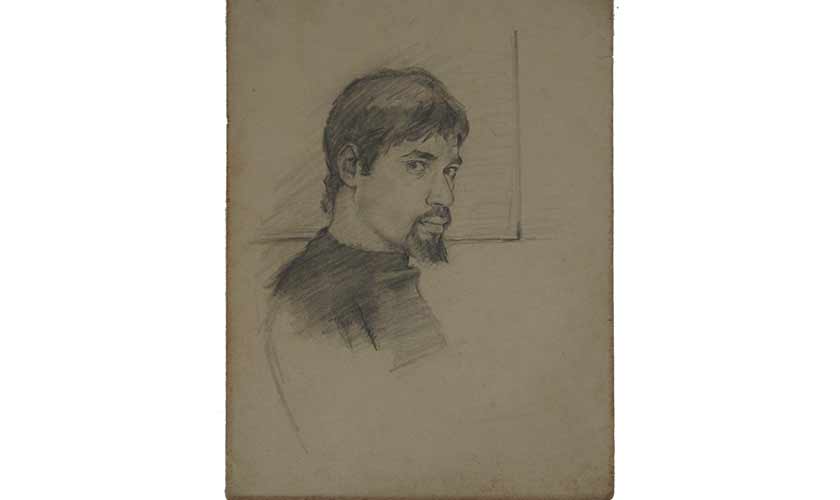
The exhibition included drawings that represent different periods, people and preoccupations in David’s work. A painter highly respected in Pakistani art for his honesty in portraying reality and the complexity with which he constructed an image, these drawings, dating from 1959 to 1990 and shown 17 years after David’s death, offer a new way of viewing the artist through the lens of his material. Working mainly in graphite pencil (with one drawing in pastel), David employed the medium with surgical precision to discover, define and delineate the contours of the human body.
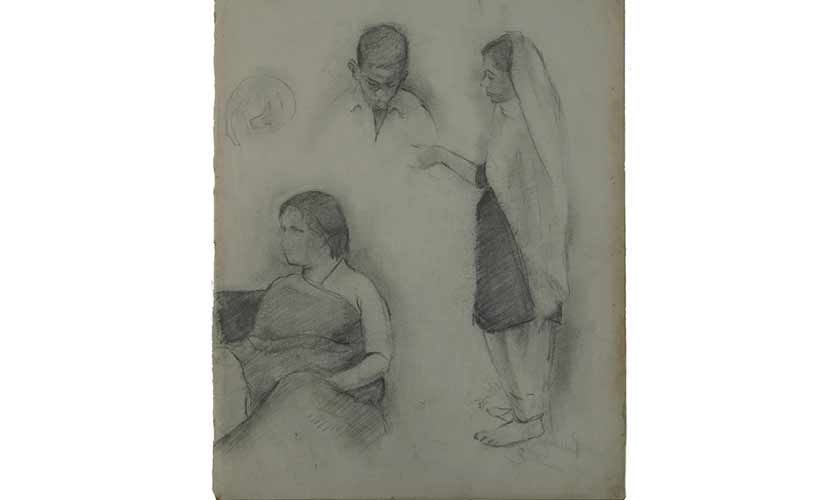
Colin David studied at the Slade School of Art, London, in 1961, and a group of drawings in the exhibition belongs to this period. Studio settings show students standing before their boards, recalling academic exercises typical of art institutions. Yet these works reveal the artist’s intention not to produce finished objects for display, but to record moments of thinking on paper. They also reflect experimentation. In one drawing, a student standing at her easel is rendered three times, with slight shifts in posture. In another, a figure engaged in a similar act appears rotated, shown in profile as well as from the back.
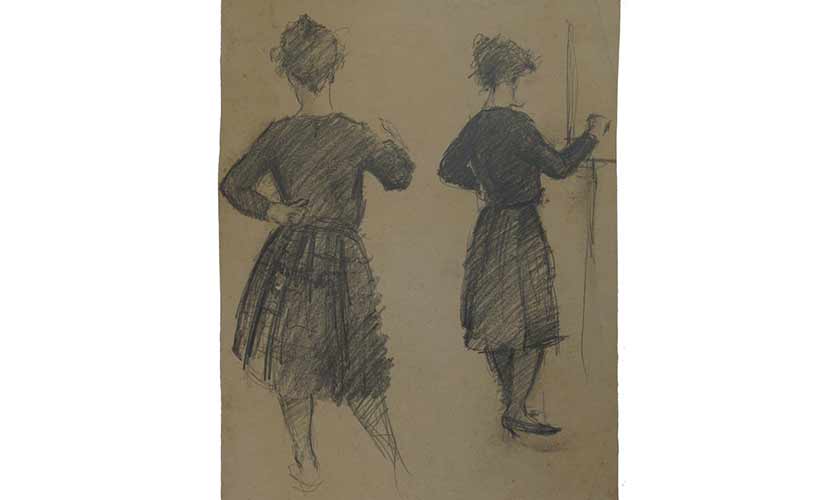
Apart from these unidentified figures, most of David’s subjects were people closely connected to him. They include his two wives, his son as a young boy, his mother-in-law and sister-in-law, and friends such as Khalid Iqbal, who also studied at the Slade School of Art and was later his colleague at the Punjab University’s Fine Arts Department, before both joined the National College of Arts. The exhibition also features the artist’s self-portraits and studies of some of his contemporaries.
Colin David’s lines are made of dots that strolled, hesitated, crossed paths, deviated, and, at times, appeared to take genuine pleasure in doing so.
Two particularly striking drawings depict Anna Molka Ahmed: one a delicately rendered small portrait, the other a profile view. Beyond capturing her likeness with sensitivity, David conveys the strong character of his former teacher at Punjab University. In these sketches, Mrs Ahmed does not appear as a strict administrator, a daunting professor or a diligent head of institution, but as a more intimate, domestic figure, perhaps content within her family life. Other works are informal depictions of David himself and his friends. In one, Khalid Iqbal is seen through a rectangular gap, contemplating a blank canvas. The window is positioned above a stack of other canvases bearing variations on still-life compositions, possibly studies for a forthcoming painting. Another sketch shows David’s self-portrait, brush in hand, facing a similar image framed within a canvas, set close to the exaggerated face of a friend or model.
In all of these works, one senses the artist’s drive to arrive at a perfect form. At times, he relies on minimal yet fluid lines; at others, he introduces a touch of shading here, an impulsive mark there, or a darkened patch to define the body, gestures that seem to anticipate his urge to pick up a paintbrush and begin a canvas. Anyone familiar with David’s paintings can recognise the extraordinary control of his hand and the pleasure of his eye in translating a living presence onto a two-dimensional surface. As his student, I witnessed how effortlessly he could lay out the outline, mass and detail of a model on a large canvas, an experience that revealed how a visual artist thinks, regardless of shifts in medium or material.
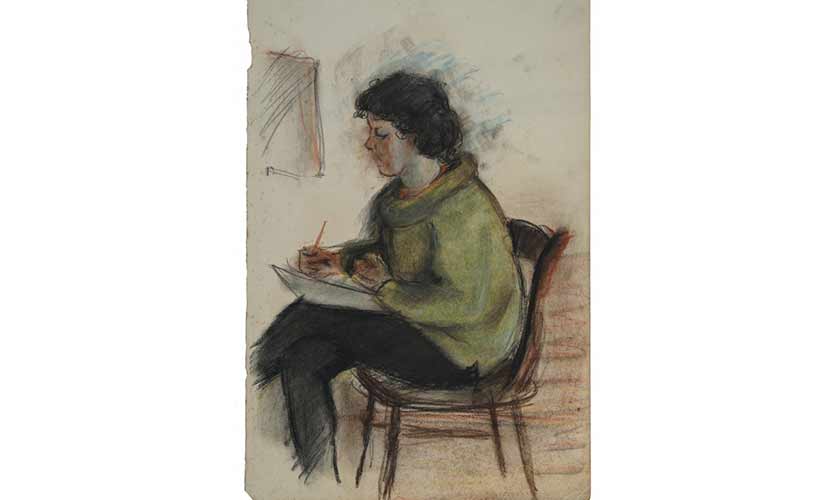
Colin David’s drawings resist easy classification. Models, poses and scale vary, yet figures drawn from his intimate circle, particularly his spouses, recur with striking force, whether seen from the front or the back. Identity, here, does not depend on facial features alone; even a back view can signal recognition. In some works on paper, the subject shifts from the personal to the universal. Self-portraits give way to scenes such as the Descent of Christ. At times the two seem to merge, as when the artist’s own head bears a resemblance to traditional depictions of Christ in European art history. David does not adhere to a single convention: some drawings are fully realised, others partially resolved, while a few remain as outlines or with missing features. This range suggests not an attempt to imitate reality, but a desire to construct a reality on his own terms.
With shifts in subject, men and women, adults and children, intimate interiors and studio spaces, unclothed bodies and dressed figures, the hand that drew scarcely wavered. For David, reality was fleeting and needed to be caught while it was still vibrant, spontaneous and alive. In conversation, he once remarked, “I enjoyed painting a lot. This is one of the greatest pleasures in life and the reason for me to paint. One paints for one’s own sake.” Whether painting or drawing, the act of image-making appears to have been, for him, both a source of pleasure and a means of measure.
Colin David’s drawings are acts of recollection, reclamation and recreation. Seen once or many times, the figures on paper gradually become part of his world. They are natural, silent, absorbed in their own soliloquy, often oblivious to their surroundings, to nearby figures, to noise, even to the artist’s scrutinising eye and the gaze of a future audience. These human subjects, rendered timeless by art, which grants ordinary lives a kind of immortality, breathe within an atmosphere of the past. It is a time that cannot be precisely located or measured, yet one that summons memory. This was evident at the exhibition’s opening, when viewers identified familiar models and guessed at settings. The moment became quietly uncanny when two of David’s most frequently drawn subjects, his wives, were present, sharing recollections of a life and a time now preserved on paper.
More than an exercise in gathering personal detail, the recently concluded exhibition stands as an act of remembrance, if not a quiet ritual of resurrection, of one of the leading figures of Pakistani art. Colin David’s deft marks, striking compositions and daring choice of subject matter set him apart from many of his contemporaries. Yet there is another, often overlooked, quality that distinguishes his work.
At the National College of Arts, one of the first lessons students encounter is Paul Klee’s oft-quoted line: “A line is a dot that went for a walk.” Colin David’s lines, however, seem to tell a different story. They are made of dots that strolled, hesitated, crossed paths, deviated, and, at times, appeared to take genuine pleasure in doing so.
The writer is a visual artist, an art critic, a curator and a professor at the School of Visual Arts and Design, Beaconhouse National University, Lahore. He can be contacted at [email protected].