Physical geography, which consists of rivers, mountains, deserts, etc, cannot be changed. However, political geography can be reimagined.
Regional categories such as South Asia, East Asia and the Middle East are not merely products of geography. They are also political constructions shaped by history, power and the strategic preferences of dominant states and empires.
The territories comprising present-day Pakistan have long been regarded as part of South Asia, and rightly so, since they occupy a significant portion of the Indian subcontinent. But there is more to Pakistan’s geography than that. Its location also places it at the intersection of West Asia, Central Asia, China and the Arabian Sea. Yet the question today is whether a sovereign Pakistan should continue to view itself primarily through inherited regional frameworks.
As a pivotal state located at the intersection of multiple regions, Pakistan has reason to reassess the geopolitical lens through which it understands its place in the world. Pakistan’s comparative advantage lies not in belonging exclusively to a single region, but in connecting several regions simultaneously.
The fact is that, despite being a South Asian country, Pakistan’s status as such has not translated into economic, political and strategic integration with South Asia. Consider the Saarc experience. South Asia remains one of the least integrated regions in the world, thanks to the physical, economic and defence asymmetries emanating from India. India and other South Asian states, with the exception of Pakistan, are, to a considerable degree, either mutually integrated or have pursued integration with adjoining regions. Intra-Saarc trade, however, accounts for barely $23 billion to $29 billion, representing less than five per cent of the region’s total trade.
Therefore, Pakistan’s opportunity, arguably, lies not in replacing South Asia with Eurasia but in supplementing its stagnant South Asian connectivity with access to one of Eurasia’s fastest-growing transport corridors. If connected through Afghanistan and Central Asia to the Middle Corridor, Pakistan would gain direct access to expanding trade flows linking Central Asia, the Caucasus, Turkiye and Europe, while leveraging Karachi and Gwadar as the southern maritime outlet of this emerging Eurasian network.
It is in that context that Pakistan has increasingly begun to explore the possibilities offered by greater Eurasian connectivity. It may be highlighted that, for the purposes of Pakistan and Afghanistan, Eurasian connectivity includes connecting to the trans-Caspian Corridor, or the Middle Corridor via Turkmenistan/Uzbekistan, Afghanistan and Pakistan. This covers a significant part of the ancient Silk Route.
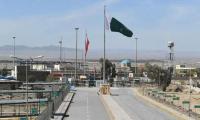
The physical infrastructure for the greater Eurasian connectivity and integration is provided by a number of complementary connectivity projects, including the geo-economically significant trans Afghan railway as agreed to between Uzbekistan, Afghanistan and Pakistan, the Lapis Lazuli Corridor which connects Afghanistan to the Caspian Sea via Turkmenistan and its Caspian Sea port of Turkmenbasi, and onwards to Europe. Pakistan and Afghanistan can be transformed significantly, creating new opportunities for trade, investment, and long-term economic growth. The two countries need to transform their borders from barriers into bridges.
Consider the economic, social, cultural and, more comprehensively, the geo-economic dividends Pakistan can accrue from its broader Eurasian connectivity and integration. It can transform Pakistan and Afghanistan from primarily geostrategic actors into economic hubs, enabling them to enjoy greater prosperity and strategic autonomy in an increasingly fragmenting international order. Pakistan’s identity as a state, rooted in its cultural and historical linkages in Greater Eurasia, also provides it with the flexibility to connect and integrate westwards, without compromising its South Asian linkages. The economic dividends can be enormous, which, to mention just a few, will include transit and customs fees, logistics hubs, economic and industrial zones along the connectivity routes, port fees and, so on.
Afghanistan remains the missing link that needs to be addressed for greater Eurasian integration to materialise for Pakistan in a more economically sustainable manner. Improved security, governance, and political stability within that country, coupled with greater trust between Pakistan and Afghanistan through sustained diplomatic efforts, will greatly enhance prospects for greater Eurasian integration.
Some will argue that the multiple problems in Afghanistan and the deep mistrust between the two countries are likely to hinder the realisation of such integration. But the more plausible argument could be that the benefits associated with connectivity provide a strong incentive to the country to fix its internal problems, as well as for the two countries to find ways to reduce the mistrust. Add to that the prospects for facilitating such moves by the main proponents of east-West and greater Eurasian connectivity, such as China, Turkiye and Azerbaijan.
Geography cannot be changed, but the way states interpret and utilise geography can. Pakistan will remain a South Asian country in physical terms. Yet its future prosperity and strategic relevance may increasingly depend on its ability to serve as a bridge between South Asia, Central Asia, China, the South Caucasus and Europe.
Reimagining Pakistan’s political geography, therefore, is not about abandoning one region for another. Rather, it is about recognising and leveraging the country’s unique position at the crossroads of Greater Eurasia.
The writer is a research analyst and Head of the Turkiye and Azerbaijan Program at the Institute of Regional Studies. He can be reached at: [email protected]