There are moments when one wonders whether the twenty-first century has quietly forgotten how to read poetry. We consume language faster than ever before, yet linger over words less than any previous generation. Screens reward speed rather than contemplation, certainty rather than ambiguity and slogans rather than metaphors.
It is perhaps for this reason that Persian poetry has become more relevant than ever. It teaches precisely those intellectual habits our age neglects: patience, inward reflection, paradox and the acceptance that truth often arrives through suggestion rather than declaration.Whenever I return to Persian poetry, I am reminded that it asks us not merely to understand a verse but to inhabit it. It demands rereading, silence and humility. Few poets embody this better than Mirza Abdul Qadir Bedil, whose poetry remains one of the highest achievements of Indo-Persian civilisation and one of its most demanding intellectual adventures.
Afzaal Ahmed Syed’s ‘Rang-e-Asrar-e-Digar’ is therefore much more than another anthology of classical verse. It is an invitation to reopen a conversation that Urdu readers have gradually allowed to fade: the conversation between Persian and Urdu, between Bedil and Ghalib, between philosophical imagination and modern sensibility. The volume consists of an insightful introduction by Nasir Abbas Nayyar, followed by Afzaal Ahmed Syed’s selection and Urdu translation of Bedil’s Persian ghazals. The introduction situates Bedil within broader debates about literary tradition, modernity and poetic consciousness, while the translations seek to make one of Persian’s most difficult poets accessible to contemporary readers.
To appreciate Bedil, however, one must first understand the literary world that produced him. Persian entered the Subcontinent centuries before the Mughals through merchants, scholars and Sufi saints. Under the Delhi Sultanate and later the Mughal Empire, it evolved into the language of administration, scholarship and refined literary culture. Long before Bedil, India had already produced distinguished Persian poets such as Amir Khusrau, Hasan Sijzi, Faizi and Urfi Shirazi, while numerous Iranian poets found generous patronage in Mughal courts.
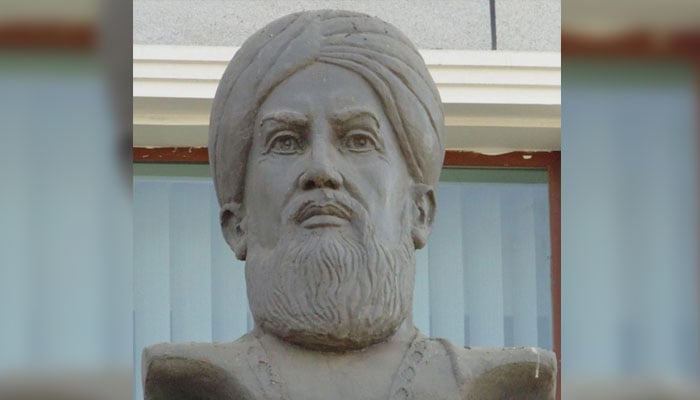
Out of this vibrant literary world emerged what later came to be known as Sabk-e-Hindi, or the Indian Style of Persian poetry. The name is somewhat misleading because many of its leading poets were born outside India. What united them was not geography but an imaginative method characterised by conceptual density, daring metaphors, philosophical reflection and intricate intellectual play. Poets such as Saib Tabrizi and Kalim Kashani expanded the expressive possibilities of Persian before Bedil elevated the style to its highest philosophical and artistic refinement. Mirza Abdul Qadir Bedil (1644–1720), born in Azimabad (present-day Patna; yes, he was a Bihari), spent most of his life in Delhi during the later Mughal period. Though descended from Central Asian migrants, he became the greatest representative of Indo-Persian literary culture.
Deeply influenced by Sufi metaphysics, especially ‘Wahdat al-Wujud’, Bedil transformed the ghazal into a vehicle for philosophical inquiry. His verses explore consciousness, time, identity, perception and existence through astonishingly compressed imagery and intellectual subtlety. They demand patience from the reader and reward repeated encounters rather than hurried reading. This difficulty partly explains Bedil’s paradoxical reputation. While he remains central to literary culture in Afghanistan, Tajikistan and parts of Central Asia, he has often remained inaccessible to ordinary Urdu readers. Yet among serious poets, his stature has never diminished.
No one illustrates this better than Mirza Ghalib. Ghalib repeatedly acknowledged Bedil as one of his greatest masters and openly admired his conceptual brilliance. Although scholars continue to debate the precise extent of Bedil’s influence on Ghalib, there is little doubt that Ghalib inherited from him a taste for philosophical speculation, layered metaphor and intellectual complexity. Reading Bedil after Ghalib often feels like walking upstream towards one of the principal sources of Ghalib’s imagination. Few contemporary poets are better equipped to introduce Bedil to Urdu readers than Afzaal Ahmed Syed. For more than five decades, he has occupied a distinguished place in modern Urdu poetry through collections marked by intellectual discipline, historical awareness and stylistic restraint.
Equally significant is his work as a translator and mediator between literary traditions. He has translated major poets from several languages into Urdu, consistently widening the horizons of Urdu literature. ‘Rang-e-Asrar-e-Digar’ is also part of a much larger literary project. More than a decade earlier, Oxford University Press Pakistan published Afzaal Ahmed Syed’s Urdu translation of Mir Taqi Mir’s Persian poetry, bringing to Urdu readers a dimension of Mir that had long remained overshadowed by his Urdu Diwan. That pioneering volume demonstrated that the Indo-Persian tradition still possessed an eager readership if presented with sensitivity and literary intelligence.
Seen in this light, the present selection of Bedil is not an isolated undertaking but the continuation of a sustained effort to recover South Asia’s Persian literary inheritance. Having reintroduced Mir’s Persian voice, Syed now turns to the even greater challenge of rendering Bedil’s metaphysical imagination into contemporary Urdu. Nasir Abbas Nayyar’s introduction deserves particular praise. Rather than treating Bedil simply as a classical mystic, Nayyar situates him within larger discussions of literary rupture, historical continuity and evolving notions of the self. Tradition, he argues, is not a static inheritance but an ongoing dialogue between past and present. He also challenges simplistic understandings of Sabk-e-Hindi, demonstrating that its philosophical richness and aesthetic innovations continue to speak to modern literary criticism. His essay alone makes the volume worth reading.
Halfway through the book, I found myself pausing, not because Bedil had suddenly become easier, but because Afzaal Ahmed Syed had quietly reminded me that difficult poetry is not an obstacle but an invitation. In university classrooms today, students often demand ‘simple meanings’. Bedil refuses such simplification. He insists that meaning emerges slowly through repeated engagement. In an age dominated by summaries, shortcuts and instant explanations, that insistence feels almost radical.
The selected ghazals reveal Bedil’s extraordinary imaginative range. Mirrors, dust, journeys, shadows, time and the endlessly shifting self recur throughout the poems, yet these are never decorative images. They become philosophical instruments through which Bedil investigates the nature of existence itself. Afzaal Ahmed Syed wisely resists burdening the reader with excessive commentary, allowing the poems to establish their own intellectual rhythm. Translation, however, always involves negotiation between fidelity and beauty. Throughout this volume, Syed generally favours conceptual accuracy over lyrical recreation. This is understandable, given Bedil’s extraordinary complexity, and the translations successfully preserve much of the poet’s intellectual architecture.
Yet there are moments when the Urdu reads more like an elegant prose exposition than an autonomous poem. The philosophical content survives, but some of the music, surprise and emotional resonance of Bedil’s Persian inevitably recede. Readers unfamiliar with the original may remain satisfied, but those acquainted with Persian may occasionally wish the translator had allowed himself greater poetic freedom. This reservation, however, should not overshadow the importance of the achievement. Bedil is among the most difficult poets in Persian. Translating him into readable Urdu without sacrificing meaning is an undertaking few contemporary poets would even attempt.
As I closed the book, I found myself thinking less about Bedil’s obscurity than about our own impatience as readers. Perhaps the problem has never been that Bedil is too difficult. Perhaps we have simply forgotten how to read slowly. ‘Rang-e-Asrar-e-Digar’ reminds us that the Indo-Persian tradition is not an archaeological curiosity but a living intellectual inheritance waiting to be rediscovered. Read alongside Afzaal Ahmed Syed’s earlier translation of Mir’s Persian poetry, this volume confirms his quiet but significant contribution to restoring Persian’s rightful place in South Asian literary culture.
Even if, at times, the translations lean towards the prosaic rather than the poetic, the book remains an important literary achievement. It reconnects Urdu readers with one of the greatest minds produced by the Indo-Persian world and reminds us that great poetry still possesses the rare power to enlarge both language and life.
The writer is dean of the faculty of liberal arts at a private university in Karachi. He tweets/posts @NaazirMahmood and can be reached at: [email protected]