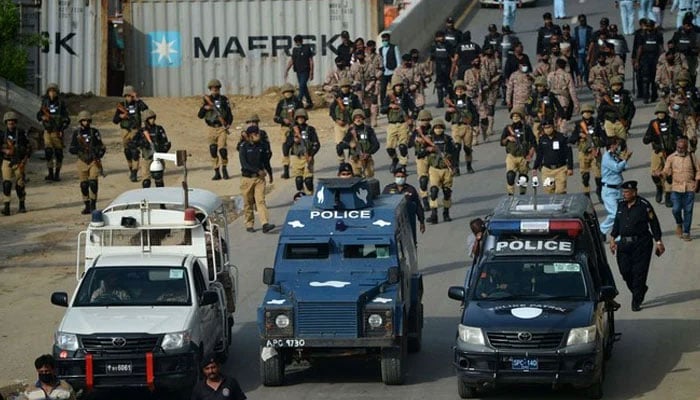
When Ashura processions reached their destinations in major cities of the country on Friday evening, a massive security operation that had kept the administration on edge was also concluded.
While adequate security arrangements are necessary to maintain peace and order at large gatherings in public spaces, the precautions taken during the first ten days of Muharram are truly exceptional. The tempo rises during the last two or three days. So does the level of vigilance.
Because this has been a regular exercise and we do have a history of sectarian conflicts, the elaborate restraints that are imposed are taken for granted. But think about it. What does this high security tell us about the state of law and order, as well as the scope for social harmony in this country?
It would appear that some highly revered religious rites are conducted within a security bubble. Ideally, such religious observances and ceremonies should be conducted in an environment of peace and freedom. Believers should be more relaxed in performing their devout obligations.
One measure of how extensive the security precautions are is to check media reports on the plans devised by the administration. High-level meetings are held, and the public is informed about the procedures that are set into motion. It is a huge initiative that, apparently, overwhelms the attention and the capacity of the provincial administrations.
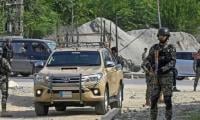
There is an example of the Punjab government releasing a television advertisement highlighting the province’s security plan, featuring Chief Minister Maryam Nawaz. We are told that more than 100,000 security personnel and paramilitary personnel were deployed to maintain peace. Significantly, they provided ‘panic buttons’ at imambargahs and set up round-the-clock medical camps. There are other details that I will not go into.
Now, I have my reasons for highlighting the implications of creating these security structures for the conduct of routine Muharram rituals. Obviously, the authorities deem these precautions necessary based on their assessment of the situation. But how much thought has gone into making an extensive plan to improve this situation?
Partly, I wanted to use this formidable show of force to enforce law and order as a peg for raising certain other issues that have subverted peace, order and social harmony in Pakistani society.
In this respect, we have to understand that the presence of armed, uniformed security personnel on the streets does not enhance people’s sense of security. This is what the social scientists have argued. In fact, they suggest that such deployment may be a sign of the establishment’s weakness or an inability to command its authority. Call it power deflation or loss of authority.
However, as a mere journalist, I would not want to delve into an academic interpretation of the existing circumstances that bear on the lives and emotions of the people of Pakistan. But my problem is that these circumstances also prevent me from being a good journalist. This is besides the difficulty of being credible in the time of AI-assisted social media.
Hence, let me just say that, in my engagement with whatever reality is accessible, I feel we are not in a happy place at this time. Again, I have little insight into economic matters and am not talking about the budget. But there have been developments in the political and social spheres that breed anxiety and some kind of dread about the consequences of the current state of affairs.
One may detect a paradox in my portrayal of Pakistani society that seems so gloomy when I had last week applauded the performance of the present rulers for their glorious mediation in the Iran war. After all, this diplomatic achievement also demonstrated positive traits such as sagacity and commitment to achieving a goal.
Ah, but that may be the foundational paradox of Pakistan: a powerful establishment and a weak, wounded society. (No, this is not a reference to the main theme of Christophe Jaffrelot’s 2015 book, ‘The Pakistan Paradox’).
So, to continue with the tragic tale of the potential insecurity and powerlessness of the people of Pakistan, here is an incident that exemplifies some glaring aspects of our society. There have been other, equally disturbing projections of barbarity recently, but the horror of the rape and murder of a three-year-old girl in Karachi on Tuesday raises many questions about what is happening in the lower depths of Pakistan.
To put it briefly, little Kulsoom was playing outside her home in Quaidabad when she disappeared and her body, in a gunny bag, was found outside her home in the evening. Until the writing of this column, police had not been able to solve the murder.
Kulsoom’s post-mortem confirmed that she was subjected to violent rape before being murdered. Police Surgeon Dr Summaiya Syed described the murder as “one of the most horrific cases” she had seen in her career. As I said, there are other reports of sexual violence involving little girls and the most recent involved an eight-year-old girl in Sargodha.
I am reminded of the Zainab rape case of January 2018 in Kasur that had shaken the nation. Seven-year-old Zainab’s body was found on a garbage dump. The police were able to find the killer and, after a trial, he was hanged in Lahore in October of the same year. It was the kind of outrage that should stay in our collective memory.
The government was compelled to pass the Zainab Alert, Response and Recovery Act in 2020, which created an official agency to help locate missing children quickly. There was a resolve that another Zainab would not suffer the same fate. But to our national shame, there have been other, similar incidents of horror.
And now we had Kulsoom, who was only three. But her rape and murder are not likely to create a national outrage because the people have so many other distractions.
The writer is a senior journalist. He can be reached at: [email protected]